
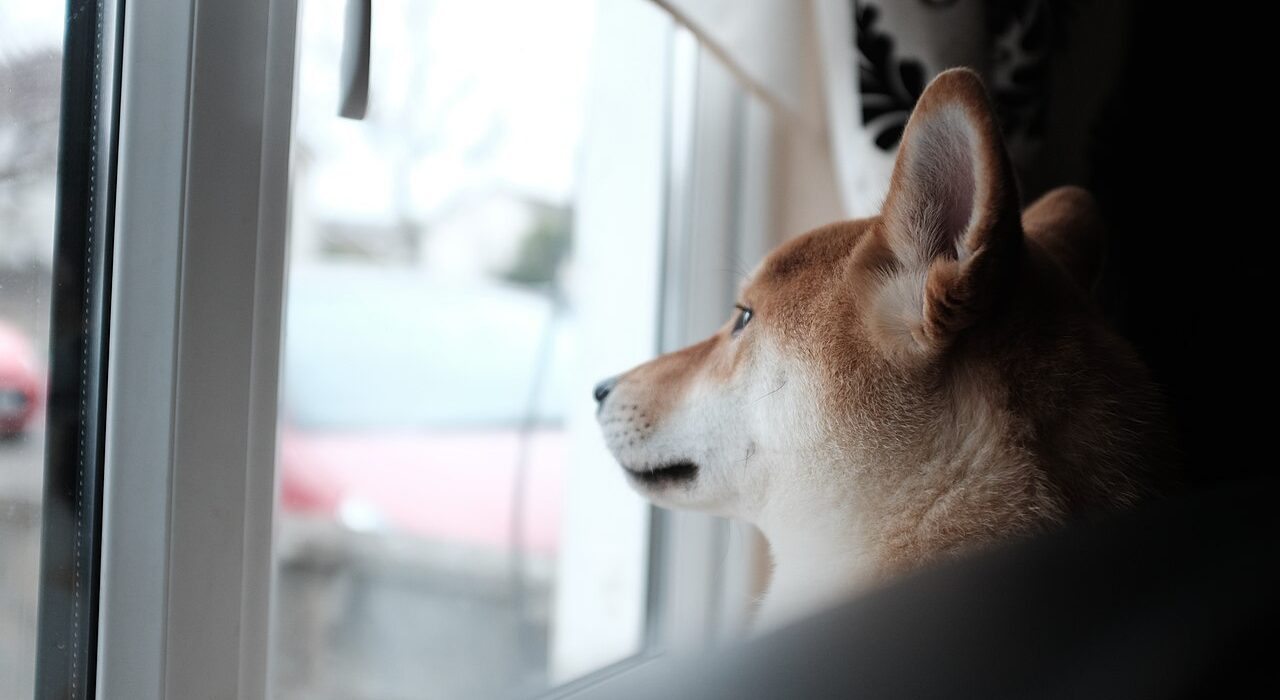

Every dog household has seen it: the pup who has snoozed on the couch all afternoon suddenly pops up, trots to the door and parks there, tail already swishing, a few minutes before the key turns. No phone call, no text, no calendar invite. Researchers and pet experts have offered three main explanations for the trick, and none of them involves a crystal ball.
Theory One: A Fading Scent Works Like a Clock

The scent theory comes from Alexandra Horowitz, a psychologist who founded the Dog Cognition Lab at Barnard College. As Psychology Today explains in a column by Stanley Coren dated Nov. 22, 2019, dogs follow scent trails from the weakest, oldest odor toward the strongest, newest one, even when the difference is tiny. Because a weaker smell generally means an older one, a dog is in effect reading the past.
Apply that to a house, where the little rituals of daily life run on a schedule. When a person leaves, the scent left behind fades at a fairly predictable pace each hour. A dog may learn that when the smell drops to a certain level, the person usually walks in. Pet owners curious about canine quirks may also enjoy dog breeds that can be surprisingly difficult to housebreak, and cat households can browse a comparison of self-cleaning litter boxes.
Horowitz made the case to NPR, as the American Kennel Club reported in 2018. She noted that smells in a room change as the day goes on, because warm air rises in currents and carries odor with it. The Animal Cognition site, in a 2016 piece, quotes her saying that “strong odor is probably newer odor, laid down more recently.” Both outlets present the idea as a hypothesis, and Coren notes that no systematic studies have tested it. It is a good fit for readers who like old-fashioned habits and their modern comebacks.
Theory Two: Sharp Ears Catch the Car Early
The second explanation is simpler: dogs hear far better than people do. The AKC says dogs can hear up to roughly 47,000 to 65,000 Hz, while most adults top out near 20,000 Hz. Dogs are also most sensitive around 8,000 Hz, compared with about 2,000 Hz for humans.
The same article adds that dogs often seem to know someone is arriving before anyone else, which it attributes to hearing a vehicle approach from farther away. A dog with a favorite window spot has a ringside seat for all of it, and watchdog types may be the first to sound off, as in this list of fearless dog breeds. Quieter homes might lean toward breeds that stay calm indoors, where the ears still work overtime, and busy families can look at breeds patient enough for noisy homes.
The AKC article does not address whether a dog can recognize one specific car, so that detail stays in the plausible-but-unproven column. It also says how far a sound carries depends on volume, weather, terrain and background noise, and that people are better than dogs at pinpointing where a sound comes from. Families still learn the rhythm of even the odd American traditions they repeat each year, and dogs presumably learn theirs.
Theory Three: Routine Does the Heavy Lifting
The third idea is the least mysterious. Dogs notice patterns, and a household runs on them. VCA Animal Hospitals says dogs have an internal biological clock that regulates sleep, wake cycles and mealtimes, and that they perceive time through changes in their bodies, surroundings and routines. A dog may anticipate dinner simply because hunger arrives on schedule.
The same article suggests that varying training times and mealtimes can keep a dog from fixating on specific intervals and relying too heavily on routine. Its language is hedged throughout, and it names no individual researchers, so it reads best as a general explanation rather than proof.
Coren points to many accounts of dogs waiting near a door or window 15 to 20 minutes before the usual arrival. He cautions that individual anecdotes are weak evidence, though the sheer number of them suggests something real is going on.
What the Research Says So Far
The best-known experiment on dogs and elapsed time is a 2011 study by Therese Rehn and Linda Keeling at the Swedish University of Agricultural Sciences. As the university’s research database describes it, 12 privately owned dogs were left alone for 30 minutes, two hours and four hours, and video-recorded. Behavior before the owner returned did not differ by absence length.
The reunions did differ. After two hours or more alone, dogs wagged their tails more, interacted more with their owners and showed a more intense greeting than after 30 minutes. Coren’s summary adds that dogs reacted more after two hours than after 30 minutes but showed no measurable difference between two and four hours, which suggests dogs can tell short absences from long ones without judging precise intervals.
The authors could not say whether the dogs knew how long they had been alone or simply noticed the owner’s return. In other words, the science leaves all three theories standing, and a blend of nose, ears and habit remains a reasonable guess. Until a lab settles it, the dog at the door remains a cozy puzzle of home life.
Get stories like this by email. Sign up for Crafting Your Home.
This article was produced with AI assistance and edited for accuracy against the sources linked above.
Image: Picography – CC0/Wikimedia Commons
