
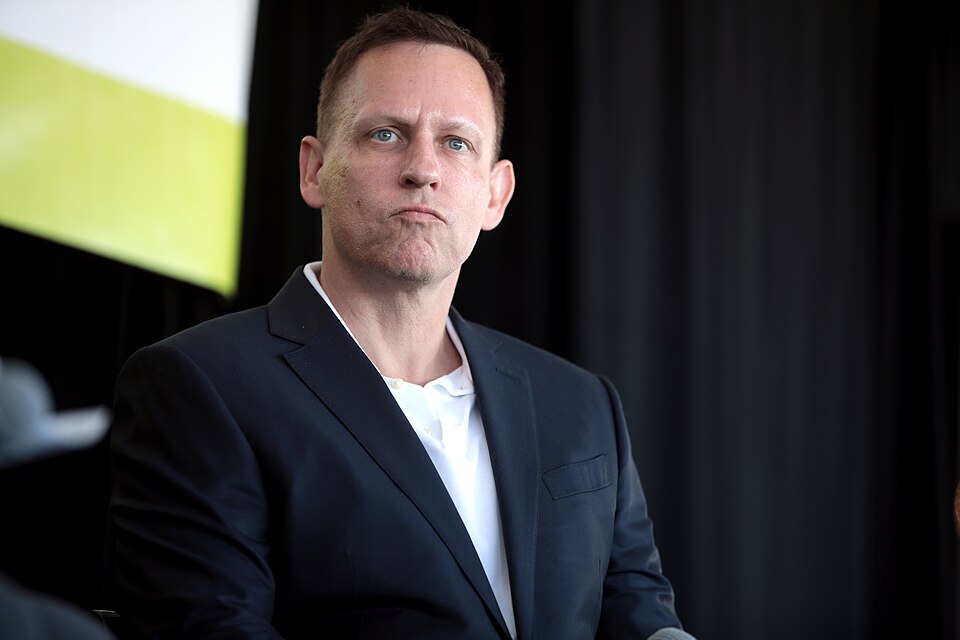

Peter Thiel’s warning about a possible democratic socialist takeover of the Democratic Party did not land in a vacuum. It arrived at a moment when the party’s internal debate is no longer only about messaging, electability, or how far left Democrats should move. It is now about power: who wins primaries, who controls city machines, who sets the policy agenda, and who speaks most convincingly to younger voters who believe the economy has stopped working for them.
At the Aspen Ideas Festival, Thiel framed the rise of democratic socialism as a political response to economic, technological, and cultural stagnation. His argument was blunt: when people feel stuck, they search for exits outside the old political consensus. On the Republican side, he linked that energy to Donald Trump’s rejection of the Bush-era establishment. On the Democratic side, he warned that the parallel force may be democratic socialism, driven not by a temporary mood swing but by deep frustration with the status quo. Fox News reported that Thiel made the remarks at the Aspen Institute’s Ideas Festival in Colorado on June 30, 2026, during a discussion that also focused heavily on artificial intelligence, stagnation, and the future of the West.
The power of Thiel’s statement comes from timing. Just days before and after his remarks, left-wing and democratic socialist candidates notched wins that turned a theoretical warning into a live political question. In New York, Mayor Zohran Mamdani backed three progressive House candidates over establishment-backed rivals, and all three won. The Associated Press reported that those victories defeated two incumbents and likely put three Mamdani allies on track to win Congress from deep-blue districts. In Colorado, Melat Kiros defeated long-serving Rep. Diana DeGette in the Democratic primary for Colorado’s 1st Congressional District, according to Ballotpedia.
Why Peter Thiel’s Comments Hit a Nerve in Liberal Politics

Thiel’s warning struck a nerve because it challenged the assumption that the Democratic establishment can always absorb left-wing pressure without losing control. For years, party leaders could treat democratic socialism as an activist current, a campus movement, or a small congressional faction. The new question is whether that faction has become an electoral machine.
The New York results are especially important because they suggest that democratic socialist politics can move beyond protest language and into disciplined primary strategy. AP reported that Mamdani used his influence as New York City mayor to support three candidates running against establishment-backed opponents, and that their victories showed his growing strength within Democratic politics. That matters because New York is not just another city. It is a Democratic media capital, a donor capital, a congressional power center, and a testing ground for urban progressive policy.
Colorado added another signal. Reuters described the June 30 primaries as a strong night for anti-establishment progressives, noting that Kiros defeated a 29-year incumbent despite being outspent and running as a younger insurgent. When a movement wins only in New York, opponents can dismiss it as a city-specific phenomenon. When it also appears in Denver-centered Colorado politics, it becomes harder to call it local noise.
The Stagnation Argument Behind the Democratic Socialist Surge
Thiel’s central claim was not simply that democratic socialists are organizing better. His deeper argument was that they are benefiting from stagnation. We should read that carefully. In political terms, stagnation does not always mean every economic indicator is down. It means enough voters feel that the bargain of American life has broken: work harder, earn more, buy a home, start a family, and move up.
That feeling has some hard numbers behind it. The National Association of Realtors reported in November 2025 that the share of first-time homebuyers fell to a record low of 21%, while the typical first-time buyer age rose to an all-time high of 40. The National Low Income Housing Coalition reported that in 2025, a full-time worker needed $33.63 per hour to afford a modest two-bedroom rental home in the United States, while the average renter wage was $23.60 per hour.
Those figures help explain why affordability politics has become so explosive. Even when national wages rise, the lived experience of housing, debt, childcare, insurance, groceries, and rent can feel like running on a treadmill. The Bureau of Labor Statistics reported that real average weekly earnings rose 1.5% from May 2024 to May 2025, but that gain does not erase years of affordability pressures for younger households.
Younger Voters Are Not Just Angry — They Are Politically Available
The most important audience in this debate is not the donor class. It is younger voters who increasingly believe the old system is closed to them. In 2025, the Pew Research Center found that about three-quarters of adults in both the United States and Canada believed children would grow up financially worse off than their parents. That pessimism is political fuel.
Democratic socialism speaks directly to that frustration by offering simple, emotionally powerful answers: tax the rich, cap rents, expand public goods, confront corporate power, and make government more aggressive on affordability. Establishment Democrats often answer with incrementalism, procedural language, and appeals to governing realism. That may be responsible policy language, but it can sound weak to voters who believe patience has already cost them a decade.
This is where Thiel’s warning becomes more than partisan theater. He is arguing that stagnation creates a hunger for alternatives. When voters feel locked out of property ownership, squeezed by rent, and ignored by party elites, they become more willing to support candidates who promise confrontation rather than adjustment.
The New York Signal: Mamdani’s Machine Is Bigger Than One Office

Zohran Mamdani’s rise matters because he represents a shift from symbolic democratic socialism to operational democratic socialism. The old question was whether a left-wing candidate could win a famous race. The new question is whether that candidate can help build a bench.
AP reported that Mamdani-backed candidates Claire Valdez, Darializa Avila Chevalier, and Brad Lander all won their Democratic House primaries in June 2026. That is the kind of result that changes how party insiders behave. A mayor who can influence congressional primaries becomes more than a municipal figure. He becomes a factional power broker.
The Guardian reported that the Democratic Socialists of America’s New York City chapter had grown from 5,900 dues-paying members in fall 2024 to 14,000 before the June 2026 primary, with at least 900 more joining on the first day after the results. It also reported that DSA leaders described more than 100,000 members nationwide and more than 200 local chapters. Those numbers do not guarantee national dominance, but they show organization, and organization wins low-turnout primaries.
Colorado Shows the Fight Is Not Confined to Coastal Politics
Colorado’s 1st Congressional District added another layer to the Democratic Socialist surge. Melat Kiros’ win over Diana DeGette was not only a youth-versus-incumbency story. It was a sign that left-wing challengers can target long-serving Democrats even inside already progressive spaces.
Reuters reported that Kiros, a 29-year-old labor organizer and lawyer, defeated DeGette, who had served for 29 years, despite being outspent by more than 2-to-1. That detail is crucial. If insurgent candidates can win while being outspent, then money alone may no longer be enough to protect incumbents in safe Democratic districts.
For establishment Democrats, the danger is not that every district suddenly becomes socialist. The danger is that safe blue seats become laboratories for ideological replacement. In those districts, the general election is often not the real contest. The Democratic primary is. That gives organized activist factions enormous leverage.
Why Democratic Socialists Are Winning the Message War
Democratic socialists are gaining traction because they have a clear villain, a clear promise, and a clear emotional lane. Their villain is corporate power and billionaire influence. Their promise is affordability through public action. Their emotional lane is urgency.
By contrast, establishment Democrats often sound divided between technocratic competence and fear of losing swing voters. They warn that democratic socialist candidates may be too risky nationally, but in deep-blue districts, that warning often lacks force. Voters choosing in those primaries are not always asking who can win the median suburban voter in November. They are asking who will fight hardest on rent, Gaza, healthcare, wages, and corporate power.
This is why Thiel’s warning landed so dramatically. He is a billionaire tech investor, PayPal co-founder, Founders Fund partner, and prominent supporter of right-wing candidates, including JD Vance’s 2022 Senate rise. CBS News reported in 2024 that Thiel donated $15 million to Vance’s 2022 Ohio Senate campaign effort. When someone with that profile warns liberal elites that democratic socialism is on the rise, the moment becomes politically theatrical: a billionaire telling Democrats that anti-billionaire politics may be coming for their party.
The Republican Opportunity — and the Republican Risk

Republicans will try to nationalize these wins. They will use Mamdani, Kiros, DSA, rent freezes, tax hikes, policing debates, and foreign policy controversies to argue that Democrats are moving too far left. In swing districts, that message may be potent.
But Republicans also face a risk. If they only mock democratic socialism without addressing affordability, they may miss why the movement is growing. Voters do not become open to economic radicalism simply by reading theory. They become open to it when rent consumes the paycheck, when homeownership moves out of reach, when healthcare feels punitive, and when the political class sounds detached.
Thiel’s own diagnosis points to this risk. His warning was not merely that democratic socialists are persuasive. It was that stagnation that made their message more persuasive. That means the answer, for either party, cannot be only anti-socialist messaging. It has to be a credible abundance agenda: more housing, more wages that beat costs, more family formation, more technological progress, and more visible upward mobility.
The Democratic Party Is Entering a New Power Test
Peter Thiel’s comments made news because they condensed a major political shift into a single dramatic warning. But the story is bigger than a billionaire shocking a liberal audience in Aspen. The real story is that democratic socialism is moving from protest energy to primary power, and the Democratic Party is being forced to decide whether to resist it, absorb it, or be reshaped by it.
We should not overstate the case. A handful of primary wins does not mean democratic socialists have taken over the Democratic Party. But we should not understate it either. New York showed organization. Colorado showed reach. Younger voters express frustration. Housing costs supply urgency. AI and inequality supply the next ideological battlefield.
Thiel’s warning landed because it identified a truth both parties now have to confront: when millions of voters believe the future is shrinking, they stop rewarding politicians who defend the present.
Read the original story on Crafting Your Home


