


A 31-year-old Orlando woman is dead after a large alligator attacked her while she was swimming with her boyfriend and a friend in the Econlockhatchee River, and the details released by Florida wildlife officials this week paint a picture of how quickly an ordinary afternoon on the water turned catastrophic.
Brittany Clark had been hiking with her boyfriend, Chance Allison, and her best friend on June 28 in the Little Big Econ State Forest in Seminole County when the group decided to cool off near the Barr Street Trailhead.
She was standing in roughly three feet of water, according to the Florida Fish and Wildlife Conservation Commission (FWC), when the alligator attacked without warning.
FWC Lieutenant Grant Eller told reporters that Clark and her group were “kneeling in 3-foot-deep water” around 1:30 p.m. when the animal seized her arms.
During the attack, Allison worked frantically to free her while simultaneously calling 911, a call that has since been released to the public and captures the panic of a boyfriend trying to save the person he loved.
Eller said Allison was still “trying to get her arms away from the alligator’s mouth” while he was on the phone with dispatchers, begging for help to reach them.
Clark’s friends eventually managed to help her reach the shore, but her injuries were catastrophic. She was rushed to a hospital but died before rescue workers could get her there.
The FWC has not speculated publicly on exactly what triggered the attack, but Eller pointed to two conditions that may have played a role.
“It’s the end of mating season, and alligators are very territorial this time of year,” he said, noting that Florida is also in the middle of a statewide drought that has pushed water levels unusually low in rivers like the Econlockhatchee.
Lower water levels can put people and alligators into closer proximity than usual, since both are drawn toward the same shrinking pools of deeper water.
Eller was careful to note that this was far from an isolated incident this season, adding, “There are alligators in all 67 Florida counties. There are risks when you swim in Florida.”
Wildlife officers hunted down two massive alligators.
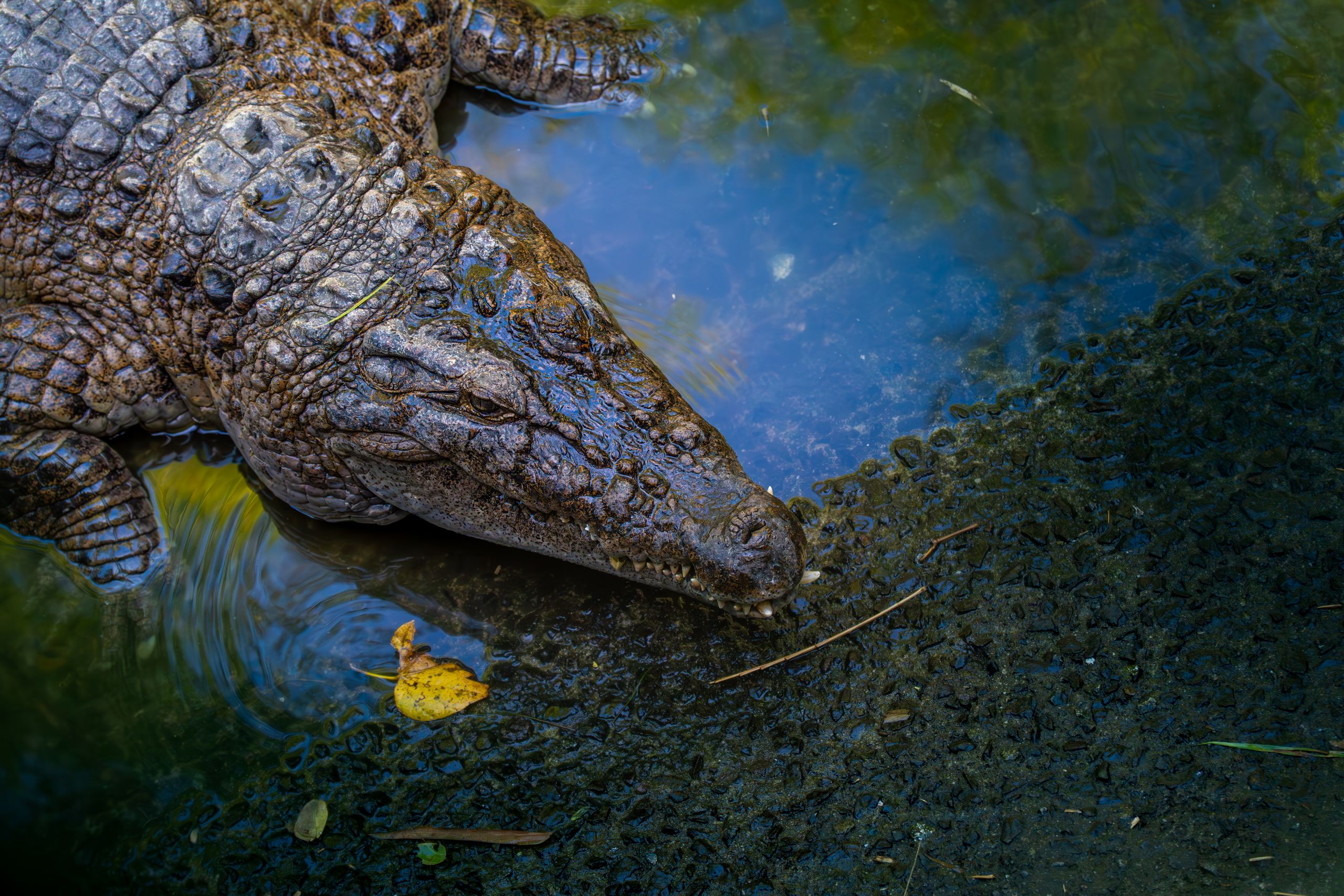
Within hours of the attack, FWC officers, a contracted nuisance alligator trapper, and the Seminole County Sheriff’s Office descended on the area to track down the animal responsible.
An FWC spokesperson identified as Weber described the scale of the search effort, saying, “We utilized our air assets, and Seminole County utilized their helicopter as well to locate the alligator.”
The search turned up not one but two enormous alligators in the vicinity of the attack. One, found at the scene itself, measured 13 feet long. The second, discovered roughly half a mile away, measured 12.5 feet. Both animals were captured and killed.
“We have harvested two that were in the area. One was 12 foot, the other one was 13 foot,” Weber said. “So currently, we’re still conducting the investigation.”
Samples were taken from both alligators and sent to a state laboratory in Gainesville, where DNA testing will determine which of the two animals was actually responsible for the attack, if not both.
As of this week, those results have not yet been made public, and the FWC has said the investigation remains open. The agency also confirmed that alligators cannot simply be relocated once they’re captured, since they tend to try to return to their original territory, and any new location would likely already have its own established alligator population.
That’s part of the reason the agency’s Statewide Nuisance Alligator Program relies on removal rather than relocation when an animal is deemed a threat.
In an official statement, the FWC extended its condolences to Clark’s loved ones. “The FWC extends its deepest sympathies to the victim’s family and loved ones,” the agency said. “Our thoughts are with you during this difficult time.”
The agency also used the moment to remind the public of basic water safety guidance for Florida’s waterways: swim only in designated, monitored areas during daylight hours, keep a safe distance from any alligator sighting, keep pets leashed and away from the water’s edge, and never feed alligators, since doing so can make them lose their natural wariness of humans. Anyone who spots a potentially dangerous alligator can report it to the FWC’s Nuisance Alligator Hotline.
Family and friends remember Clark as full of life.
In the days since the attack, tributes to Clark have poured in from the people who knew her best. Her boyfriend, Chance Allison, was too overwhelmed with grief to speak on camera, but he sent a written statement to a local news outlet describing how much she meant to him.
“She was the strongest and most outgoing person I’ve ever met in my 30 years of life,” Allison wrote. “The most beautiful person I could have asked to be in my life.”
He added that Clark “loved going out on the water every chance she could” and said the family never could have imagined this outcome, writing, “Never in a million years would we have seen this nightmare come about.”
Clark’s brother, Nate Clark, echoed that sentiment, describing his sister as someone who cared deeply for the people around her.
“I would love to share with the public how amazing she is,” he said, adding that the past few days have been especially difficult for a family already dealing with the recent death of their grandmother.
Friends who spoke to local reporters described Clark similarly, saying she had a gift for lifting people up and brightening any room she walked into.
One detail adds an especially painful layer to the story. A man who told reporters he’s visited the trails in the area for roughly 30 years said he crossed paths with Clark and her group earlier that same Sunday and warned them directly about the danger in the water.
“I said, ‘Be careful, there’s a lot of gators around here,’” he recalled. At the time, he said, the group seemed to be having the kind of carefree day anyone would want.
“They were really happy. They were walking happily. They were having a great day,” he said, adding that his only concern in the moment was that “they were being a little bit too inattentive.”
He learned only later that evening that Clark had been killed, and said the news immediately brought him to a place of empathy for what she and her loved ones must have gone through.
“You automatically go to that place where you feel for these people, what they must have gone through… the trauma,” he said.
Clark’s family has since launched a GoFundMe campaign to help cover the cost of bringing her remains home to California, where her parents live, titled “In Memory of Brittany’s Fun-Loving Spirit.”
The stretch of the Little Big Econ State Forest where the attack occurred remains closed to the public while the investigation continues.
Officials also noted that Clark’s death was not an isolated event in an otherwise quiet stretch for Central Florida wildlife. It marked the third reported alligator attack in the region in seven days, and the second in just 24 hours.
On June 21, a man snorkeling in the Rainbow River at Rainbow Springs State Park was bitten and taken to the hospital. Then, on June 27, a child was bitten on the hand while fishing at a resort in Marion County; an FWC officer later removed an 8-foot, 7-inch alligator connected to that incident.
The FWC has said fatal alligator attacks remain statistically rare in Florida, but the recent cluster has renewed public attention on the risks of swimming in the state’s rivers and lakes, particularly during the warmer months when alligators are most active near shore.


