


The post Owls Can’t Turn Their Heads All the Way Around — Here’s How Far They Really Go first appeared on Crafting Your Home.
Owls have one of the strangest-looking abilities in the bird world. Watch one perched on a branch, and its head can seem to swivel so far around that it looks almost detached from the rest of its body. That has helped create the popular idea that owls can turn their heads a full 360 degrees. The reality is more interesting.
The conventional figure used by scientists and owl experts is that an owl can rotate its head about 270 degrees from a forward-facing position in either direction. That is already three-quarters of a full circle. However, newer anatomical research has complicated the simple claim that 270 degrees is an absolute mechanical limit. Studies using deceased owl specimens have produced rotations of 360 degrees or more, although that does not prove living owls normally make those movements.
So how do owls manage such extreme movement without simply twisting their necks like a corkscrew? Their unusual eyes, flexible neck structure, and specialized blood vessels all play a part.
An Owl Can Turn Its Head About 270 Degrees
Start with an owl looking straight ahead. If it turns its head 90 degrees, its bill points roughly toward one shoulder. At 180 degrees, it is looking directly behind itself. Continue another 90 degrees, and the head reaches the 270-degree position, with the bill pointing toward the opposite shoulder after taking the long route around the back.
That means an owl doesn’t need to make a full 360-degree rotation to look dramatically twisted around. Another reason the movement can be confusing is the starting position. Starting position matters. An owl that begins with its head facing backward can rotate through the forward-facing position and continue until it is looking backward on the other side.
That entire movement can cover a 360-degree sweep without the bird making a full 360-degree twist from a neutral, forward-facing position. This also explains why photos and short videos can be misleading. A still image shows where an owl’s head ended up, but not where it started or which direction it traveled.
Scientists have also discovered that the familiar 270-degree figure should not necessarily be treated as a rigid anatomical stop. A 2017 study of barn owls found that the skeleton and muscles themselves did not appear to limit rotation specifically to 270 degrees. Researchers manually rotated deceased barn owls beyond 360 degrees without tearing muscles or ligaments.
A later study published in the Journal of Morphology also produced full turns in fresh specimens from several owl species. The important distinction is that these experiments involved deceased specimens. They show what the anatomy may physically allow, not what a living owl regularly does.
Their Eyes Explain Why So Much Head Movement Is Necessary
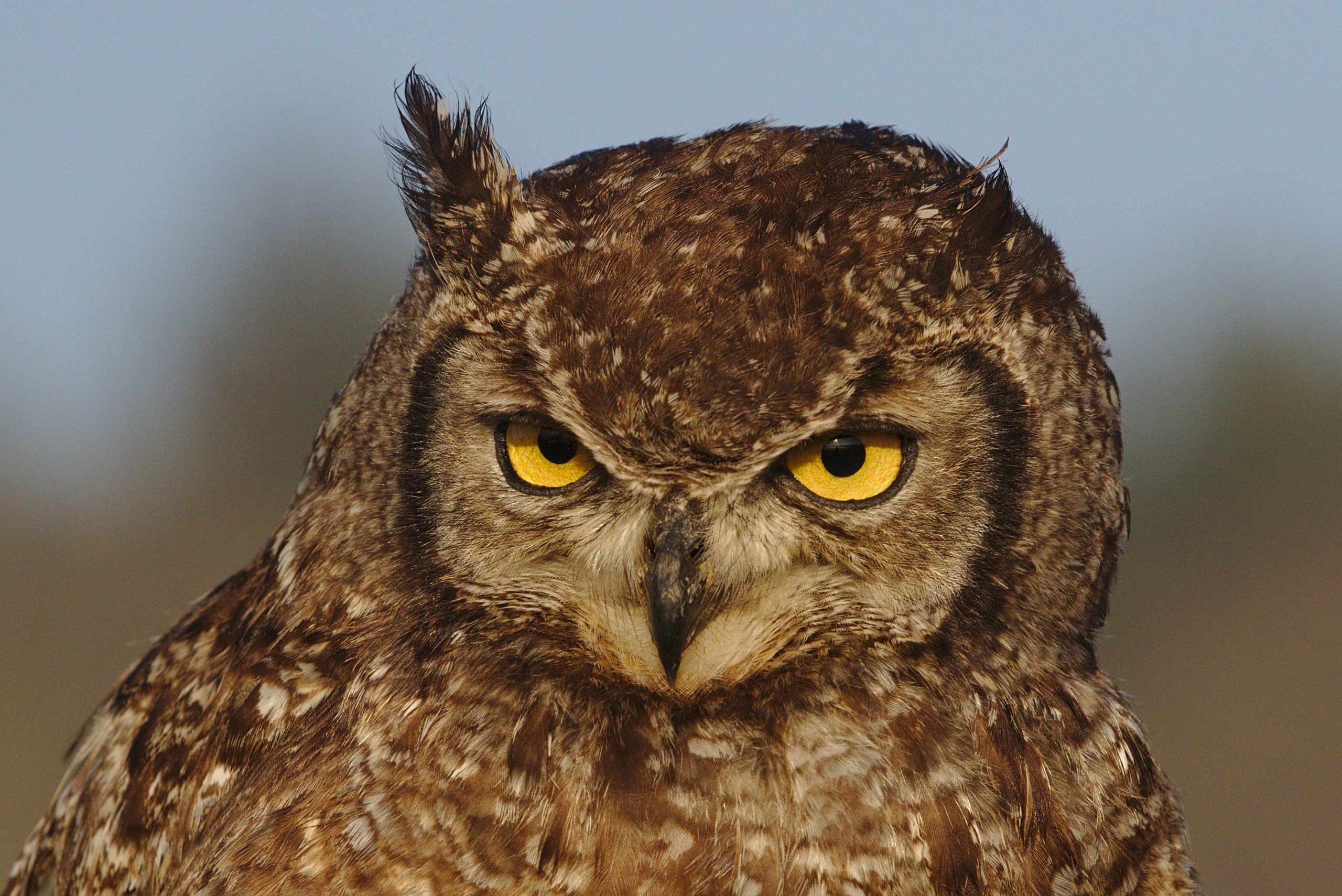
Owls do not rotate their heads so dramatically just to look spooky. Their visual system gives them a strong reason to move their necks. Unlike human eyes, owl eyes have extremely limited movement inside the skull. They are elongated and often described as tubular rather than round like human eyeballs.
Bony structures called sclerotic rings support them, helping hold the eyes firmly in place. It is common to hear that owl eyes cannot move at all, but that is slightly exaggerated. Research has documented small eye movements. One barn-owl study described movements of only about one to four degrees. The more accurate description is that owl eyes are nearly immobile.
That makes head movement much more important. When humans want to glance to the side, we can move our eyes first and then turn our heads if necessary. Owls rely much more heavily on moving the entire head to redirect their gaze.
Their forward-facing eyes also create overlapping visual fields, which support binocular vision and depth perception. This can help an owl judge the distance to prey. Extreme neck mobility allows the bird to scan its surroundings while keeping much of its body relatively still, an advantage for a predator waiting quietly on a perch.
Head movement also works together with hearing. In some species, facial discs help collect and direct sound toward the ears, so turning the head can help the owl orient itself toward noises as well as visual targets.
Fourteen Neck Vertebrae Help Make the Movement Possible
The owl’s neck is much more complicated than it appears beneath all those feathers. In the American barn owl examined in a major 2017 anatomical study, researchers counted 14 cervical vertebrae. Humans have only seven. The extra joints give the owl more places to distribute movement.
That doesn’t mean the entire neck twists evenly. Research shows that different sections perform different jobs. The lower portion can roll and bend sideways, shifting the head laterally. The upper neck contributes strongly to horizontal rotation. Together, those movements create the dramatic final head position.
The owl’s neck also rests in an S-shape, and many of its cervical joints are saddle-shaped, allowing sliding and flexible motion. The connection between the skull and first neck vertebra also differs from the typical mammalian arrangement. One caution is important.
It is tempting to say every owl species has exactly 14 neck vertebrae, but the scientific literature differs on how vertebrae are counted. The safest conclusion is that barn owls have been documented with 14, roughly twice the human number, though exact descriptions vary across studies.
Humans, by comparison, typically rotate their necks about 80 degrees to each side. One study of healthy young adults reported total head-and-neck rotation of about 155 to 162 degrees, dramatically less than the conventional owl range.
Specialized Blood Vessels Help Protect the Brain
Flexible bones are only part of the problem an owl must solve. Extreme neck rotation could potentially squeeze or stretch the blood vessels carrying oxygen to the brain. Researchers at Johns Hopkins studied this question using snowy, barred, and great horned owls that had died naturally. They used CT imaging, injected contrast material, performed dissections, and manually rotated the heads to examine the vascular system.
They found several unusual features. The bony openings surrounding the vertebral arteries were much larger than the arteries themselves. In the examined necks, some openings were reported to be roughly 10 times the artery’s diameter. That creates room for the vessels to move as the neck twists rather than being pressed tightly against surrounding bone.
Researchers also found expandable blood vessel areas near the base of the skull. These reservoir-like structures may help maintain blood supply when incoming circulation is temporarily reduced during extreme movement. Connections between different arterial routes provide another possible safeguard. If one pathway is partly compressed, alternate connections may help keep blood moving toward the brain and eyes.
The study did not prove that blood flow remains perfectly unchanged at every possible head angle, since the tests were performed on deceased specimens rather than living owls. Still, the anatomy offers a convincing explanation for how these birds tolerate movements that would be impossible for humans to reproduce safely.
So, can an owl turn its head all the way around? The safest answer is more nuanced than a simple yes or no. About 270 degrees from the forward-facing position remains the conventional reference for living owls. Experimental anatomy suggests their necks may physically allow even more, but researchers have not established 360-degree turns as normal behavior in living birds.
What looks like a supernatural trick is really an impressive combination of specialized vision, extra-flexible neck anatomy, coordinated joints, and a vascular system built to handle extreme movement.
Other Posts You May Like
- 8-animals-that-are-illegal-to-keep-as-pets-in-many-states
- elephants-crows-and-orcas-what-scientists-have-seen-when-animals-grieve
If you like what you just read, then subscribe to our newsletter and follow us on social media.
