

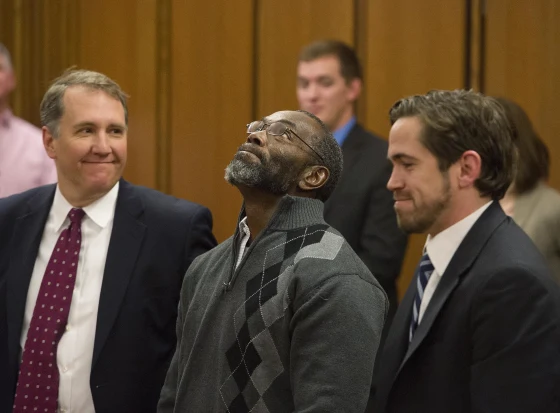
Rickey Jackson’s wrongful conviction remains one of the most chilling reminders that a courtroom can look official, a verdict can sound final, and a sentence can still be disastrously wrong. Convicted at 18 for a 1975 Cleveland murder he did not commit, Jackson spent 39 years, 3 months, and 8 days in prison before his conviction collapsed. At the time of his release in 2014, his case was widely recognized as the longest wrongful imprisonment to end in exoneration in United States history, though newer exonerations have since surpassed that record.
What makes the Rickey Jackson case so haunting is not just the number of years stolen. It is the thinness of the evidence that helped steal them. His conviction rested heavily on the testimony of a child witness who later recanted, saying he had lied and that police fed him details about the crime. The Ohio Innocence Project later helped uncover the evidence that led prosecutors to dismiss the case, setting Jackson free after nearly four decades behind bars.
The 1975 Cleveland Murder That Changed Everything
The case began after the killing of Harold Franks, a Cleveland businessman, during a robbery outside a store in 1975. Jackson and the Bridgeman brothers, Wiley Bridgeman and Ronnie Bridgeman, later known as Kwame Ajamu, were accused and convicted. All three young men were initially sentenced to death before those sentences were later commuted to life in prison.
For a justice system that claims to require proof beyond a reasonable doubt, the foundation of the case was disturbingly fragile. There was no strong physical evidence linking Jackson to the crime, and the prosecution’s case rested heavily on a young witness whose account would later fall apart. When one person’s false testimony becomes the pillar holding up a murder conviction, the result is not justice. It is a slow disaster dressed in legal language.
How a Child Witness Became the Center of the Case

The key witness was Edward Vernon, who was 12 years old at the time. Decades later, Vernon admitted he had not actually seen the crime and said police pressured him into sticking with a false story. He testified in 2014 that officers supplied details and that he tried to recant at the time, but he was too young, frightened, and trapped inside a system far more powerful than he was.
That detail matters because it exposes a dangerous weakness in criminal investigations. A frightened child can sound convincing under pressure, especially when adults in authority shape the story around him. Once that story reaches court, jurors may hear confidence where there is confusion, certainty where there is fear, and truth where there is only survival.
Why Rickey Jackson’s Wrongful Conviction Still Feels So Alarming
Jackson entered prison as a teenager and walked out close to 60. That means entire eras of American life passed without him. Presidents changed, technology transformed daily life, families grew old, communities shifted, and Jackson remained locked away for a crime he did not commit. The Innocence Project noted that his freedom came after the eyewitness recantation and other exculpatory evidence made the conviction indefensible.
The emotional weight of that loss cannot be reduced to a timeline. Prison did not just take Jackson’s freedom. It took ordinary mornings, birthdays, relationships, career years, grief rituals, private choices, and the quiet dignity of building a life on one’s own terms. We can count the years, but we cannot truly count the versions of himself he never got to become.
The Role of Police Misconduct in the Jackson Case

The National Registry of Exonerations has identified Jackson’s case as an example of government misconduct, noting that police threatened the central witness and concealed evidence that the witness had tried to take back his accusation. That means the injustice was not simply a mistake caused by bad luck or imperfect memory. It involved actions that pushed a false story deeper into the legal system.
This is why the case continues to matter beyond Cleveland. When law enforcement officers pressure witnesses, hide doubts, or treat early assumptions as facts, they do not merely weaken one investigation. They create a path where innocent people can be convicted, and guilty people can remain free. Every wrongful conviction carries two harms at once. The innocent person loses life, and public safety loses truth.
The 2014 Exoneration That Finally Opened the Door
In 2014, Jackson’s case returned to court after the witness recantation became impossible to ignore. The prosecution dismissed the charges, and Jackson was released after nearly four decades. Wiley Bridgeman was also released, and Ronnie Bridgeman, who had taken the name Kwame Ajamu, was later fully exonerated.
That moment was not a clean victory. It was a correction after irreversible damage. The courtroom could finally say the conviction was wrong, but it could not return youth, erase prison trauma, rebuild lost family time, or give Jackson the ordinary life he deserved from the beginning. Exoneration is powerful, but it is never the same thing as restoration.
The Money Could Never Match the Time Lost

After his release, Jackson received compensation from the state of Ohio. The Ohio Court of Claims first granted him more than $1 million for 14,178 days in prison, then later approved an additional $2.65 million settlement. In 2020, Cleveland agreed to an $18 million settlement with Jackson, Wiley Bridgeman, and Kwame Ajamu, with Jackson receiving 40 percent of that agreement.
Those numbers sound large until we place them beside 39 years. No settlement can buy back a first job, a young marriage, children growing up, aging parents, privacy, freedom, or the small daily choices most people never think to value. Compensation matters because society must acknowledge harm in material terms, but money is only a receipt for damage. It is not a cure.
The Lesson Rickey Jackson’s Case Leaves Behind
Rickey Jackson’s story is painful because it shows how a single false narrative can become a prison sentence, a public record, a stolen adulthood, and a lifelong scar. His exoneration proved the conviction was wrong, but it also exposed something larger. A system can follow procedure and still betray justice when pressure matters more than proof.
The lesson is blunt. Wrongful convictions are not old stories buried in courthouse archives. They are living warnings about power, fear, race, poverty, witness pressure, and the danger of treating certainty as evidence. Rickey Jackson walked out of prison, but the real question remains for the justice system that put him there: how many years must an innocent person lose before doubt finally matters?
Read the original story on Crafting Your Home


