The mail route was supposed to be ordinary.
A familiar road. A rural stretch of Wilkes County. A postal worker doing the kind of quiet, essential job most people only notice when it is suddenly interrupted. But on June 26, that routine route in Hays, North Carolina, became the scene of a killing that has shaken a small community and drawn national attention.
Brandi Reynolds, a 35-year-old United States Postal Service letter carrier and mother of two, was found dead while working her rural route, according to authorities. William Craig Durham, 56, has been arrested and charged with first-degree murder and first-degree kidnapping in connection with her death. Officials have not released a motive, and authorities have not said whether Reynolds and Durham knew each other.
The case is heartbreaking not only because Reynolds died while doing her job, but because of what her family had already endured. Reports say her husband, Brent Reynolds, died in a car crash months earlier, leaving their two children without both parents in less than a year.
What officials say happened on the route
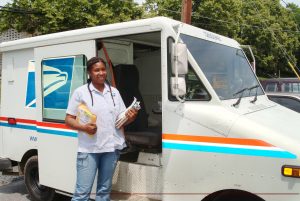
National Archives at College Park – Still Pictures, Public domain, via Wikimedia Commons
The North Carolina State Bureau of Investigation said the Wilkes County Sheriff’s Office responded around 4:16 p.m. to a request for law enforcement assistance at a location in Hays. When deputies arrived, they found Reynolds dead at the scene. ABC News reported that the U.S. Postal Inspection Service said Reynolds had been on her route at the time.
Court records cited by ABC News say Durham was charged with first-degree murder and first-degree kidnapping. The charges allege that Reynolds was restrained and kidnapped “for the purpose of terrorizing” her, and that Durham killed her with malice, according to the filing. Durham is being held without bond after his initial court appearance.
The case is being investigated jointly by the U.S. Postal Inspection Service, the North Carolina State Bureau of Investigation, and the Wilkes County Sheriff’s Office. The Postal Inspection Service said it was not releasing additional details while the investigation continues.
That silence leaves the public with painful questions. Why was Reynolds targeted? Was the attack random or personal? Were there warning signs? Could anything have prevented it? For now, those answers remain inside the investigation.
A mother remembered beyond the uniform.

In stories like this, the uniform can sometimes overwhelm the person wearing it. Reynolds was a postal worker, yes. But she was also a mother, a neighbor, and someone people on her route recognized as part of the rhythm of daily life.
PEOPLE reported that Reynolds was a rural mail carrier for USPS and was killed while delivering mail. The outlet also cited a February social media post in which Reynolds wrote about her children as the reason she got up every morning.
Neighbors remembered her as friendly and dependable. One woman who received mail from Reynolds described her to an ABC affiliate as “outgoing” and someone the community could count on.
That kind of description matters. Rural mail carriers often become more than delivery workers. They know which homes sit far back from the road. They recognize names, vehicles, dogs, porches, and patterns. In many small communities, the mail carrier is one of the few public workers who passes nearly every home, almost every day.
Reynolds was part of that network. Her death tore a hole not just in one family, but in the everyday trust that keeps rural life feeling safe.
Why does the killing of a postal worker hit differently
A killing on a mail route carries a particular kind of shock because postal workers represent reliability. They move through neighborhoods as symbols of public service, bringing medication, checks, bills, ballots, letters, packages, and small pieces of normal life.
Their work is visible but often solitary. Rural carriers may travel long distances alone, stopping at isolated mailboxes, long driveways, and quiet roads with limited immediate backup. That independence is part of the job. It is also part of the risk.
When a postal worker is attacked on duty, the fear spreads quickly among other carriers. It reminds them that their workplace is not a building with locked doors and security desks. It is the road. It is the shoulder of a highway. It is an unfamiliar driveway. It is the moment someone approaches the vehicle.
This is why Reynolds’ death feels larger than one criminal case. It raises fresh concerns about the safety of essential workers whose jobs require them to move through public and private spaces every day.
A broader pattern of concern for mail carrier safety
Reynolds’ killing comes at a time when violence against postal workers has already been drawing federal attention. In another case this year, federal prosecutors charged a man in Georgia with killing USPS letter carrier Dequavious Graves while he was working his route in Decatur. Prosecutors described the killing as a premeditated act, and federal officials said protecting postal workers is one of the Postal Inspection Service’s core missions.
The circumstances of the Georgia case are separate from Reynolds’ death, but together they point to the same concern: postal workers are vulnerable when violence follows them into the field.
Some attacks on carriers involve robberies for postal keys. Others involve personal disputes, random violence, or unknown motives. In Reynolds’ case, investigators have not publicly explained what they believe led to the killing. But the fact that she was allegedly kidnapped and killed while working makes the question of route safety impossible to ignore.
The legal consequences ahead
Durham now faces serious charges, but the case is still in its early stages. He is accused, not convicted, and he is presumed innocent unless prosecutors prove the charges in court.
ABC News reported that the judge noted Durham had a “significant criminal record,” including prior convictions for second-degree kidnapping and possession of a firearm by a felon, according to court filings. His attorney had no comment when contacted by ABC News.
The next stages will likely focus on evidence from the scene, witness statements, forensic findings, any relationship between the suspect and victim, and whether investigators can establish motive. The kidnapping charge may become especially important because it suggests prosecutors believe Reynolds was restrained and moved before she was killed.
For Reynolds’ family, the legal process may bring answers, but it cannot restore what was lost.
The children at the center of the tragedy

The most devastating detail is what Reynolds leaves behind.
Reports say her two children had already lost their father months earlier. Now, after their mother’s killing, they are facing a loss so complete that it is hard to process. Fox News reported that Brent Reynolds died in December 2025 and that the couple had two children.
That is why this story has cut through so much noise. It is not simply about a violent crime. It is about two children whose family life was shattered twice in a short span of time.
The public often absorbs crime stories through charges, mugshots, court dates, and police statements. But behind this case are birthdays, school days, family photos, routines, and the sudden absence of both parents.
A rural community left with fear and grief
In a place like Hays, a killing on a mail route does not feel anonymous. It feels close.
People know the roads. They know the mailboxes. They know what time the carrier usually comes. When violence breaks into that pattern, it changes how people see their own community.
Residents are left mourning Reynolds while also wondering how something so brutal could happen in a setting built on familiarity. For postal workers, the question is even more immediate: how do you keep doing the job when the route itself begins to feel unsafe?
That is the tension now surrounding Reynolds’ death. The mail still has to be delivered. The roads still have to be driven. The community still has to continue. But something has changed.
A woman who spent her workdays connecting homes to the outside world was killed while doing it.
And now, a family, a workplace, and a rural North Carolina community are left to carry the consequences.