This article was originally published on Crafting Your Home. A human contributor also wrote and edited the post.
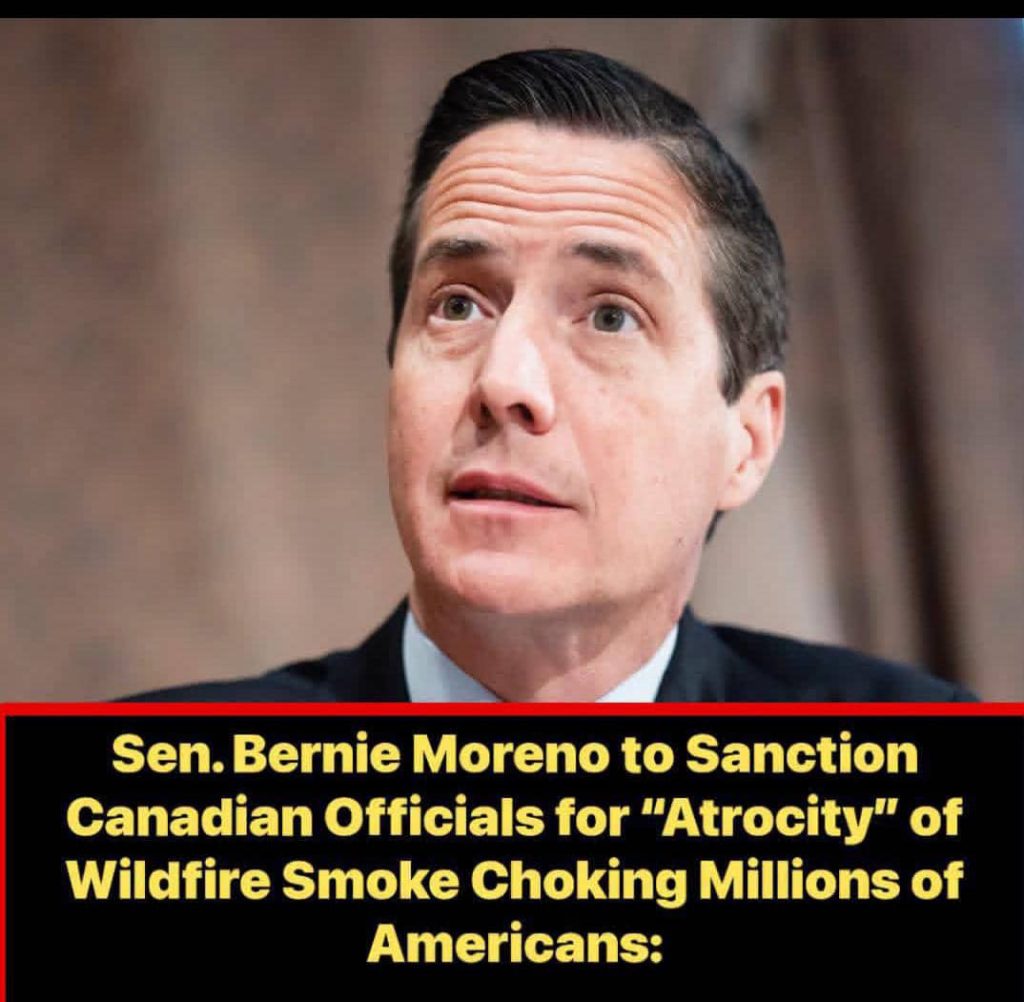
A cloud of wildfire smoke has become the latest source of tension between the United States and Canada, with Ohio Republican Sen. Bernie Moreno pushing a dramatic response: sanctions against Canadian officials he says failed to prevent dangerous air pollution from crossing the border.
Moreno announced plans to introduce legislation aimed at punishing Canadian government officials over wildfire smoke that spread across parts of the United States, affecting air quality and raising health concerns for millions of Americans.
The proposal has sparked a heated debate. Supporters say the measure holds foreign governments accountable for environmental harm affecting Americans. Critics argue that wildfire smoke is a complex environmental issue influenced by weather patterns, climate conditions, and the unpredictable nature of large wildfires.
At the center of the controversy is a simple but complicated question: Who is responsible when pollution crosses an international border?
Moreno’s proposal would target Canadian officials.
Moreno, a first-term senator from Ohio, says the United States should take action against Canadian officials responsible for what he describes as a failure to manage wildfire risks.
His proposed legislation, called the Countering Atmospheric Nuisances Arising from Drifting Airborne Foreign Incendiary Residual Emissions Act, or the CANADA FIRE Act, would impose sanctions on certain Canadian officials and create additional penalties tied to the wildfire smoke issue.
According to the bill text, the legislation would allow sanctions against individuals considered responsible for failing to address wildfire conditions that contributed to smoke affecting American communities. It also includes provisions involving visa restrictions and diplomatic consequences.
Moreno argued that Americans should not be left dealing with hazardous air conditions without accountability.
“I’ll be introducing a bill next week to sanction Canada and the responsible Canadian government officials for this atrocity,” Moreno wrote in a statement shared about the proposal.
The senator has pointed to repeated years of wildfire smoke affecting U.S. communities as evidence that stronger action is needed.
His supporters say the issue is about protecting Americans from cross-border pollution and demanding that neighboring countries take responsibility when their environmental problems affect others.
Wildfire smoke created widespread air quality concerns.
The political fight comes after major wildfire seasons sent thick smoke across parts of Canada and the United States.
Wildfire smoke can travel hundreds or even thousands of miles depending on wind patterns, affecting communities far from where fires actually burn.
The smoke contains fine particles that can worsen air quality and create health concerns, especially for children, older adults, and people with respiratory conditions.
During recent wildfire events, millions of Americans experienced air quality alerts as smoke from Canadian fires moved into the United States.
However, environmental experts have pushed back against the idea that Canada alone can prevent all wildfire smoke from crossing the border.
Scientists have noted that wildfire behavior is influenced by many factors, including drought, extreme heat, forest conditions, and changing climate patterns.
The debate has become part of a larger discussion about how countries should respond when environmental problems do not stop national borders.
While governments can improve wildfire prevention and response efforts, controlling smoke movement once fires become massive is far more difficult.
Supporters and critics clash over responsibility.
Moreno’s proposal has drawn support from some conservatives who argue that Canada has not done enough to reduce wildfire risks.
Supporters say governments have a duty to protect citizens and should face consequences when their policies contribute to international problems.
Some lawmakers have previously criticized Canada’s forest management practices, arguing that better prevention and land management could reduce wildfire impacts.
Critics, however, say blaming Canadian officials for wildfire smoke oversimplifies a much larger environmental challenge.
They argue that wildfires are not controlled by government decisions alone, and that smoke movement across borders is a natural consequence of large-scale fires.
Environmental scientists have warned that focusing only on blame could distract cooperation between countries on wildfire prevention, emergency response, and climate adaptation.
The Canadian government has also faced its own challenges managing increasingly severe wildfire seasons, including evacuations, firefighting demands and air quality emergencies.
For now, Moreno’s bill remains a proposal and would need to pass through Congress before becoming law.
The controversy highlights a growing reality: environmental problems are becoming international disputes.
Smoke does not recognize borders, but political responsibility often does.
As lawmakers debate Moreno’s proposal, the larger question remains whether sanctions and punishment are the right tools for dealing with a crisis driven by both human decisions and natural forces.
If you like what you just read, then subscribe to our newsletter and follow us on social media.