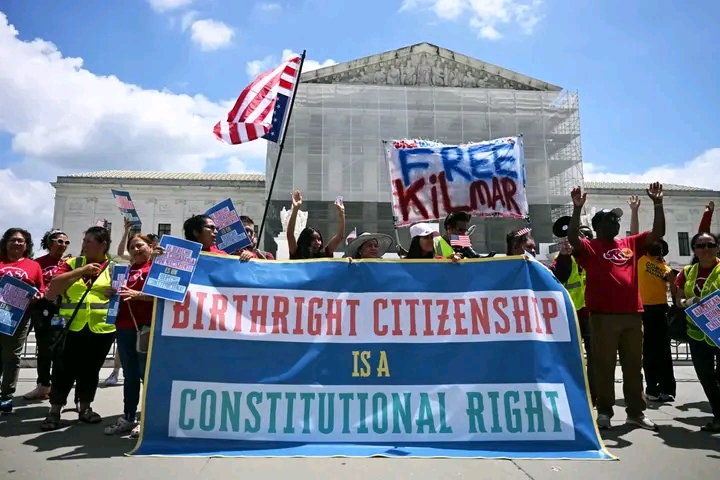
The United States Supreme Court is confronting one of the most consequential constitutional and immigration disputes in modern history as it weighs President Donald Trump’s effort to restrict birthright citizenship for children who were born on American soil to parents who are in the country without authorization or on temporary status.
At the center of the case is a question that goes far beyond immigration enforcement: whether the meaning of American citizenship, anchored in the 14th Amendment, can be narrowed by executive action after more than a century of settled interpretation.
A Constitutional Guarantee Born From Reconstruction
In the aftermath of the Civil War, the Citizenship Clause of the 14th Amendment was introduced as part of a sweeping effort to redefine national belonging in a country still deeply scarred by slavery. It confirmed that anyone born or naturalized in the United States and subject to its laws is automatically granted U.S. citizenship at birth.
That provision was crafted to directly overturn the Supreme Court’s notorious ruling in Dred Scott v. Sandford, which had completely denied Black Americans recognition as citizens of the United States. By embedding birthright citizenship into the Constitution, Reconstruction lawmakers sought to prevent political and judicial systems from stripping entire groups of their legal identity.
Trump’s Executive Order and the Constitutional Break It Creates

President Donald Trump’s executive order challenges that long-standing interpretation by seeking to deny automatic citizenship to children born in the United States if neither parent is a U.S citizen or lawful permanent resident. The administration argues that such children are not fully “subject to the jurisdiction” of the United States and therefore fall outside the Citizenship Clause.
In legal filings, the administration frames the issue as one of allegiance and political membership rather than geography. It argues that the 14th Amendment was intended to secure citizenship for formerly enslaved people, not to extend it to children of undocumented migrants or temporary visitors whose presence in the country is not fully lawful.
The Real Battle Hidden in One Phrase: “Jurisdiction”
At the core of the case is a single constitutional phrase: “subject to the jurisdiction thereof.” That language has carried different interpretive weight throughout American legal history, but its modern meaning has been relatively stable.
Under the dominant interpretation, jurisdiction refers to legal authority. Anyone physically present in the United States is subject to its laws, courts, and enforcement systems. Under that reading, children born on U.S. soil are citizens regardless of their parents’ status, with very slim exceptions such as children of foreign diplomats.
The Trump administration’s position dramatically narrows that interpretation. It suggests that jurisdiction requires full political allegiance to the United States, excluding those whose parents lack lawful immigration status or maintain primary allegiance to another sovereign.
The Statutory Foundation Most Debates Overlook
Beyond the Constitution, federal law also codifies birthright citizenship. The Immigration and Nationality Act mirrors the 14th Amendment’s language by granting citizenship to those born in the United States and subject to its jurisdiction.
A System Not Built for Conditional Birth Citizenship
One of the most significant practical implications of the case lies in how citizenship is currently recorded. The United States does not verify parental immigration status at the moment of birth for citizenship purposes. Hospitals issue birth records based on place of birth, and those records form the basis for passports, Social Security numbers, and state identification systems.
If the Trump administration’s interpretation were upheld, it would require a fundamental redesign of how citizenship is documented at birth. Hospitals and state agencies would likely be forced into verifying parental legal status at the time of delivery, introducing an entirely new administrative function into a system built on automatic citizenship recognition.
The Diplomatic Exception and Its Expanding Legal Shadow
Even the strongest defenders of birthright citizenship recognize narrow exceptions rooted in international law. Children born to foreign diplomats are not considered subject to U.S. jurisdiction because diplomats operate under protected legal status.
The legal controversy now before the Court is whether that exception can be conceptually expanded. The administration’s argument effectively attempts to extend the idea of “limited jurisdiction” beyond diplomats to include undocumented migrants and certain temporary residents.
Wong Kim Ark and the Weight of Historical Precedent
The 1898 ruling in United States v. Wong Kim Ark stands as the foundational precedent shaping today’s doctrine of birthright citizenship in the United States. It was decided during a period of intense anti-Chinese immigration sentiment, including the enforcement of the Chinese Exclusion Act. Yet, the Court still affirmed that birth on American soil confers citizenship.
That historical tension is central to the modern debate. It demonstrates that even in eras of restrictive immigration policy, the Supreme Court upheld a broad reading of the Citizenship Clause grounded in territorial birth rather than parental origin or political preference.
Institutional Stakes: Courts, States, and Executive Power
The case also raises broader questions about the balance of power between branches of government. If the Supreme Court were to uphold Trump’s order, it would effectively validate a presidential interpretation that narrows a constitutional guarantee long treated as settled law.
Such a ruling could also create uneven implementation across states and federal agencies, especially if administrative responses differ in how citizenship documentation is handled. That possibility introduces the risk of fragmented legal recognition of citizenship depending on jurisdictional enforcement.
A Nation Divided Over the Meaning of Birth
The United States now faces two competing constitutional visions. One treats citizenship as an automatic legal status grounded in geography and constitutional text. The other views it as a conditional status that depends on parental legal standing and a narrower interpretation of jurisdiction.
The Defining Question Before the Court
At its core, this case forces the Supreme Court to answer a question that sits at the foundation of American identity: whether citizenship is something a person is born into simply by entering the world on U.S. soil, or something that can be restricted based on parental status as defined by executive interpretation.
The answer will determine not only the reach of immigration policy but the meaning of belonging itself. In resolving Trump’s challenge, the Court is not just interpreting a clause of the Constitution; it is defining the boundary of the American community from the moment of birth.