The idea sounded simple enough at first. Bring the country to Washington, line the National Mall with state booths, food, music, flags, families, and spectacle, then turn America’s 250th birthday into something big enough to feel historic.
But the Great American State Fair has become more than a patriotic festival. It has turned into a revealing snapshot of the country itself, a nation trying to celebrate its past while still arguing over what that past means, who gets to tell it, and who feels comfortable standing under the same banner.
The event was promoted as a coast-to-coast celebration, a kind of modern World’s Fair planted between the U.S. Capitol and the Washington Monument. Organizers promised state pavilions, cultural displays, music, military pageantry, food, a giant Ferris wheel, and the kind of family-friendly attractions that usually make state fairs feel harmless and familiar.
Yet even before the gates fully opened, the fair had already become a political weather vane.
A Celebration Built for Unity Meets a Divided Country
The Great American State Fair was designed to mark the country’s semiquin centennial, the 250th anniversary of the signing of the Declaration of Independence. In theory, few things should be easier to celebrate than a national birthday.
In practice, even birthday parties can become complicated when the guest of honor is America.
Several states decided not to send official delegations. Their reasons varied, but the message was similar. Some said the cost was too high. Others said their resources were better spent on local anniversary events. Some expressed concern that the Washington celebration was taking on a partisan tone.
That is where the story became larger than one fair.
A state fair usually works because it is rooted in shared nostalgia. People go for the food, the music, the animals, the rides, and the pride of seeing their home represented. This version tried to scale that feeling to the size of the nation. But in today’s America, even nostalgia comes with a question attached: Whose version of the country are we celebrating?
The Cost of Showing Up
For state governments, participation was not just symbolic. It came with real expenses. States were expected to design, furnish, ship, and staff their displays. For some officials, that meant asking whether a temporary pavilion in Washington was worth the money when local museums, community events, and historical programs also needed support.
That financial question gave some states a practical reason to stay away. But the political backdrop made the decision heavier.
The fair is tied to Freedom 250, a Trump-backed initiative created to help organize major anniversary events. Supporters see the celebration as an unapologetic display of national pride. Critics see it as another example of a national milestone being pulled into partisan branding.
That tension has followed the fair from planning to opening day.
Some artists withdrew from related performances after saying they believed the events would be nonpartisan. Some state officials kept their distance. Some attendees came simply to enjoy the spectacle and take their children to the Ferris wheel. Others saw the whole production as a political statement, whether they wanted to or not.
This is the strange reality of American public life now. A fair can still sell food, play music, and entertain families, but it cannot fully escape the politics around it.
A Fair Full of Symbols
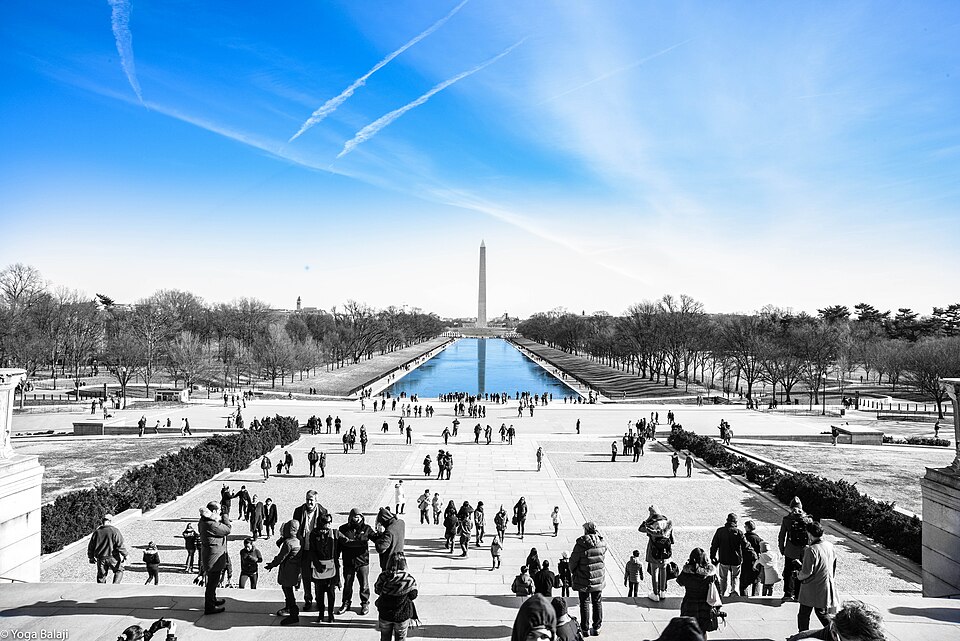
The location makes the event inseparable from history. The National Mall is not just an open lawn. It is America’s symbolic stage.
It is where people come to protest, mourn, celebrate, remember, and demand better. It is where monuments turn national memory into stone. It is where presidents speak, crowds gather, and the country tries to see itself.
So when a massive state fair takes over that space, every detail carries extra meaning.
A Ferris wheel becomes more than a ride. It becomes a photo frame for power. A state pavilion becomes more than a booth. It becomes a statement of belonging. A missing delegation becomes more than an absence. It becomes a headline.
That is why the fair has attracted so much attention. It is not just about whether people will buy snacks, watch performances, or pose for pictures. It is about whether a fractured country can still gather around a common celebration without turning the celebration into another fight.
The America On Display
The fair also raises a deeper question about which parts of America are highlighted on a national birthday.
Organizers have emphasized culture, innovation, family, agriculture, military service, and patriotic pride. Those are familiar themes, and many Americans will find them meaningful. They reflect real parts of the national story.
But critics argue that a serious anniversary should also make room for harder chapters, including slavery, Native American dispossession, inequality, war, immigration struggles, and the long fight over civil rights.
That does not mean every celebration must feel like a history seminar. Families can enjoy a fair without carrying the entire weight of the republic on their shoulders. But a 250th anniversary is not an ordinary party. It is a national mirror.
The challenge is that Americans do not all want the same mirror.
Some want a celebration that feels proud, bright, and uncomplicated. Others want one that is honest enough to hold both the achievement and the damage. Many probably want something in between, a celebration that allows love of country without pretending the country has always lived up to its promises.
Why This Story Matters Beyond Washington
The Great American State Fair matters because it shows how difficult national unity has become, even around moments designed to bring people together.
It also shows the growing divide between federal spectacle and local identity. Some states that declined to participate in Washington are still planning their own anniversary events at home. That matters. They are not rejecting the country’s birthday. They are choosing a different way to mark it.
That may be the most revealing part of the story.
America’s 250th anniversary will not belong only to Washington. It will also unfold in small towns, libraries, schools, museums, parades, church halls, city parks, and family gatherings. Some celebrations will be loud and political. Some will be quiet and local. Some will look backward. Others will ask what the next 250 years should become.
The National Mall may host the biggest stage, but it will not host the only version of America.
A Birthday Party With Bigger Questions
The Great American State Fair was meant to showcase the country. In a way, it has succeeded before the celebration even ends.
That does not make the fair a failure. It makes it a very American story.
A country turning 250 is bound to carry contradictions. It can be proud and restless, powerful and insecure, celebratory and divided. It can build a Ferris wheel on the National Mall and still argue over who should stand beneath it.
It has shown the ambition, spectacle, and patriotic confidence that still shape American public life. It has also shown the suspicion, division, and exhaustion that now follow almost every national symbol.
The fair may draw families, tourists, supporters, critics, and curious passersby. Some will come for the food. Some will come for the politics. Some will come for the view.
But the bigger question will remain after the booths come down and the Mall returns to normal.
Can America still throw a birthday party big enough for all its people, or has even the celebration become another place where the country sits apart?