


WASHINGTON — Under a gray weekend sky, visitors moved through the first days of President Donald Trump’s Great American State Fair with the easy rhythm of people determined to enjoy a national celebration, even as politics swirled around the event before many of them arrived.
The fair, staged on the National Mall as part of America’s 250th anniversary celebration, has become more than a showcase of food, music, exhibits, and patriotic pageantry. It has also become another test of whether any major national event connected to Trump can avoid being pulled into the country’s larger political divide.
Before the fair opened, some critics questioned whether the celebration would feel more like a political rally than a public festival. Several musical acts reportedly backed away from the event after concerns grew that the atmosphere had become too partisan. Trump’s own opening appearance added to that perception, turning the kickoff into a highly watched political moment.
But on the ground on Saturday, many fairgoers described something different.
For visitors walking between booths, sampling fair food, taking pictures, and watching families move through the attractions, the dominant feeling was not conflict. It was curiosity, patriotism, and a desire to be part of a rare national milestone.
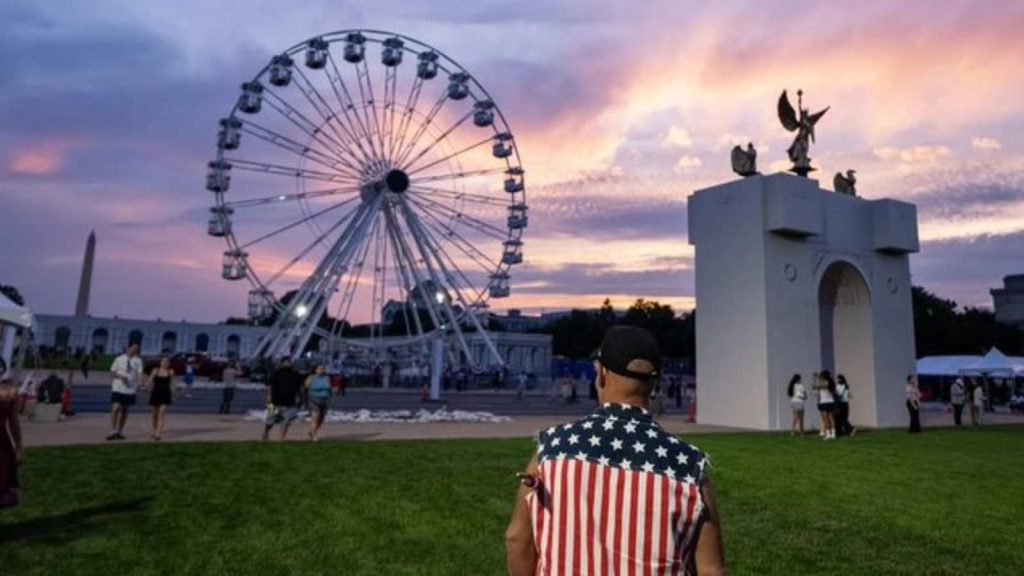
The event was designed as a large-scale public celebration of the United States ahead of the nation’s semiquincentennial. Organizers promoted it as a free, family-friendly gathering featuring state and territory pavilions, cultural displays, entertainment, military performances, exhibits, and classic fair attractions. The National Mall, already one of the country’s most symbolic public spaces, gave the celebration a dramatic backdrop.
That setting matters. A fair on the National Mall does not feel like an ordinary festival. It sits between monuments, museums, and government buildings that already carry the weight of American history. Every booth, flag, performance, and public speech becomes part of a larger message about how the country sees itself at 250 years old.
For supporters of Trump, the fair represents a confident patriotic celebration led by a president who has long favored grand public displays of American power and pride. For critics, it raises questions about whether a national birthday party should be so closely associated with one political figure.
Yet many attendees seemed less interested in that argument than in the experience itself.
That gap between national commentary and visitor experience is the most revealing part of the story. From a distance, the fair can look like another chapter in America’s political fight. Up close, for many guests, it appears to be something simpler: a public outing, a patriotic spectacle, and a chance to mark a historic anniversary.
The weather may have been gloomy, but visitors were not treating the day as a failure. Families still arrived. People still wandered through the grounds. The mood, at least among many attendees interviewed, suggested that politics had not completely swallowed the celebration.
That does not mean politics was absent. It would be nearly impossible for it to be. Trump’s name, presence, and role in shaping the event made the political context unavoidable. The decision by some performers to pull out also gave the fair a source of controversy before it had even begun. In today’s America, even a state fair can become a cultural signal.Still, the public reaction inside the fairgrounds shows how complicated these events can be. A person may dislike the politics around an event and still enjoy the music, food, exhibits, or atmosphere. Another person may support Trump and see the fair as a proud national statement. Others may simply want to take their children somewhere memorable during a historic summer.
That mix is what makes the Great American State Fair a revealing moment. It is not just a celebration of America’s past. It is a reflection of America’s present: divided, symbolic, emotional, and still capable of drawing people together in shared public spaces.

The fair also raises a broader question about how the United States should celebrate its 250th birthday. Should the focus be on unity, history, military strength, cultural diversity, local traditions, or political leadership? The answer depends heavily on whom you ask.
For now, the first weekend suggests that the event is carrying two stories at once. One is the political story playing out in headlines, where Trump’s involvement, performer withdrawals, and partisan concerns dominate the conversation. The other is the visitor story, where many attendees say they are seeing a celebration first and politics second.
That contrast may define the fair more than any single speech or controversy.
At a time when public life often feels consumed by political identity, the Great American State Fair shows how difficult it is to separate patriotism from partisanship. But it also shows that ordinary attendees do not always experience events the same way commentators describe them.
For many people on the National Mall, the fair was not a political argument. It was a day out under cloudy skies, surrounded by flags, booths, music, food, families, and the spectacle of a country preparing to mark its 250th anniversary.
Whether that spirit lasts through the full run of the event remains to be seen. But in its opening weekend, the Great American State Fair offered a familiar American scene: a celebration wrapped in controversy, a crowd trying to enjoy itself, and a country still arguing over what patriotism should look like.


