
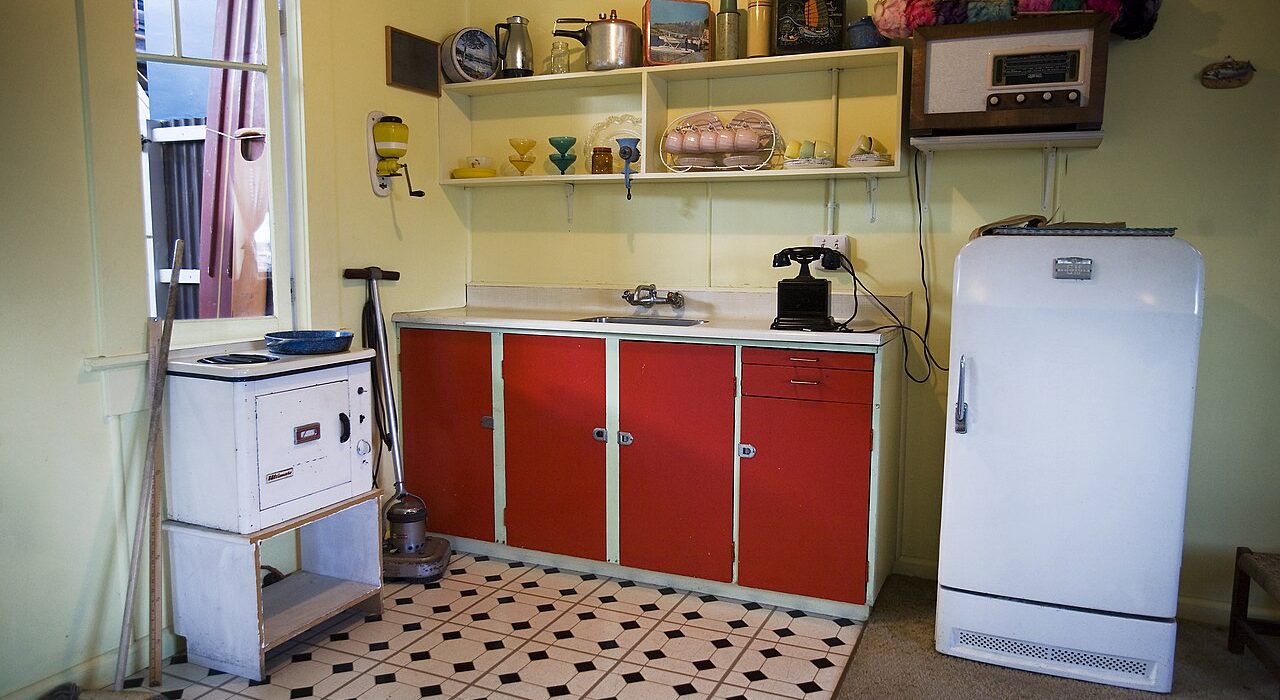


A typical family home in the 1960s was built around a short list of everyday objects, and most of them have since faded from view. A Cheapism roundup of things families almost always had in the decade covers 12 of them, from the rotary phone to the encyclopedia set. Together they show how much of daily life once ran through the living room, the kitchen table and the laundry line.
In the living room

1. A television set everyone shared. According to Cheapism, by 1960 over 46 million occupied U.S. housing units had at least one set, usually one large set in a wood cabinet in the living room. The New-York Historical Society adds that television was the most popular new appliance of the postwar era and replaced radio as the family’s main entertainment.
2. A rotary telephone with a long cord. Callers dialed one digit at a time, and Cheapism names Western Electric’s Model 500 and the Princess phone, which the Smithsonian dates to around 1960, among the popular models. Readers curious about the era can try why Gen Z would struggle to survive a week in the 1960s, and forgotten household items covers more objects like the phone.
3. A record player or giant hi-fi console. Most homes had one, Cheapism says, from portable units to console cabinets that combined a turntable, radio, amplifier, speakers and storage.
4. A shelf full of encyclopedias. World Book and Encyclopaedia Britannica sets were common reference tools for families who could afford them, with annual supplements to keep them somewhat current. The household-size numbers in this comparison of 1960 and 2025 census tables hint at how many people shared those shelves, and surprising 70s home decor shows where the look went next.
5. At least one radio. The 1960 Census asked whether households had one working radio, two or more, or none, excluding car radios. Kitchen radios and portable transistor sets were popular.
6. Wall-to-wall carpeting. Broadloom carpet covered entire rooms, often in colorful synthetic materials, and deep shag became more prominent as the 1970s approached. Kids of the next decades remember a different set of routines, as in this list of 70s and 80s childhood experiences and these boomer habits making a comeback.
Chores and sewing
7. An iron and a full-size ironing board. Ironing was a regular chore for cotton shirts, dresses, school clothes and table linens, and spray starch was a frequent addition. The decade’s earning power is the subject of this look at median family income from 1960 to 1980, and these vanished household rituals pick up where the 1960s left off.
8. A sewing machine ready for repairs. Singer was a recognizable brand. Home sewing was used for mending, curtains and outfits, and the Smithsonian holds Singer design material from 1960 to 1977.
9. A clothesline and a bag of clothespins. The 1960 Census distinguished electric dryers, gas dryers and homes with no dryer, so many families air-dried laundry outdoors or on indoor racks.
In the kitchen
10. A refrigerator that doubled as a bulletin board. Families posted children’s drawings, shopping lists, calendars, photos and reminders on the fridge door. The Smithsonian’s National Museum of American History notes that by 1960 nearly every American household had a refrigerator.
11. A kitchen table used for almost everything. The table served for homework, crafts, sorting bills, board games and family meals.
Keepsakes
12. A family photo album. Pictures were kept in albums, envelopes and shoeboxes. Kodak’s Instamatic line, introduced in 1963, helped spread casual photography, and Cheapism reports that more than 50 million Instamatic cameras were produced between 1963 and 1970.
The postwar boom behind these objects was real. History.com reports that Levitt and Son built more than 17,000 homes in three communities between 1946 and the early 1960s, and that by the end of the 1950s some 75% of households owned a car. Homes of the 1960s were filled with the results.
The common thread in the list is that each item did one job well and stayed in the same spot for years. The phone sat on the wall or table, the album sat on the shelf and the table in the kitchen stayed busy from breakfast to homework.
Get stories like this by email. Sign up for Crafting Your Home.
This article was produced with AI assistance and edited for accuracy against the sources linked above.
Image: Jorge Royan