

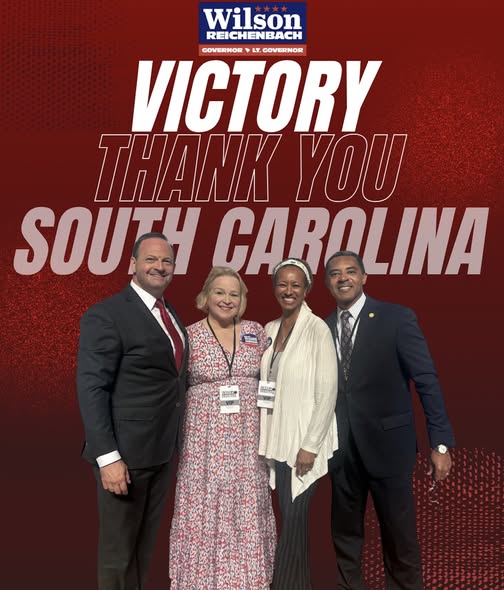
Alan Wilson did not merely survive South Carolina’s Republican governor runoff. He walked out of it with the kind of victory that changes the temperature of a campaign overnight. The state attorney general defeated Lt. Gov. Pamela Evette in the GOP runoff, capturing the Republican nomination for governor after a turbulent closing stretch defined by one of the most unusual political twists of the cycle: President Donald Trump endorsed both candidates.
For weeks, Evette appeared to hold the most valuable stamp in Republican politics. Trump had first backed her, giving her the kind of MAGA seal that can freeze a primary field, steer undecided voters, and force rivals to explain why they were running without it. But as Wilson gained strength, collected endorsements, and consolidated support from defeated Republican rivals, Trump reshaped the race by offering a last-minute two-way endorsement.
That move gave both campaigns something to claim. Evette could say she had been Trump’s first choice. Wilson could say he had become impossible to ignore. By runoff night, voters had delivered their own answer.
Wilson turned momentum into a rout
Wilson’s win was not a squeaker. It was a political statement. After finishing second in the first round of voting, he entered the runoff with a clearer path than he had enjoyed during the crowded primary. The original Republican field had been packed with recognizable conservative names, including Evette, Wilson, and U.S. Reps. Nancy Mace, Ralph Norman, and businessman Rom Reddy.
Once the race narrowed to two candidates, Wilson became the landing place for many Republicans who wanted a prosecutor, a familiar statewide figure, and a candidate with enough institutional support to carry the party into November. That consolidation mattered. Norman and Mace, once rivals, moved behind Wilson. Sen. Tim Scott backed him.
Sen. Ted Cruz campaigned for him. Law enforcement figures across South Carolina also helped reinforce his image as a tough, steady, courtroom-tested conservative. The result was a runoff that looked less like a divided party limping toward the general election and more like a party rapidly choosing its nominee and moving on.
Trump could not lose, but Evette still did

The strange genius of Trump’s final move was also its sharpest political contradiction. By endorsing both Evette and Wilson, Trump protected himself from a loss in a race that had started to look risky. If Evette won, he could point to his original endorsement. If Wilson won, he could say he backed him, too. In practical terms, Trump turned a potentially damaging primary defeat into a victory lap.
But that does not erase what happened on the ground. Evette had the earlier endorsement, the lieutenant governor title, and the support of Gov. Henry McMaster, the term-limited Republican she hoped to succeed. She had spent much of the race presenting herself as a loyal Trump-aligned conservative with executive experience and a business-focused background.
Wilson, however, found a stronger closing message. He leaned into his record as attorney general, his long history in Republican politics, and his ability to pull together multiple GOP factions. When Trump’s late endorsement arrived, Wilson did not hesitate.
He treated it not as a shared prize but as proof that his campaign had broken through. In politics, timing can be everything. Wilson peaked when it mattered.
The race exposed South Carolina’s new GOP reality
South Carolina Republican politics has long been shaped by loyalty, relationships, church networks, law-and-order messaging, and conservative credentials. This runoff added another rule: proximity to Trump remains powerful, but it is no longer always simple.
The contest showed that a Trump endorsement can still dominate a race, but it also showed that Republican voters can weigh other signals. Wilson had statewide experience. He had party relationships. He had a prosecutorial brand that fit the current GOP mood.
He also had help from major Republican figures who made it easier for voters to see him as the safer November bet. That is why the two-way endorsement did not confuse the final result as much as it could have. Voters were no longer being asked to choose between Trump and anti-Trump politics.
They were choosing between two Trump-friendly Republicans. In that environment, biography, alliances, debate performance, and perceived electability mattered again. Wilson won that contest decisively.
Evette’s loss closes one McMaster-era chapter
Evette’s defeat also carries symbolic weight. As lieutenant governor, she was closely tied to the McMaster administration. Her campaign offered continuity: more Republican leadership, more business-friendly policy, and a continuation of the state’s current conservative direction.
But South Carolina Republicans chose a different kind of continuity. They picked Wilson, the son of longtime U.S. Rep. Joe Wilson and a fixture in state politics since becoming attorney general in 2011. His victory does not represent a rebellion against the Republican establishment so much as a reshuffling of which establishment figure gets to lead the next chapter.
Evette conceded and moved to support Wilson, a necessary step for a party that wants to avoid lingering bitterness from the runoff. That unity message will matter because Democrats now have a nominee of their own and a list of issues they believe can cut into Republican dominance.
November brings a different fight
Wilson’s next opponent is Democratic state Rep. Jermaine Johnson, who won his party’s nomination outright. Johnson is expected to frame the general election around issues that affect daily life in South Carolina: roads, health care, crime, economic strain, education, and whether one-party Republican control has delivered enough for working families.
Still, the hill for Democrats remains steep. South Carolina has not elected a Democratic governor since 1998, and Republicans have dominated statewide races for years. Wilson enters the general election as the favorite, not only because of party registration and voting history, but because the runoff gave him something every nominee wants: momentum, unity, and a commanding win.
For Johnson, the challenge will be to make the race about performance, not partisanship. For Wilson, the challenge will be to avoid treating the general election as a formality.
What Wilson’s victory really means
Wilson’s runoff win tells three stories at once. First, South Carolina Republicans wanted a nominee they believed could win cleanly and govern forcefully. Second, Trump’s influence remains central, but campaigns still need organization, timing, and a closing argument. Third, the Republican Party in South Carolina remains deeply favored, but its internal battles are becoming more complex.
The final days of the runoff were messy, loud, and unusually dramatic. There was a first endorsement, then a shared endorsement. There were rival factions, bruising attacks, and questions about who truly carried the MAGA lane.
Then the votes came in. Alan Wilson emerged not as the accidental beneficiary of Trump’s hedge but as the candidate who best understood the moment. He absorbed the endorsement drama, claimed the momentum, unified former rivals, and turned a runoff into a coronation.
Now the race for governor moves from a Republican family fight to a statewide test. Wilson has the nomination. He has the party machinery. He has the conservative wind at his back.
The question for November is no longer whether South Carolina Republicans can rally around him. They already have. The question is whether Democrats can make enough voters believe the state needs something different.


