

The post Why Leaves Change Color: The Science Behind Fall’s Show first appeared on Crafting Your Home.
Every yellow leaf in October was already yellow in June. Green just drowned it out.
Henry David Thoreau published Autumnal Tints in the Atlantic Monthly in October 1862, months after his death, and spent its pages on red maples and scarlet oaks with the devotion most people reserve for ballgames.
Chemistry had no answer for him then. It has partial answers now, and they are less flattering than his prose: what looks like a celebration is a tree salvaging what it can from tissue it is about to abandon.
Yellow was never missing, only outvoted
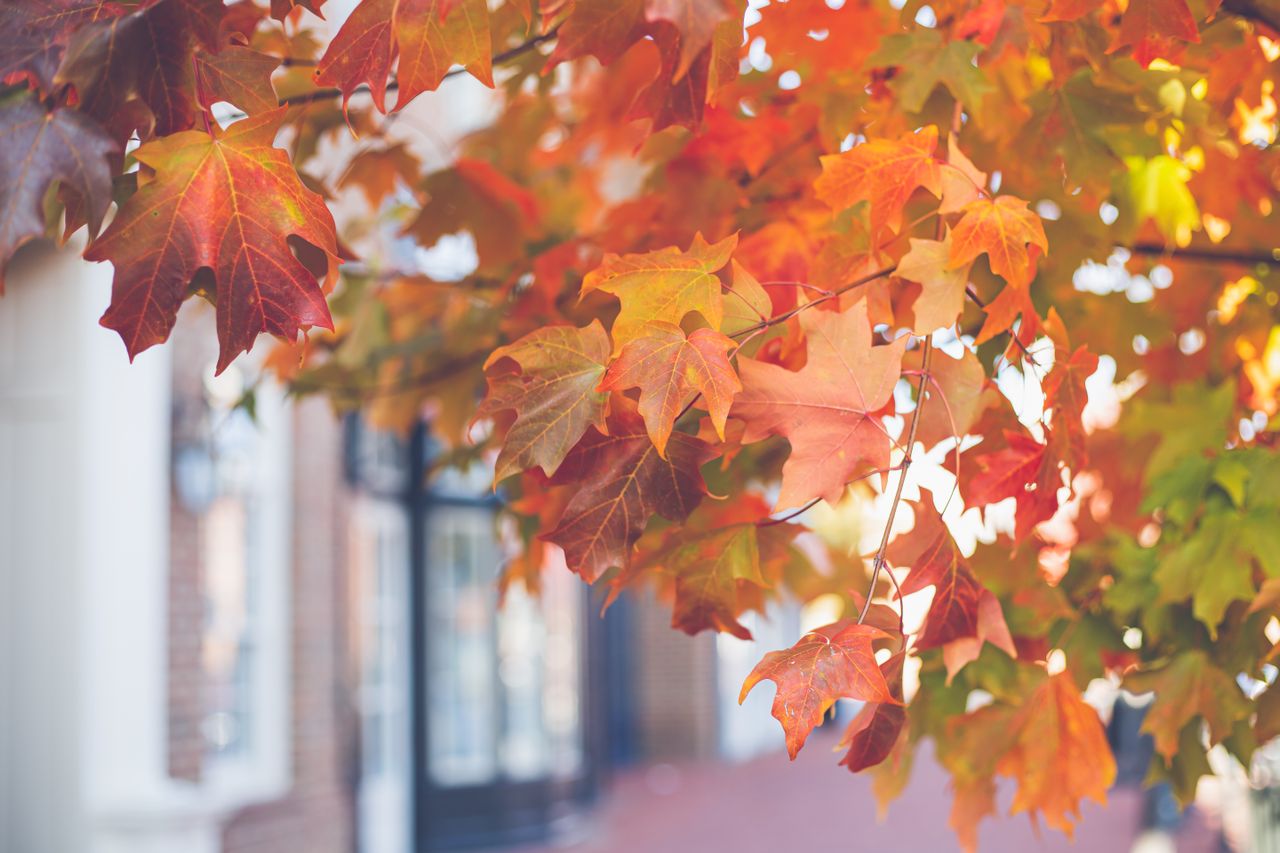
Lincoln Taiz and Eduardo Zeiger’s textbook Plant Physiology, standard reading in university botany courses, treats carotenoids as pigments a leaf carries through the whole growing season. Chlorophyll outnumbers them, so the leaf reads green until the balance tips.
Shrinking daylight tips it. A corky layer forms where the leaf stem meets the twig, the supply lines close and chlorophyll stops being rebuilt. Aspens, birches and hickories lean on that reveal, which is why a Colorado hillside in late September runs gold instead of crimson.
Nothing new gets manufactured for yellow. It is the cheapest color of the season.
Green gets dismantled and leaves nothing behind
Chemist Bernhard Kräutler at the University of Innsbruck began tracing chlorophyll’s breakdown in 1991, and the products turned out to be colorless. Whatever paints an autumn leaf, chlorophyll itself contributes no pigment on its way out.
The same chemistry runs in fruit. Kräutler’s group later found glowing blue breakdown compounds in ripening banana peels, visible under ultraviolet light.
Green leaves no stain, only a leaf with less inside it. Because the leftovers carry no color, every hue on the branch comes from a pigment that was either hiding or freshly built.
Trees claw back about 62% of leaf nitrogen before letting go
A 2012 analysis in Ecological Monographs, led by Lora Vergutz at Duke University, pooled resorption studies worldwide. Average nitrogen recovery from green leaves landed near 62%, with phosphorus close to 65.
Economically, a tree treats each leaf as a loan it collects on before default. Fall color is what the accounting looks like from the sidewalk. Calling it a show flatters the audience more than it describes the tree.
The leaf that finally hits the lawn is closer to an empty envelope than to waste.
The warning-flag theory for red is elegant and unproven

W.D. Hamilton and Sam Brown proposed in a 2001 Proceedings of the Royal Society B paper that red leaves tell aphids a tree is well defended and not worth colonizing. Hamilton had died the year before, so the paper reads partly as a last idea from a famous mind.
Color as a costly signal is a tidy story. Field tests on insects have not settled it, and I find the theory easier to admire than to believe.
Elegance is not evidence, and evolutionary biology has a long record of beautiful ideas that lost to boring ones.
The sunshade theory has an experiment behind it
William Hoch and colleagues at the University of Wisconsin-Madison published “Resorption protection” in Plant Physiology in 2003. Their work on red osier dogwood found that leaves make anthocyanins fresh in autumn, and that the pigments shield leaves from damaging light while nutrients drain out.
Under that reading, red is a tree spending a little sugar on a parasol so the nitrogen recovery can finish. It is less romantic than a warning flag and better documented.
Neither theory has knocked out the other, and anyone who calls the question closed has not read the literature.
America runs red because of a quirk scientists still argue over
Simcha Lev-Yadun and Jarmo Holopainen asked in a 2009 New Phytologist paper why autumn leaves are red-dominated in America and yellow-dominated in northern Europe. Their answer tied the split to how ice ages and insect pests shaped each continent’s forests.
On that account, the Vermont postcard owes as much to Pleistocene ice as to any October weather. Sweetgum and sumac carry the same reds south into Georgia, far from any maple syrup camp.
Their explanation remains a hypothesis, and a good reminder that the scenery Americans treat as a birthright has a contingent past.
Related Post: 8 Scenic Train Rides for Seeing Fall Colors
The Northeast palette leans on a tree that also pays the bills
Materials from the Vermont Maple Sugar Makers’ Association describe the state as the country’s largest maple syrup producer. Sugar maples supply the orange and flame red that draw leaf peepers each October, and red maples add scarlet.
Visitors photograph a working farm asset. The sap that fills buckets in March comes from the same trunks that fill phone cameras in October.
A tree carrying a syrup industry and a tourism season at once has little room for a bad decade, and nobody should pretend the two economies are separate.
Cameras now watch the canopy every half hour
Andrew Richardson of Northern Arizona University leads PhenoCam, a network of automated cameras across North America that photographs forest canopies every half hour during daylight. Software turns each image into a greenness score, so the date a canopy starts to fade can be pinned down without a single person leaning on a fence.
Human foliage reports, the phone calls and posts announcing peak, are anecdotes by comparison. I trust the pixels more than the press release, though a camera cannot tell you where to park.
Related: U.S. Residents Can Still Visit National Parks Free on Two More Days This Fall
One meta-analysis found autumn arriving later
A team including Boston University biologist Richard Primack reviewed autumn phenology studies across the Northern Hemisphere and published the results in 2015. Their conclusion pointed toward delayed leaf senescence in many deciduous trees as temperatures rose.
Later color stretches the season toward November in some places. It also pushes the reds toward dates when frost is likelier, a risk worth watching rather than a proven outcome.
For anyone booking an October cabin months ahead, last decade’s dates are a weaker guide than they look.
A 2020 Science paper says faster growth can bring autumn sooner
David Zani and colleagues at ETH Zurich reported in Science in 2020 that temperate trees which grow more during the season tend to shed leaves earlier. Warmer springs boost productivity, so the same warming could pull autumn forward.
Both papers are peer-reviewed, and neither can describe every forest. Anyone who claims to know exactly what your October will look like in 2040 is selling something.
The honest summary is a contest between two mechanisms, with the winner varying by species and region.
The pigments outside the window are on the table too
German pharmacist Heinrich Wackenroder crystallized carotene from carrot roots in 1831, and the pigment family took its name from the vegetable. Carrots, pumpkin and the orange in a sugar maple leaf belong to the same chemical class.
Red cabbage owes its color to anthocyanins, the family behind the reds in maple leaves. A fall table of roasted carrots, pumpkin and red cabbage is a botany demonstration with gravy.
By the time the plates are cleared, the trees outside will have finished paying themselves back.
Other Posts You May Like
- Why More Gardeners Are Treating Fall, Not Spring, as the Real Start of the Planting Season
- Instead of Decorating for 4 Seasons a Year, Maybe Just… Don’t
If you like what you just read, then subscribe to our newsletter and follow us on social media.


