


The post Why Cutting Onions Makes Your Eyes Water And 6 Ways to Reduce It first appeared on Crafting Your Home.
You may be preparing a simple meal when the familiar sting begins. Your eyes start burning, tears run down your cheeks, and suddenly cutting one onion feels like an emotional experience you never signed up for.
This reaction is common, but it isn’t caused by the onion’s smell alone. Cutting an onion sets off a series of chemical reactions that
release an irritating substance into the air. When it reaches your eyes, your body responds by producing tears.
Scientists have studied this process because onions contain several sulfur-containing compounds responsible for their distinctive smell and irritating effect. Understanding what happens can also explain why certain kitchen tricks work better than others.
Cutting an Onion Damages Its Cells

An intact onion contains chemical compounds and enzymes stored in different parts of its cells. When you slice through the onion, you break that cellular structure and let previously separated substances interact.
This starts a chain of chemical reactions that produces the familiar sharp onion aroma. One product is a volatile compound called
propanethial S-oxide, commonly known as the onion’s lachrymatory factor.
The word lachrymatory refers to something that causes tears. Because the compound can travel through the air, it does not have to touch your fingers or skin to affect you.
That is why your eyes can start watering while you are still holding the knife above the chopping board.
The Irritating Compound Reaches the Surface of Your Eyes
As the volatile compound spreads away from the cut onion, some of it reaches your eyes. It stimulates sensitive nerve endings on the eye’s surface, triggering a protective response.
Your tear-producing system responds by releasing more fluid. Those tears help wash away the irritant, which is why your eyes may water heavily while you continue cutting.
This response works on the same principle as other protective reactions that help the body respond to irritating substances. Your eyes are not deliberately overreacting; they are trying to protect a delicate surface.
Rubbing your eyes with onion-contaminated fingers can worsen irritation because you may transfer more of the irritant directly to the area.
Some Onions Seem More Irritating Than Others
Have you ever cut one onion with hardly any discomfort, only to find yourself tearing up while preparing another?
That difference can be influenced by several factors, including the onion variety, its chemical composition, how it is stored, and the way it is cut. The amount of irritating compound released may vary.
Your own sensitivity can also affect how strongly you react. Two people preparing the same onion in the same kitchen may not tear as much.
That is why a single trick doesn’t always work equally well for everyone. A method that makes cutting easier for one person may offer less relief to another.
A Sharp Knife May Help
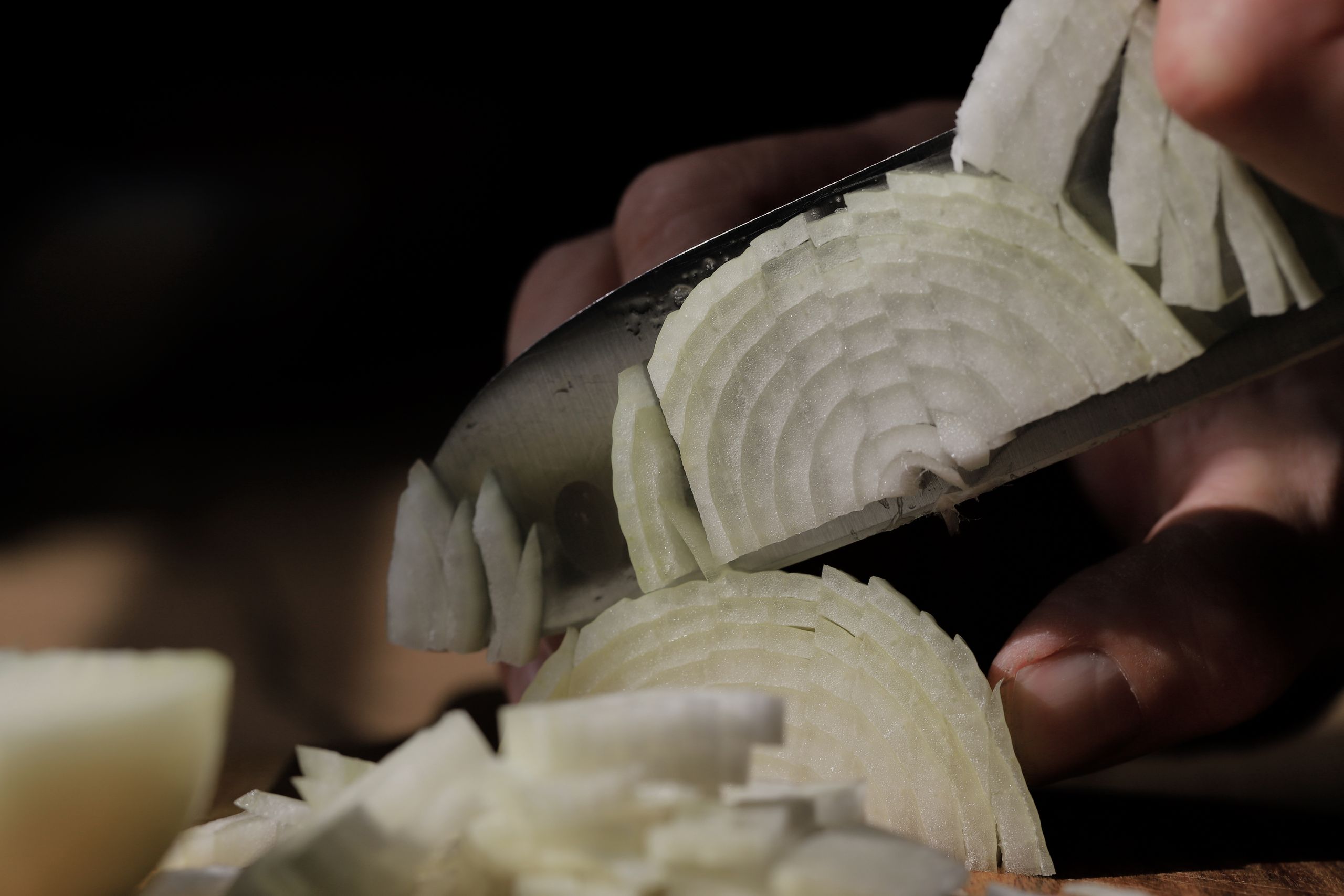
A sharp knife helps because it cuts through the onion cleanly instead of unnecessarily crushing and tearing the tissue. Cutting
technique may affect how much material is damaged and released during preparation.
A dull knife is not only frustrating; it also requires more force and makes the process less controlled.
Use a sharp knife carefully, keep the chopping board stable, and curl your fingertips away from the blade. Don’t sacrifice safety to reduce tears.
A sharper knife may help, but it doesn’t guarantee you will stay completely tear-free. The onion’s chemistry and your sensitivity still matter.
Ventilation Can Help Move the Irritant Away
If irritating vapor builds up around your face, your eyes may keep reacting. Improving ventilation can help carry some of it away from your immediate working area.
If possible, prepare the onion near an effective kitchen exhaust fan or in a well-ventilated space. Position yourself so airflow moves the vapor away from your face.
Avoid placing your face directly above the chopping board. Even a small change in your position can reduce how much of the released compound reaches your eyes.
Be careful around fans or ventilation equipment that blows the vapor toward other people. The aim is to move the irritant away, not redistribute it around the room.
Chilling the Onion May Reduce the Problem for Some People
Some cooks refrigerate an onion briefly before cutting it. Cooling can affect how volatile substances move and are released so this method may reduce irritation in some cases.
However, results can vary, and refrigeration does not remove the chemical compounds responsible for the reaction.
If you try this method, use a clean cutting surface and promptly return any unused cut onion to suitable storage. Don’t leave prepared
food out for long periods just because you are experimenting with kitchen techniques.
You can test whether chilling helps with the type of onion you usually buy, but do not expect it to work perfectly every time.
Onion Tears Are Not the Same as Crying from Emotion
Tears can occur for different reasons. Emotional crying involves processes associated w