
This article was originally published on Crafting Your Home. A human contributor also wrote and edited the post
President Donald Trump turned a discussion about automobile manufacturing into a viral political moment Monday when he repeatedly pronounced Mexico as “Meh-Hee-Ho” before a crowd at General Motors’ proving ground in Milford, Michigan.
The unusual pronunciation drew laughter, but the moment carried a larger message. Trump used the joke while arguing that American companies had spent years moving manufacturing operations south of the border. He then connected the story to tariffs, factory investment and his effort to persuade global automakers to produce more vehicles inside the United States.
As we examine the full exchange, we find more than a brief verbal detour. The moment brought together three increasingly important political issues: Trump’s communication style, the future of American automobile manufacturing and the complicated economic relationship between the United States and Mexico.
What Trump said about the pronunciation of Mexico
Trump was discussing the movement of automotive production when he paused over the name of America’s southern neighbor. Instead of using the common English pronunciation, he repeatedly rendered Mexico as “Meh-Hee-Ho.”
He then told the audience that Mexican President Claudia Sheinbaum pronounces the country’s name beautifully. Trump described Sheinbaum as a “very nice” president who speaks well before attempting to imitate what he presented as her pronunciation.
In Spanish, “México” is generally pronounced approximately “MEH-hee-koh,” with a final “o” sound. Trump’s version appeared to exaggerate or alter that pronunciation, especially in its final syllable.
The president then recalled using the same word before another audience. He said he had promised to stop businesses from moving to “Meh-Hee-Ho,” only to discover that listeners did not know which country he meant.
Trump laughed at the failed delivery and admitted that the line had not worked as intended. The crowd in Milford responded with amusement.
Why the Michigan audience laughed
The humor came from Trump’s willingness to turn his own confusing pronunciation into the punchline.
Rather than pretend that the earlier audience had understood him, he described the awkward reaction and acknowledged the joke’s failure. That self-deprecating ending gave the Milford crowd permission to laugh with him rather than simply at the unusual pronunciation.
The exchange also reflected a familiar feature of Trump’s public speaking. He frequently interrupts policy arguments with personal stories, impressions, exaggerated phrases and observations about people he has met. The detours can make his speeches unpredictable, but they also create short clips that travel quickly through television coverage and social media.
In Milford, a complex trade argument became a memorable performance. “Business relocation to Mexico” is an abstract economic issue. “Meh-Hee-Ho” is a phrase audiences can repeat, debate and share.
That distinction explains why the pronunciation attracted significant attention even though it occupied only a small portion of a much broader automotive speech.
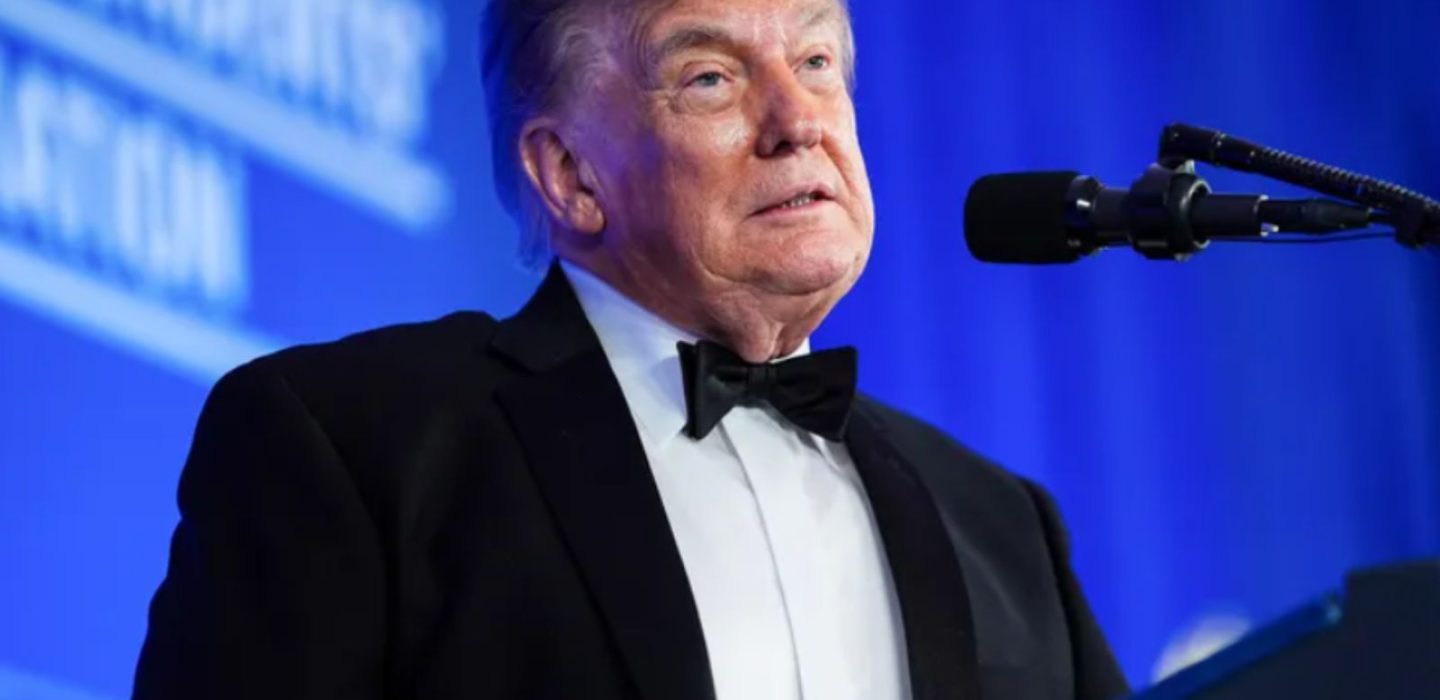
Trump delivered the remarks at GM’s Milford Proving Ground.
Trump made the comments on July 27, 2026, during an appearance at the General Motors Milford Proving Ground in Michigan.
The White House published video of the president’s remarks, while news reports identified the event as part of his continuing effort to highlight American automobile production and manufacturing investment.
Milford’s role in the story matters. The General Motors site is not simply a symbolic campaign location. Michigan remains closely identified with the American automotive industry, and speeches delivered there are often aimed at factory workers, suppliers, engineers, union households and communities whose economic fortunes depend on vehicle production.
Trump praised General Motors and argued that tariffs had strengthened domestic manufacturers. He framed his administration as a defender of auto workers who had watched jobs and production leave the country over several decades.
The pronunciation joke therefore arrived inside a carefully selected political setting. Trump was speaking in Michigan, standing at a GM facility and addressing an audience receptive to promises about factories, jobs and industrial revival.
The serious message behind Trump’s Mexico joke
Although the crowd laughed, Trump’s underlying statement was not primarily about language.
He was repeating his promise to prevent businesses from transferring production from the United States to Mexico. He argues that tariffs, trade pressure, and incentives for domestic investment can change corporate decisions.
Trump has consistently presented international trade as a competition between locations. Under that view, a factory built in Mexico may represent an opportunity lost by an American community. A production line moved to Texas, Michigan or another U.S. state becomes evidence that his economic strategy is succeeding.
The relationship is more complex in practice. Automobile supply chains cross borders repeatedly, with parts, engines, electronics and finished vehicles moving among the United States, Mexico and Canada. A vehicle assembled in one country may contain components produced in the other two.
That integration is one reason automobile rules have become central to the ongoing review of the United States-Mexico-Canada Agreement.
Trump points to Toyota’s San Antonio expansion.
During his manufacturing argument, Trump highlighted Toyota’s decision to expand its operations in San Antonio, Texas.
Toyota announced a $3.6 billion investment on July 6. The project will add a second vehicle assembly line, create 2,000 jobs, and expand the San Antonio campus by approximately 2.5 million square feet. Toyota expects the expansion to double the facility’s size by 2030.
The company also plans to transition Tacoma pickup production from Toyota Motor Manufacturing Baja California to the expanded Texas facility over an estimated four-year period.
The San Antonio plant already produces the Tundra and Sequoia. Once the expansion is completed, it will also assemble the Tacoma. Toyota said its local workforce should grow to roughly 6,000 employees, supported by suppliers operating at the manufacturing campus.
For Trump, the decision offers a powerful political example. A well-known truck currently associated with Mexican production will eventually be assembled in Texas, where thousands of new jobs are expected.
Toyota did not say tariffs caused its decision.
Trump has credited tariffs with encouraging Toyota and other manufacturers to invest in American production. However, Toyota’s official announcement did not say tariffs directly caused the San Antonio expansion.
The company described the project as an investment in its North American workforce, manufacturing flexibility, advanced technology and long-term growth. Toyota also said it remained committed to operations in the United States, Mexico and Canada.
That distinction is important.
Trump is entitled to argue that his policies influenced corporate calculations. Tariffs and uncertainty surrounding regional trade rules can affect where companies choose to produce vehicles. However, a political interpretation should not be presented as a confirmed corporate explanation when the manufacturer has not adopted it.
Toyota’s announcement included another significant detail. The company encouraged a quick resolution to the USMCA review so that North America could remain globally competitive.
The statement suggests that Toyota views the region as an integrated manufacturing system rather than a collection of entirely separate national markets.
How Trump’s joke connects to the USMCA negotiations
The United States, Mexico and Canada are reviewing the trade agreement that has governed much of their regional commerce since July 2020.
In July 2026, U.S. and Mexican negotiators were discussing automobiles, steel, aluminum, labour, agriculture, electronic payments and economic security.
A joint statement issued after the third bilateral negotiating round said officials had discussed automobiles and the need to strengthen North American manufacturing and regional supply chains. The two governments also addressed the risk that countries outside the agreement could benefit from the region without meeting the same standards.
These negotiations provide the policy background to Trump’s remarks.
When he talks about stopping companies from moving to Mexico, he is not speaking in an economic vacuum. His administration is negotiating rules that could influence where vehicles and components must be produced to receive favorable treatment under the regional agreement.
The debate involves tariffs, domestic-content requirements, wages, supply-chain security and competition from manufacturers based outside North America.
Mexico remains one of America’s largest trading partners.
Trump’s comments may present Mexico as a competitor for U.S. factories, but the country is also one of America’s most important customers and suppliers.
U.S. goods trade with Mexico reached an estimated $872.8 billion in 2025. American companies exported about $338 billion in goods to Mexico and imported approximately $534.9 billion, according to the Office of the U.S. Trade Representative.
U.S. Census Bureau figures similarly placed total 2025 goods trade with Mexico at more than $871 billion.
These figures show why even a humorous remark can attract attention from businesses, investors, and government officials.
The United States cannot treat Mexico only as a destination for outsourced production. Mexico is also a major purchaser of American goods, an essential link in regional supply chains and a production base for industries serving consumers across North America.
Changes in tariffs or automotive rules can therefore affect companies and workers on both sides of the border.
Trump praised Claudia Sheinbaum before imitating her.
Trump’s description of Sheinbaum added an unusual layer to the exchange.
He did not introduce the Mexican president with direct hostility. He referred to her as pleasant and said she spoke well before imitating the way he claimed she pronounced her country’s name.
That combination left the tone open to interpretation.
Supporters could view the moment as a harmless attempt to reproduce a Spanish pronunciation. Critics could interpret it as mockery of a foreign leader or a distorted imitation of Spanish speech.
The context also matters. Trump moved from praising Sheinbaum to promising that he would stop businesses from relocating to Mexico. Personal warmth and economic confrontation appeared in the same anecdote.
That mixture has repeatedly characterized the Trump-Sheinbaum relationship. Public compliments can exist alongside tariff threats, border disputes and aggressive trade negotiations.
Mexico and the United States had recently highlighted cooperation.
Only days before Trump’s Milford remarks, American and Mexican officials publicly emphasized cooperation during the USMCA review.
A July 23 joint statement said Sheinbaum had met U.S. Trade Representative Jamieson Greer during the third negotiating round. Officials said they shared an interest in stronger North American manufacturing, reinforced regional supply chains and constructive economic dialogue.
The governments instructed their teams to prepare for another round of negotiations in Washington in September 2026.
That diplomatic language contrasts with the sharper imagery used in Trump’s Michigan speech. At the negotiating table, the focus is cooperation and regional competitiveness. At a political event, the focus becomes factories leaving America and an administration determined to bring them back.
Both messages can operate at the same time, but they are aimed at different audiences.
What Trump’s pronunciation moment means for Michigan
The Milford appearance allowed Trump to connect those concerns to a national story about trade. The laughter helped him hold the crowd’s attention, but the economic promises will face a much more demanding test.
For Michigan residents, the key issue is not simply how Trump pronounced Mexico.
The more important question is whether his manufacturing policies will produce lasting investment, stable employment and stronger supply chains in the state.
Michigan competes with other states and countries for new vehicle plants, battery facilities, research centers and supplier operations. A Toyota project in Texas may support Trump’s national argument, but it does not automatically create jobs in Oakland County, Detroit, Flint or other Michigan communities.
Local workers will judge the administration’s policies through visible results. They will look at hiring, wages, factory utilization, investment announcements and the long-term health of General Motors, Ford, Stellantis and their suppliers.
Trump’s Mexico pronunciation turns policy into a viral moment.
The episode demonstrates how a few seconds of unscripted speech can dominate coverage of a lengthy policy address.
Trump began with automobile production. He moved to Mexico. He attempted a Spanish-style pronunciation, attributed it to Sheinbaum and told a story about an audience that failed to understand him.
The resulting clip contained humor, international politics, trade policy and cultural controversy in a compact form.
For supporters, it showed Trump entertaining a crowd while defending American manufacturing. For critics, it offered another example of a president using imitation and exaggeration when discussing a foreign country and its leader.
For businesses, the larger message was unmistakable. Trump intends to keep using tariffs and political pressure to influence where companies build vehicles.
What happens next
The pronunciation controversy may fade quickly, but the economic issues behind it will remain.
Toyota’s San Antonio expansion will unfold over several years rather than immediately. The company expects to transition Tacoma production from Baja California over approximately four years, with the expanded Texas operation planned for completion around 2030.
Meanwhile, the United States and Mexico are continuing negotiations over the USMCA framework. Automobiles remain one of the most sensitive areas under review, alongside steel, agriculture, labor and economic security.
We should therefore view Trump’s “Meh-Hee-Ho” remark as both entertainment and political messaging.
The laughter captured public attention. The policy argument underneath it could shape factories, investment decisions, and cross-border commerce for years.