The Fascinating Science of Water: 10 Lesser-Known Facts That Will Blow Your Mind
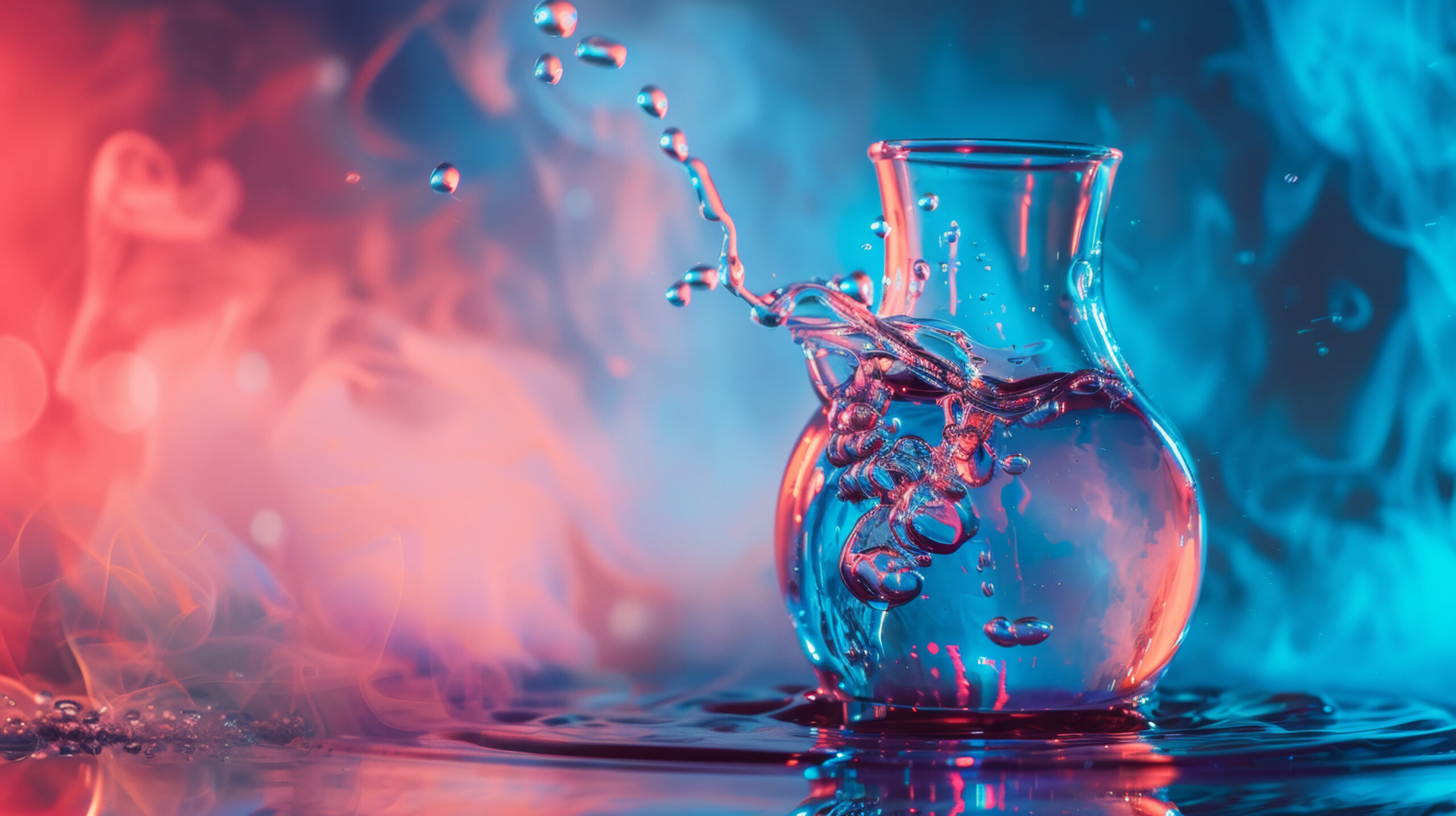
A dynamic and artistic capture of a water splash in a transparent vase, with vibrant colors and smoke creating a surreal effect.
Water is an extraordinary substance, making up around 70% of the Earth’s surface and 60% of the human body. We encounter it daily and rely on it for virtually every aspect of life, yet countless properties of water remain largely unknown.
In this article, we delve deep into 10 captivating, often surprising facts about water that go beyond the basics of hydration and water cycles.
These revelations will not only enhance your appreciation of this life-sustaining liquid but also expand your understanding of the science that governs the world around us.
The Mpemba Effect
Photo Credit: peshkova/23rf
One of the most counterintuitive phenomena in physics is the Mpemba Effect, which suggests that, under certain conditions, hot water can freeze faster than cold water.
Several factors contribute to this perplexing occurrence, including:
Evaporation Rates: Hot water evaporates more quickly, reducing the volume of water that needs to freeze.
Convection Currents: Hot water experiences stronger convection currents, which may promote quicker cooling.
Supercooling: Hot water is more likely to supercool, staying liquid below freezing temperatures before freezing suddenly.
The exact mechanisms behind the Mpemba Effect are still debated, but understanding it could have practical implications in industries ranging from food processing to cryogenics.
Water Can Be Supercooled
Water can exist as a liquid below its normal freezing point of 32°F (0°C), a state known as supercooling. This phenomenon occurs when water is cooled in a clean, smooth container with minimal impurities. In these conditions, water molecules do not form ice crystals, so it remains liquid even at temperatures as low as -40°F (-40°C).
Supercooling and Its Mysteries
When supercooled water is disturbed or comes into contact with an impurity, it can freeze instantly, creating a spectacular display of rapidly forming ice. Scientists are still studying supercooling, as it presents fascinating insights into the behavior of liquids at extreme temperatures.
Heavy Water
Most people know water as H2O, but water can exist in different forms depending on the isotopes present. One such variant is heavy water (D2O), which contains deuterium (an isotope of hydrogen) instead of regular hydrogen.
While it still behaves like water, its distinct properties make it vital for specific scientific applications, particularly in nuclear reactors.
The Role of Heavy Water
Heavy water has a higher density than regular water because deuterium is heavier. This unique feature allows it to slow down neutrons, which is crucial in nuclear fission reactions. However, it is not safe for human consumption due to its biological effects at higher concentrations.
Water’s Role as the Universal Solvent
Water’s status as the universal solvent is no exaggeration. Its ability to dissolve more substances than any other liquid makes it an essential component in life processes.
This remarkable property is due to the polarity of water molecules, which allows them to interact with a wide range of ionic and polar substances.
How Does Water Dissolve Substances?
Water molecules consist of one oxygen atom bonded to two hydrogen atoms, creating a dipole with a positive and a negative end.
This dipole allows water molecules to surround and break apart other molecules, facilitating chemical reactions necessary for life.
From the digestion of food in our stomachs to the transmission of electrical signals in our nervous system, water’s dissolving power is essential to biological functions.
Sodium displaces hydrogen ions from water, forming hydrogen gas and releasing significant heat. This reaction is highly exothermic and can result in dangerous explosions. This phenomenon serves as a reminder that even familiar substances like water can exhibit dangerous, unexpected reactions under the right conditions.
Sea Ice
Photo Credit: justlight77/123rf
Despite the salty oceans, sea ice is composed of nearly pure freshwater. This occurs due to a process called freezing-point depression, in which the salt in seawater lowers its freezing point, allowing only freshwater to freeze. As seawater freezes into ice, the salt is excluded, and the resulting sea ice is almost entirely freshwater.
The Importance of Sea Ice for Freshwater Access
This property of sea ice is crucial in polar regions, where freshwater resources are limited. The ability to melt sea ice for drinking water has been a vital resource for both humans and animals living in these extreme environments.
The Triple Point of Water
Water exhibits a unique property known as its triple point, which occurs when temperature and pressure conditions allow water to exist simultaneously in all three phases: solid (ice), liquid (water), and gas (steam). This delicate balance happens at exactly 0.01°C and 611.657 pascals of pressure.
Practical Applications of the Triple Point
The triple point of water serves as a fundamental reference in thermodynamics and is used to calibrate temperature and pressure measurement devices. This scientific concept is essential for creating accurate thermometers and barometers, ensuring precise measurement in both everyday and industrial applications.
Water’s Superionic Ice
Water can take on a fascinating form known as superionic ice, which exists under extreme pressure and temperature conditions, such as those found on the gas giants Uranus and Neptune. In this state, water behaves like both a solid and a liquid simultaneously.
The oxygen atoms form a crystalline lattice, while the hydrogen ions move freely within it as a liquid.
Superionic Ice and Its Implications
Superionic ice challenges traditional definitions of matter and has significant implications for our understanding of the universe.
This form of water could play a key role in the deep interior of gas planets and provide insights into the behavior of matter under extreme conditions.
Water’s Fifth State
At temperatures close to absolute zero, water can exist in a fifth state of matter: a Bose-Einstein condensate (BEC). In this state, water molecules lose their individual identities and behave as a single quantum entity.
This phenomenon occurs at extremely low temperatures and leads to unusual properties, such as superfluidity, in which the liquid flows without friction.
The Potential of BEC in Scientific Research
BECs are used in research to study quantum phenomena and develop technologies that rely on quantum properties, such as ultra-sensitive measurement instruments. Understanding BECs is a major area of study in quantum physics, with the potential for groundbreaking technological advancements.
The Unusual Nature of Negative Temperature Water
Photo Credit: liudmilachernetska/123rf
Under specific conditions, water can exist at temperatures below freezing without freezing. This phenomenon, known as negative-temperature water, occurs when water is cooled rapidly in a pristine environment free of impurities.
The absence of nucleation sites (places where ice can form) allows water to remain liquid at temperatures below 0°C.
Exploring the Potential of Negative Temperature Water
While negative-temperature water is rare, studying it could unlock new insights into the behavior of liquids under extreme conditions.
This phenomenon is closely tied to the study of supercooled water and could have applications in various fields, including cryogenics and space exploration.
Conclusion
Water is far more than just a life-sustaining liquid. Its fascinating properties, from freezing hot water to behaving like a hybrid of solid and liquid, challenge our understanding of matter itself.
The mysteries of water continue to unfold, offering opportunities for scientific discovery and practical applications across various fields.
Whether it’s the Mpemba effect or superionic ice, water’s surprising behaviors remind us that there’s always more to learn about the world around us.