

Hakeem Jeffries tried to do what party leaders usually do after bruising primaries: turn the page, congratulate the winners, and point Democrats toward November.
Instead, his message opened a fresh political wound.
The House Democratic leader publicly congratulated Democratic nominees in New York, including candidates backed by the Democratic Socialists of America. On the surface, it looked like routine party housekeeping.
In practice, it became another flashpoint in a much larger argument over where the Democratic Party is heading, who now holds influence inside it, and whether the party’s progressive wing is still an insurgent force or already part of the governing coalition.
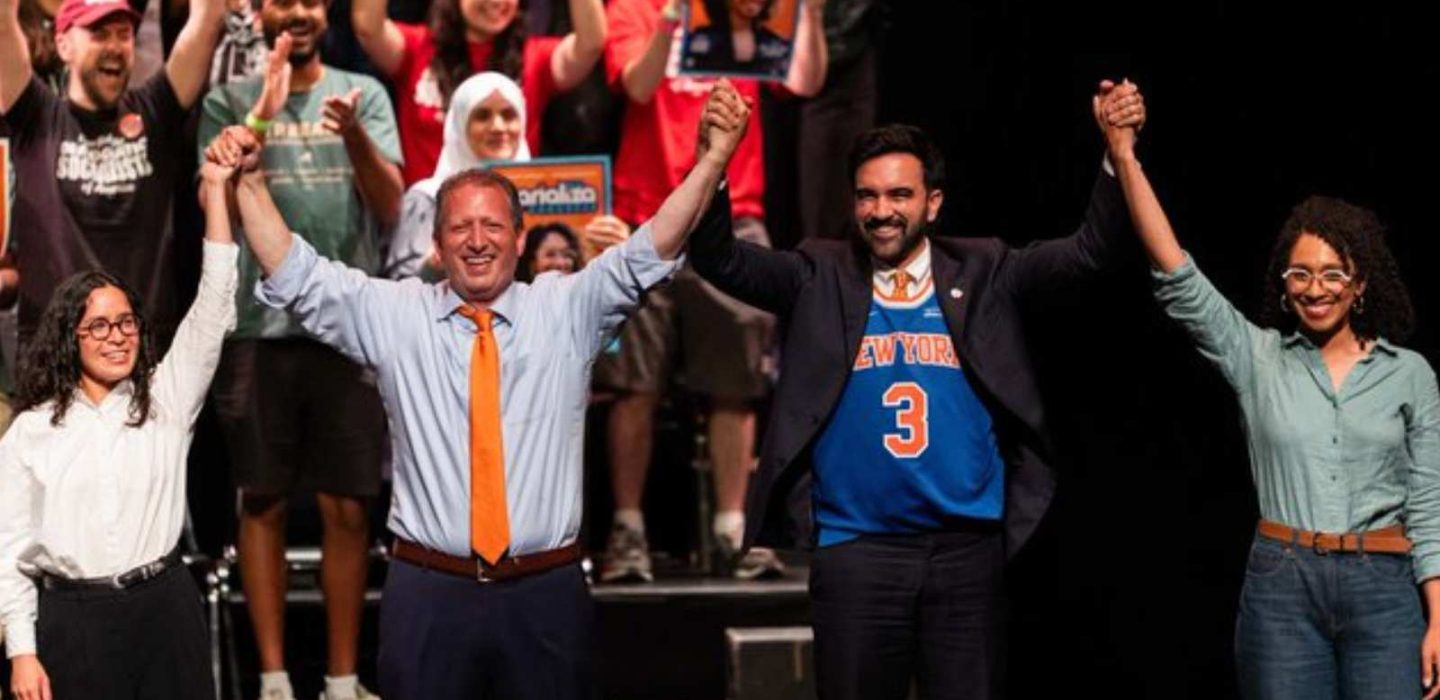
The names at the center of the fight are Brad Lander, Claire Valdez, and Darializa Avila Chevalier. Their primary victories did more than add new faces to the Democratic lineup. They sent a sharp message to establishment Democrats: in some deep-blue districts, the old rules no longer guarantee protection.
A Congratulatory Post With Heavy Political Baggage

Jeffries’ move was not shocking in a traditional sense. Party leaders usually support Democratic nominees once primary voters have spoken. That is how parties avoid open civil war before a general election.
But this moment carried more weight because several of the winners were not just ordinary Democratic challengers. They were associated with a progressive movement that has openly challenged the party’s older leadership, its foreign policy consensus, its policing positions, and its approach to economic power.
That is why the reaction was immediate. Critics saw Jeffries’ congratulations as more than unity. They saw it as acceptance. Some conservatives argued that Democrats were revealing the party’s true direction. Some centrist voices worried that the party was normalizing candidates whose views could become political liabilities outside safe Democratic districts.
Jeffries, however, faces a harder calculation. If Democrats want to retake the House, they cannot afford to alienate nominees in heavily Democratic seats. Yet if he fully embraces the party’s left flank, Republicans will likely use that image against Democrats in swing districts.
That is the trap: unity may be necessary, but unity now comes with a price.
New York Becomes the Party’s Ideological Testing Ground
New York has become one of the clearest windows into the Democratic Party’s internal struggle. The state is home to powerful establishment Democrats, wealthy donors, labor networks, progressive organizers, and an increasingly vocal socialist movement.
Those forces collided in the recent primaries.
The victories by DSA-backed and DSA-aligned candidates showed that progressive campaigns can do more than create noise online. They can organize, target vulnerable incumbents, and win.
Their message often blends economic frustration with moral urgency: rent is too high, wages are stretched thin, public services feel broken, and U.S. policy abroad is facing deeper skepticism among younger Democratic voters.
That message has power, especially in cities where voters feel priced out and politically ignored.
For establishment Democrats, the danger is obvious. If incumbency, fundraising, and leadership endorsements no longer provide safety, every senior Democrat in a blue district has to think differently. A primary challenge from the left is no longer a symbolic protest. It can be a serious threat.
Why Critics Are Sounding the Alarm
The strongest criticism focuses on what these victories may signal nationally. Republicans see an opportunity to brand Democrats as a party drifting toward socialism. That attack line is not new, but victories by candidates openly tied to democratic socialist politics give conservatives a clearer target.
The concern from some Democrats is different but just as serious. They worry that positions popular in deep-blue urban primaries may damage the party in suburbs, swing states, and competitive House races. Issues like policing, immigration enforcement, Israel, and public spending can play very differently depending on the district.
That creates a messaging problem. A candidate in Brooklyn or Queens may win by attacking the political establishment from the left. A Democrat in a competitive Pennsylvania, Arizona, or Michigan district may spend the next election trying to prove they are not tied to those same positions.
This is why Jeffries’ role is so delicate. He is not only a New York Democrat. He is the leader of a national caucus that includes progressives, moderates, suburban battleground Democrats, and members from districts that can flip with a small shift in voter mood.
He has to keep the family together while making sure one wing of the family does not define everyone else.
The Israel Divide Cuts Deeper Than Normal Policy Disagreement
One of the most emotionally charged parts of this fight is Israel.
Recent progressive victories have highlighted a widening split among Democrats over U.S. support for Israel, the war in Gaza, and the influence of pro-Israel groups in Democratic primaries. For many younger progressives, criticism of Israel’s government has become central to their politics. For many Jewish leaders, pro-Israel Democrats, and older party figures, the rhetoric from parts of the left has raised deep concern.
That divide is not just about foreign policy. It touches identity, morality, generational change, and donor power. It also creates painful tensions in a party that relies on both progressive activists and long-standing Jewish Democratic support.
Jeffries has often positioned himself as a disciplined institutional leader. But the rise of candidates more willing to challenge the party’s old foreign policy boundaries makes his job harder. He must speak to voters who want a sharper moral break from the status quo while reassuring others who fear that the party is tolerating rhetoric they see as dangerous or alienating.
This is not an argument that will disappear after one primary cycle. It is becoming one of the defining divides inside Democratic politics.
The Mamdani Factor and the Power of a New Left Machine
The influence of Zohran Mamdani adds another layer to the story. His backing for progressive candidates has made him more than a local figure. He now appears as a symbol of a new political machine built around affordability, tenant anger, anti-establishment energy, and disciplined grassroots organizing.
That matters because the left has often been dismissed as loud but disorganized. These wins challenge that assumption.
The new progressive strategy is not just a protest. It is candidate recruitment, field operations, endorsements, small-dollar energy, and targeted pressure on incumbents. It is learning how power works and then using those tools against the people who once controlled them.
That is what makes the establishment nervous. Movements become far more threatening once they stop only demanding power and start winning it.
Jeffries Is Trying to Hold a Party That Is Changing Under His Feet

Jeffries’ congratulations may have sounded simple, but the politics beneath it are anything but simple.
He is trying to lead a party that needs both energy and discipline. The progressive wing brings passion, younger voters, and a message that speaks directly to economic frustration. The moderate wing brings swing-district credibility, donor networks, and a path to national majorities.
Democrats need both sides, but both sides increasingly distrust each other.
Progressives believe establishment Democrats have moved too slowly, protected incumbents too aggressively, and failed to meet the urgency of the moment. Moderates believe the left is too willing to risk winnable elections on slogans that may thrill activists but frighten persuadable voters.
Jeffries sits between those camps. His public embrace of the nominees may have been a practical act of party leadership. Still, it also showed the limits of establishment control. Once voters choose the nominees, leaders can either accept the result or deepen the fracture.
Jeffries chose acceptance. Critics chose to call it exposure.
The Bigger Question for Democrats
The fight over these New York nominees is really a fight over the Democratic Party’s future identity.
Is the party becoming more openly populist, more skeptical of old alliances, and more willing to challenge capitalism from the left? Or are these victories still limited to a handful of safely Democratic urban districts?
That is the question Democrats cannot avoid.
For now, Jeffries is trying to project unity. But unity does not mean agreement. It means keeping the coalition from breaking long enough to win elections.
The socialist-backed victories in New York did not suddenly remake the Democratic Party overnight. But they did prove that the party’s left flank is no longer waiting politely outside the door. It is inside the room now, winning nominations, shaping debates, and forcing leaders like Jeffries to respond.
That is why one congratulatory post became such a loaded political moment. It was not just about three candidates. It was about a party, looking in the mirror, and arguing over what they saw.


