

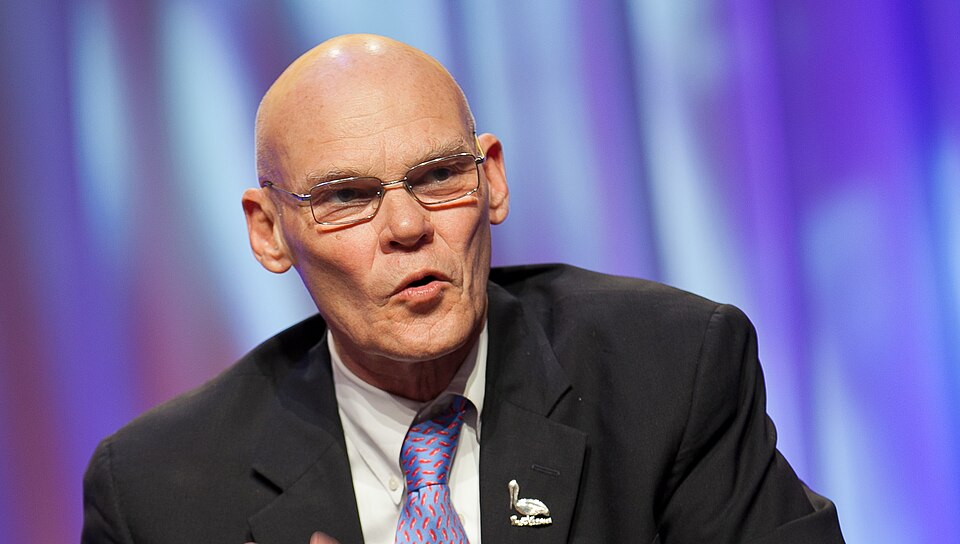
James Carville did not simply criticize President Donald Trump. He placed a date on his prediction, tied it to the 2026 midterms, and argued that the pressure of a major political rejection could push Trump to walk away from the presidency by Easter 2027.
That claim is not a fact. It is a political forecast from one of the Democratic Party’s most recognizable strategists. Still, the reason it is spreading is not only because Carville used dramatic language. It is spreading because it lands at a moment when Trump’s second term is already being judged by three interconnected problems: the cost of living, the war in the Middle East, and the looming fight for Congress.
We should read Carville’s prediction less as a crystal-ball moment and more as a sign of how Washington is preparing for a brutal midterm season. The presidency is not on the ballot in November 2026, but Trump’s power is. Every House seat is politically exposed, control of the Senate is in play, and Republicans are being forced to defend an administration facing weak approval on affordability.
Why Carville’s Trump Prediction Is Getting Attention Now

Carville’s argument rests on a simple idea: Trump, in his view, is not built for the kind of political humiliation that could follow a sweeping midterm defeat. He has made versions of this prediction before, but the latest version sharpened the timeline and pushed the phrase “walk away” into the center of the story.
The timing matters. The 2026 midterm elections are scheduled for November 3, and the outcome could determine whether Trump spends the final two years of his term working with a Republican Congress or fighting a Democratic House with subpoena power.
That is the real pressure point behind the prediction. If Democrats take the House, Trump would face a far more hostile Washington. Oversight hearings could intensify. Investigations could multiply. Cabinet officials, agency heads, and White House allies could be summoned before committees. Even if impeachment remains uncertain, the threat of formal accountability would become much more serious.
Carville’s theory depends on that possible chain reaction. A midterm backlash would not just be a bad news cycle. It could reshape the daily reality of the presidency.
The Midterms Are Becoming a Referendum on Trump’s Second Term
Midterm elections often become a public judgment on the president in power. That pattern is especially dangerous for a president whose brand dominates his party. In 2026, Republican candidates are not just running on local issues. Many are also running with Trump’s record attached to them.
For Republicans, that creates a difficult balance. They need Trump’s base, but they also need swing voters who are frustrated with prices, gas costs, and political chaos. They need turnout from loyal conservatives, but they cannot ignore independents who may decide control of Congress.
For Democrats, the strategy is equally clear. Their strongest argument is not just that Trump is controversial. It is that daily life has become too expensive and unstable under Republican control. That message is easy to understand because it begins at the grocery store, the gas station, the rent bill, and the insurance statement.
That is why Carville’s prediction has legs. It connects Trump’s personal style with a broader political environment that could punish Republicans if voters decide the country feels worse, not better.
The Cost of Living Is the Political Problem Trump Cannot Spin Away

The affordability issue is the center of the story. Trump returned to office promising to control inflation and ease household pressure. Yet many Americans are still measuring the economy by what they pay every week, not by stock market headlines or speeches from Washington.
Recent inflation data shows why this is so damaging politically. Energy prices have been a major driver of rising costs, and gasoline has remained a sensitive pressure point for families, commuters, rural voters, and small businesses. Food prices have also kept household budgets under strain, especially for families already living close to the edge.
This is where the politics becomes personal. A voter may not follow every congressional fight, but that same voter knows what it costs to fill a tank, buy eggs, pay rent, or renew car insurance. When those prices rise, blame often moves toward the party in power.
That is why Democrats are pushing affordability so hard. It is not just a slogan. It is the issue most likely to travel across party lines, especially among working-class voters, independents, and rural households who supported Trump but now feel squeezed.
The Impeachment Question Is Quietly Back in the Room
Democratic leaders are not centering their midterm pitch on impeachment. They are centering it on affordability. But that does not mean accountability talk has disappeared.
House Democratic Leader Hakeem Jeffries has said Democrats have not ruled anything in or out regarding accountability, while also stressing that the party’s focus is on lowering the cost of living. That careful language matters. It avoids promising impeachment, but it also leaves the door open.
For Trump, that door matters because a Democratic House would control committees, hearings, and investigative priorities. A president can survive oversight politically, but it changes the atmosphere around an administration. Every document request becomes a headline. Every aide becomes a possible witness. Every agency decision becomes a possible hearing.
Carville’s argument depends heavily on that environment. He appears to believe Trump would not want to live under two years of subpoenas, televised hearings, and reduced power after a major midterm defeat.
Why Republicans Cannot Ignore the Warning
Even if Carville is wrong about resignation, Republicans cannot ignore the warning embedded in his argument. A president does not need to quit for a midterm defeat to damage him. Losing Congress would be enough to change the final stretch of Trump’s second term.
A Democratic House could block priorities, investigate the administration, and force Republicans into defensive votes. A tighter Senate or a Democratic Senate would create even bigger problems. Judicial nominations, confirmations, budgets, and foreign policy fights would all become harder.
Republican candidates know this. Some may run directly with Trump. Others may try to localize their races and focus on crime, immigration, taxes, or cultural issues. But the national mood will be hard to escape if voters believe the country is moving in the wrong direction.
That is why the midterms are not just another campaign season. They are a stress test for Trump’s second-term coalition.
The White House Response Shows the Stakes

The White House did not treat Carville’s prediction as harmless punditry. It responded with a personal attack, dismissing him as a partisan critic obsessed with Trump.
That kind of response may appeal to Trump’s supporters, who see Carville as another Democratic voice predicting doom. But it also keeps the story alive. A quiet dismissal would have reduced the temperature. A sharp insult turned the exchange into another chapter in the larger Trump-era media war.
This is familiar territory. Trump’s political world often responds to attacks by escalating them. That strategy can energize supporters, but it can also keep unfavorable narratives in circulation longer than necessary.
In this case, the unfavorable narrative is not just that Carville dislikes Trump. Some Democrats believe Trump’s presidency could enter a crisis phase after November.
Carville’s Real Message Is About Power, Not Easter
The Easter 2027 deadline makes the prediction catchy. But the deeper issue is power.
If Republicans hold Congress, Trump’s second term becomes far easier to manage. If Republicans lose one or both chambers, Trump’s final two years will become a fight over survival, oversight, and legacy. That is the battlefield Carville is pointing toward.
The presidency is powerful, but it is not isolated. It depends on Congress, public approval, party discipline, donor confidence, and the belief that the president still has momentum. A bad midterm can weaken all of those at once.
That is why Carville’s prediction sounds dramatic but sits on a real political foundation. He may be wrong about the ending, but he is identifying the correct pressure points.
The Bottom Line for Voters Watching This Story
For voters, the question is not whether James Carville can predict the future. The question is whether the 2026 midterms will become a national breaking point for Trump’s second term.
If prices remain high, if gas costs continue to sting, if the Middle East conflict keeps shaping the economy, and if Democrats maintain an advantage on affordability, Republicans could face a painful November. If that happens, Trump would enter 2027 with less room to maneuver and more powerful enemies.
That does not mean he will resign. It does mean the final two years of his presidency could look very different from the first two.
Carville has placed a bold bet that Trump will walk away. The safer conclusion is that the midterms may decide whether Trump governs from strength or spends the rest of his term fighting off a political siege.
Read the original story on Crafting Your Home


