


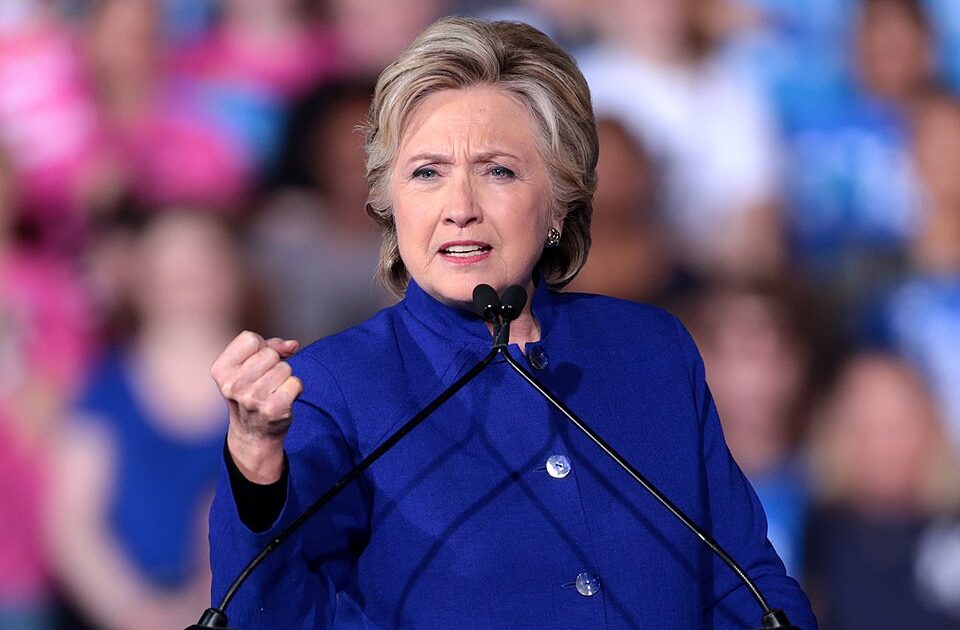
Hillary Clinton has escalated the fight over President Donald Trump’s decision to place Bill Pulte at the top of the U.S. intelligence system, warning that Americans should be “worried about everything” connected to Pulte’s temporary control of the Office of the Director of National Intelligence. Her comments, made during an appearance on Marc Elias’ Democracy Docket podcast, turned what could have been treated as another Trump personnel controversy into a broader national security argument about qualifications, access to classified information, election security, and political loyalty inside one of the most sensitive offices in Washington.
The concern is not simply that Pulte is a political ally of Trump. The deeper issue is that the acting Director of National Intelligence sits at the center of America’s intelligence system, with visibility into the work of agencies that track terrorism, foreign influence, cyber threats, military risks, espionage, nuclear proliferation, and election interference. The DNI is responsible for leading intelligence integration across the U.S. Intelligence Community and advising the president and national security councils on intelligence matters.
Why Bill Pulte’s Acting DNI Appointment Sparked Immediate Alarm

Bill Pulte was sworn in as director of the Federal Housing Finance Agency in March 2025, a role that placed him in charge of Fannie Mae, Freddie Mac, and the Federal Home Loan Banks. That housing background is now central to the controversy because critics argue it does not resemble the usual path to the nation’s top intelligence post.
Trump appointed Pulte as acting Director of National Intelligence in June 2026 after Tulsi Gabbard’s departure from the role, and later said Pulte would serve only for a “short period” while Jay Clayton awaits confirmation for the permanent job. That temporary label has not calmed critics, because even an acting DNI can sit inside the flow of highly sensitive national security information.
Clinton’s warning focused on that access. Her argument was that the DNI role was created after the September 11 attacks to improve coordination among intelligence agencies, not to become a partisan command post. The ODNI was established under the Intelligence Reform and Terrorism Prevention Act of 2004, following the 9/11 Commission’s recommendations for major changes to how intelligence was shared and coordinated across government.
The Post-9/11 Purpose of the Director of National Intelligence
To understand the intensity of Clinton’s criticism, we have to understand what the DNI was designed to do. Before the ODNI existed, intelligence responsibilities were spread across agencies with different cultures, priorities, and reporting lines. The post-9/11 reform effort was built around one urgent lesson: dangerous signals can be missed when agencies fail to share information quickly and clearly.
The DNI became the official responsible for coordinating national intelligence and helping ensure that information reaches the president, executive agencies, military leaders, and Congress. Federal law gives the DNI broad responsibilities involving intelligence delivery, budget guidance, coordination, and oversight across the National Intelligence Program.
That means the office is not symbolic. It is a powerful gateway. The person in that role can influence what intelligence is prioritized, what gets elevated to the White House, how agencies coordinate, what gets declassified, and how intelligence is framed during moments of national crisis.
Clinton’s Core Argument: A Political Loyalist Should Not Control the Intelligence Hub
Clinton described Pulte as dangerous and argued that his appointment amounted to a partisan takeover of the intelligence leadership structure. Her concern was sharpened by Pulte’s lack of direct national security experience, an issue that has also been raised by lawmakers and intelligence observers since Trump announced the appointment. Reuters reported that Pulte came into the role with no national security experience while continuing to lead the FHFA.
The legal concern is tied to the statute governing the DNI position. Federal law says that any individual nominated for appointment as Director of National Intelligence must have “extensive national security expertise.” Clinton’s proposed lawsuit theory would likely test how that requirement applies to an acting director who has not been nominated for the permanent job.
That is why the acting title matters. The administration can argue that Pulte is not the permanent nominee and that Jay Clayton is the intended Senate-confirmed director. Critics can argue that the acting role still places Pulte in the same operational chair, with the same access to sensitive intelligence throughout his service.
The Mortgage Fraud Controversy Following Pulte From FHFA
Pulte’s housing record has become part of the national security debate because critics see a pattern: a powerful federal post used aggressively against Trump’s opponents. The Associated Press reported in 2025 that Pulte had used property records to make mortgage fraud accusations against Trump critics and encourage criminal investigations. Those allegations became politically explosive when Trump used claims publicized by Pulte to remove Federal Reserve Governor Lisa Cook.
That background is why Clinton and other critics are not treating the acting DNI appointment as a normal temporary staffing move. They see a figure who already attracted criticism for the politicized use of federal authority now being placed over intelligence systems that handle foreign threats, election security risks, classified assessments, and declassification decisions.
The administration’s defenders can point to Trump’s position that Pulte is only serving temporarily and that Clayton is intended for the permanent job. But for critics, temporary service is still consequential when the office involved handles the most sensitive intelligence in the federal government.
Trump’s Declassification Comments Intensified the Dispute

The controversy intensified after Trump said Pulte had the authority to declassify records, including material related to the 2020 election. Reuters reported that Trump said his acting spy chief was free to declassify records, while Pulte remained in temporary control of ODNI.
That matters because declassification is not simply an administrative act. It can shape public narratives, expose sources and methods if mishandled, affect ongoing investigations, and influence election-related messaging. In a highly polarized political environment, critics worry that selective declassification could turn intelligence into a political weapon.
Clinton’s election-interference concern sits directly inside that context. If the acting DNI has access to intelligence on foreign influence operations, cyber activity, threats to voting infrastructure, or past election disputes, then the public fight becomes bigger than Pulte’s resume. It becomes a question of trust in the firewall between intelligence and campaign politics.
Why Jay Clayton’s Nomination Has Not Ended the Debate
Trump’s plan to nominate Jay Clayton as the permanent DNI has not alleviated the central concern, as Pulte is already serving in the acting role. Clayton, a former Securities and Exchange Commission chairman and U.S. attorney for the Southern District of New York, is awaiting confirmation steps while Pulte remains in place temporarily.
The longer the confirmation process takes, the more consequential Pulte’s acting tenure becomes. A temporary official can still make staffing decisions, request records, influence internal priorities, receive sensitive briefings, and participate in declassification decisions.
That is why the debate is moving from “Who is the nominee?” to “Who has power right now?” In national security, timing is everything. A few weeks can matter if the acting official is handling intelligence connected to elections, foreign adversaries, military threats, or politically sensitive records.
The Staffing Question Inside ODNI
Pulte’s arrival also drew attention due to reports of possible personnel cuts. Reuters reported that CNN said Pulte was seeking to fire hundreds of ODNI staff members, with concerns raised by Rep. Jim Himes, the ranking Democrat on the House Intelligence Committee.
Staffing at ODNI is not an ordinary bureaucracy story. Career intelligence officials hold institutional memory. They know how agencies coordinate, how foreign influence threats are tracked, how sensitive collection is protected, and how intelligence products are reviewed before reaching top decision makers.
A major staffing shakeup under an acting director with no background in intelligence would naturally raise questions about continuity. Supporters may describe cuts as reform or streamlining. Critics see the risk of weakening the very coordination system created after 9/11.
The Legal Question Clinton Wants Tested
Clinton’s call for litigation is rooted in one clear dispute: can someone without extensive national security expertise serve as acting DNI when the permanent role carries a statutory expertise requirement? The text of 50 U.S.C. § 3023 says a nominee for DNI must have extensive national security expertise, but