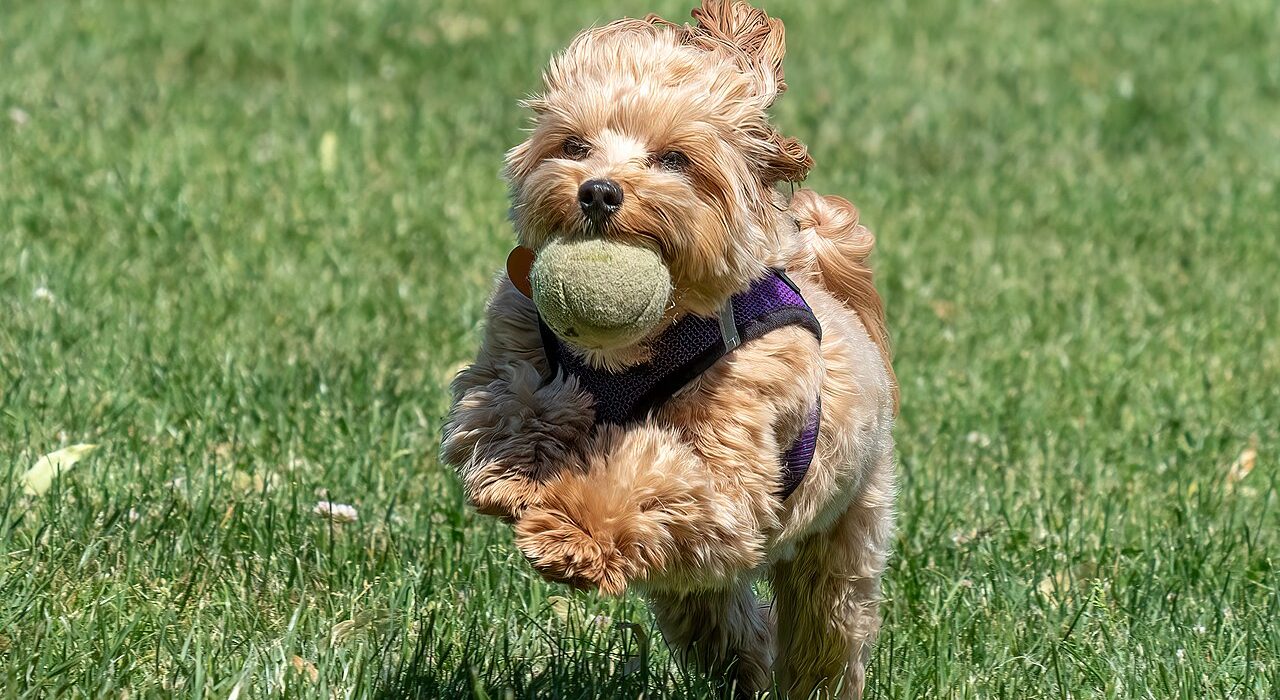


A dog that tilts its head at the word “ball” might be doing more than waiting for a treat. Researchers in Budapest recorded the brains of 18 dogs and found that activity changed depending on whether a toy matched the name just spoken.
The result, published in Current Biology in March 2024, is among the most direct looks yet at what dogs may understand about everyday words. Here is how the experiment worked, what the brain recordings showed, and what the scientists say it does and does not prove.
How the Experiment Worked

According to a March 22, 2024 EurekAlert release, the team at Eotvos Lorand University tested 18 dogs and their owners. Each owner said the name of a toy the dog knew, then showed either the matching toy or a different object. Researchers wrote the setup up under the title “Neural evidence for referential understanding of object words in dogs.” It is the sort of experiment that sounds simple until a dog is asked to sit still while wearing sensors, and plenty of smart herding breeds would likely have opinions about the sitting still. Owners are used to research of their own, from vet advice to gadget shopping, as a look at whether a self-cleaning litter box is worth it shows.
Brain activity was recorded with non-invasive EEG, so the dogs did not have to fetch, choose or do anything at all. The researchers said that approach could be a more sensitive measure than active-choice tests, and the ScienceDaily write-up gives the example of an owner saying “Zara, look, the ball” while presenting a ball. That quiet method suits pets that spend a good deal of time mirroring their owners’ routines and emotions anyway.
According to science writer Mary Bates in Psychology Today, owners were recruited only if their dogs already knew at least five object words, and the dogs wore external electrodes during testing. Those dogs come from a long line of companions, since many breeds have roots reaching back centuries of life beside people, and the owners who volunteered are the kind of pet people described in research on how dog people and cat people differ. Daily time together, the kind a guide to work-life balance urges people to protect, is also what builds a shared vocabulary.
What the Brain Recordings Showed
The key result is a difference between two conditions. Dogs’ brain activity looked different when the object matched the spoken word than when it did not, a pattern the researchers compare to what is seen in humans and is widely taken as evidence of word understanding. The Psychology Today article reports that it appeared in a time window comparable to the human one, and describes it as the first neural evidence for object word knowledge in a nonhuman animal.
The effect was larger for words the dogs knew better. That is the detail that makes the finding feel less like a quirk and more like real learning, the kind that comes from repetition, much as daily little rituals stick in memory. A dog with a firm grip on the word “ball” showed a bigger difference than one with a shakier grasp of it, and a guide to gentle parenting would add that patient, consistent talk is how any young learner builds vocabulary.
Vocabulary size did not matter. The researchers had expected dogs with more object words to show the effect more strongly, but the pattern held regardless of how many words a dog knew. The university’s Department of Ethology concludes this suggests the ability is widespread among dogs, not limited to a few exceptional word-learners.
What the Scientists Say It Means
Researcher Marianna Boros says that when dogs hear a known word, they activate a memory of the object, and that dogs do not only react to certain words with a learned behavior. The finding hints at something a bit more flexible than a trained response.
Co-author Lilla Magyari puts the broader point plainly: dogs understand more than they show signs of. Bates quotes a related line from the study’s lead author, noting that dogs “might passively grasp those meanings.” The word passively matters. Understanding a word and acting on it are different things, and a dog that ignores a request may still know exactly what was said.
The Limits of 18 Dogs
The study is small. Eighteen dogs is a modest sample, and the dogs were chosen because their owners had already taught them object words, so the results do not say how an average dog would do. The interpretation that the dogs grasp meaning in a way comparable to people is the researchers’ own conclusion from EEG patterns, and the EurekAlert text itself notes that its content may have been edited.
Several questions remain open. The team wants to know whether the ability appears in other mammals, how it developed, whether it depends on living with people, and why more dogs do not show it in standard behavioral tests. Psychology Today adds that such tests are often confounded by energy, motivation and task understanding, and that the findings concern passive understanding.
For now, the practical takeaway is gentle. Dogs may call up a mental picture of the things they hear named, according to the researchers, so naming toys, treats and places is probably not wasted breath.
Get stories like this by email. Sign up for Crafting Your Home.
This article was produced with AI assistance and edited for accuracy against the sources linked above.
Image: Rhododendrites – CC BY-SA 4.0/Wikimedia Commons