
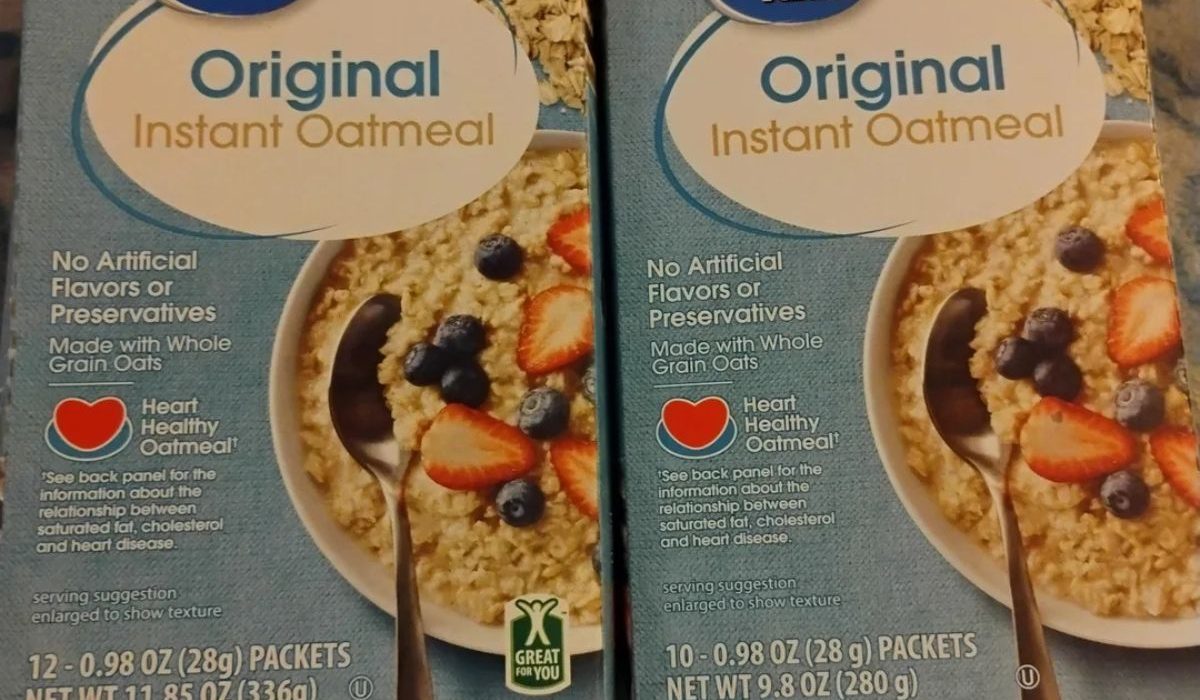


The post Did Shrinkflation Just Catch Walmart’s Great Value Oatmeal? Shoppers Say the Box Dropped From 12 Packets to 10 first appeared on Crafting Your Home.
Consumer observation across retail aisles often signals shifts in product sizing before official corporate filings record changes in net weight.
On store shelves nationwide, shoppers purchasing store-brand breakfast staples have noted a distinct structural shift in packaging dimensions.
Walmart’s proprietary line, Great Value, faces growing public scrutiny over its instant oatmeal lineup as package tallies decrease while shelf prices remain unchanged.
The arithmetic of reduced volume on grocery shelves

Standard retail inventory records show that store-brand instant oatmeal boxes traditionally contained 12 individual serving packets per container. Recent shelf inspections and inventory receipts confirm that select varieties of Great Value instant oatmeal now land on distribution pallets containing only 10 packets per box. This shift represents a 16.6% reduction in physical product quantity per unit purchase.
Corporate price tracking across retail supply networks reveals that the unit price per box maintained its existing baseline despite the drop in net content weight. When net volume decreases while total shelf price stays flat, the effective cost per unit weight rises immediately for the end consumer.
Statistical tracking from the Bureau of Labor Statistics shows that consumer price index metrics for food-at-home items rose consistently over preceding fiscal quarters. Manufacturers and private-label retail distributors frequently adjust physical package metrics rather than sticker prices to manage rising wholesale supply chain costs.
Supply chain pressures reshaping private label packaging
Raw commodity benchmarks explain much of the pressure leading to retail packaging reconfigurations. According to trade data from the United States Department of Agriculture, international oat grain yields have been highly volatile because of regional climate shifts and transport bottlenecks. Increased agricultural input costs directly elevate processing expenses for private label suppliers that manufacture store-brand goods for mass retailers.
Retail market metrics compiled by the Food Industry Association indicate that private label sales grew substantially as shoppers sought alternatives to higher-priced national brands. Store brands rely on slim operating margins, making them highly sensitive to small increases in packaging materials, milling labor, and shipping tariffs.
To preserve gross margin percentages without pushing sticker prices past psychological consumer thresholds, retail buyers alter package specifications. Dropping two internal pouches per box lets distributors maximize shipping container space, reduce corrugated cardboard use, and offset higher ingredient costs at the same time.
Related Post: 10 grocery-items-americans-are-cutting-back-on-due-to-inflation
Economic indicators mark a systematic shift in food packaging
Economist E.J. Antoni of the Heritage Foundation noted in economic policy briefings that non-price inflation mechanisms directly alter consumer purchasing power. Reducing volume while keeping prices fixed acts as an implicit price increase, distorting long-term cost comparisons for household budgets.
Data from the Federal Reserve Bank of St. Louis show that average household expenditure on processed grain products surged compared with pre-2020 baseline figures. While headline inflation rates may appear stabilized on official indices, volumetric reduction skews real-world expenditure figures.
Federal Trade Commission guidelines require that product labels clearly state net weight metrics on the front display panel of all consumer packaging. While reducing internal packet counts without changing outer box designs remains fully compliant with federal trade law, it relies on established consumer buying habits where shoppers look at retail price tags rather than net weight declarations.
Consumer sentiment and market mechanics in mass retail

Consumers are far more price-elastic based on visible shelf tags than on changes in volumetric weight. Shoppers notice an immediate dollar increase at the register but frequently overlook minor reductions in package volume during routine shopping trips.
A competing view suggests package resizing is a necessary mechanism to prevent severe demand destruction. If retailers raised flat box prices to match raw-ingredient inflation, consumer drop-off would accelerate rapidly, hurting both retail volume and manufacturer supply agreements.
Retail analysts from the National Retail Federation report that private-label shoppers prioritize absolute dollar outlays at checkout over precise unit-cost efficiency. Maintaining accessible entry-level price points ensures low-income households can still access basic pantry items without immediate cash-outlay shocks.
Related Post: 7 Alarming Ways Rising Costs Are Shrinking the American Grocery Cart
Regulatory oversight and statutory labeling frameworks
State departments of weights and measures monitor retail establishments to verify that shelf labels accurately match point-of-sale scanner outputs and physical package contents.
Legal precedents under consumer protection statutes clarify that manufacturers have complete discretion over product sizing, provided the declared net weight on the exterior package accurately reflects the internal contents. Unless a box contains deceptive empty space exceeding statutory allowances, known as non-functional slack fill, packaging alterations do not violate federal trade statutes.
Net quantity declarations must appear prominently on the principal display panel in both avoirdupois and metric systems. So long as the numerical count of 10 packets is explicitly listed, the transition fulfills all legal requirements under the Fair Packaging and Labeling Act.
Long-term implications for household pantry budgets
The shift from 12-packet to 10-packet boxes changes weekly grocery purchasing power for middle- and low-income households. Households that rely on structured meal planning must buy more units over shorter calendar cycles to maintain the same consumption levels.
Cumulative stealth inflation across multiple pantry staples significantly compounds annual household food expenditures. When grain items, dairy products, and canned goods undergo concurrent sizing reductions, real grocery costs escalate faster than reported headline consumer price indices.
Retail inventory trends suggest package reconfigurations rarely revert to larger volumes, even when raw commodity prices normalize in global markets. Once distribution networks adapt to streamlined package dimensions, the reduced volume becomes the new industry baseline for store-brand retail products.


