


The post Cats Don’t Rub Against You Just to Be Sweet — Here’s What They’re Really Doing first appeared on Crafting Your Home.
When your cat winds around your ankles or presses a cheek against your hand, it may look like a simple request for cuddles. The real explanation is a little more interesting.
Cats use rubbing as part of their communication. The same behavior can involve leaving scent, greeting someone familiar, building social connections, investigating a person, or asking for attention. That means the affectionate interpretation is not necessarily wrong. One small feline gesture can simply be doing several jobs at once.
So, what is your cat actually doing when it gives you that determined cheek rub? Here are seven possibilities worth knowing.
They’re Leaving Their Scent on You
That cheek rub is not just physical contact. Your cat is also leaving scent behind.
Cats have scent-producing glands around areas of the face, including the cheeks, chin, and forehead. When they rub their head or body against a person, another animal, or an object, they can deposit secretions from those glands. The Merck Veterinary Manual identifies rubbing as one of the ways cats use scent as part of communication.
That does not mean your cat is stamping you with a tiny invisible “property of Fluffy” label. Describing the behavior simply as ownership or dominance goes beyond what the evidence supports.
A better way to think about it is that your cat is combining familiar scent with social contact.
Related: Why Cats Hate Closed Doors, According to Feline Behavior Experts
It Can Be a Form of Social Bonding
Cats also rub against individuals they have social relationships with.
The broader term for this behavior is allorubbing, which means rubbing the head or body against another individual. International Cat Care lists rubbing alongside behaviors such as nose touching and resting together as forms of tactile communication between cats. Rubbing can also help exchange scent.
When your cat weaves around your legs, it may be using a behavior that also appears in friendly interactions with other cats.
It is tempting to translate that as “You’re officially part of my family,” but that’s a little too neat. Social affiliation is supported, while exact translations of what a particular rub “means” are not.
Your Cat May Simply Be Saying Hello
Ever notice how the rubbing often starts the minute you walk through the door?
That timing makes sense. Cats commonly rub against people as part of a greeting. International Cat Care explains that your legs are an easy target for the kind of face-and-body rubbing a cat might use when greeting another cat.
You may also hear the word bunting. That usually describes head rubbing or head bumping, while allorubbing is the broader term for rubbing against another individual.
So that enthusiastic head bump after you get home may be your cat’s version of a social hello, complete with scent exchange.
Related: Why Do Cats Purr? Scientists Are Still Figuring It Out
They Might Want Something From You
Of course, sometimes the explanation is wonderfully practical.
Cats may rub against people when seeking food, attention, or play. Context is what matters. A cat circling your ankles beside the food cupboard may have a very different immediate goal from one rubbing against you during a relaxed reunion on the couch.
Your own response can also become part of the routine. If rubbing regularly leads to petting or another desired response, the cat may learn that rubbing is an effective way to get your attention.
That still does not give you a perfect cat-to-human dictionary. Rubbing alone cannot reliably tell you whether your cat wants dinner, playtime, affection, or something else.
They Could Be Investigating Your Smell
Cats pay close attention to scent, including human scent.
A 2025 PLOS One study tested 30 domestic cats using samples containing their owner’s odor, an unfamiliar person’s odor, and a blank control. The cats spent longer sniffing the unfamiliar human odor, averaging 4.82 seconds, compared with 2.40 seconds for their owner’s odor and 1.93 seconds for the blank sample.
Researchers also observed some cats rubbing their faces against the testing apparatus after sniffing it and suggested there could be a connection between investigating an odor and later marking.
The study does not prove that cats can identify a particular person by smell alone, and it does not establish exactly why a cat rubs after sniffing someone. It does show that familiar and unfamiliar human odors prompted different responses under those test conditions.
Rubbing Does Not Always Mean “Pet Me”
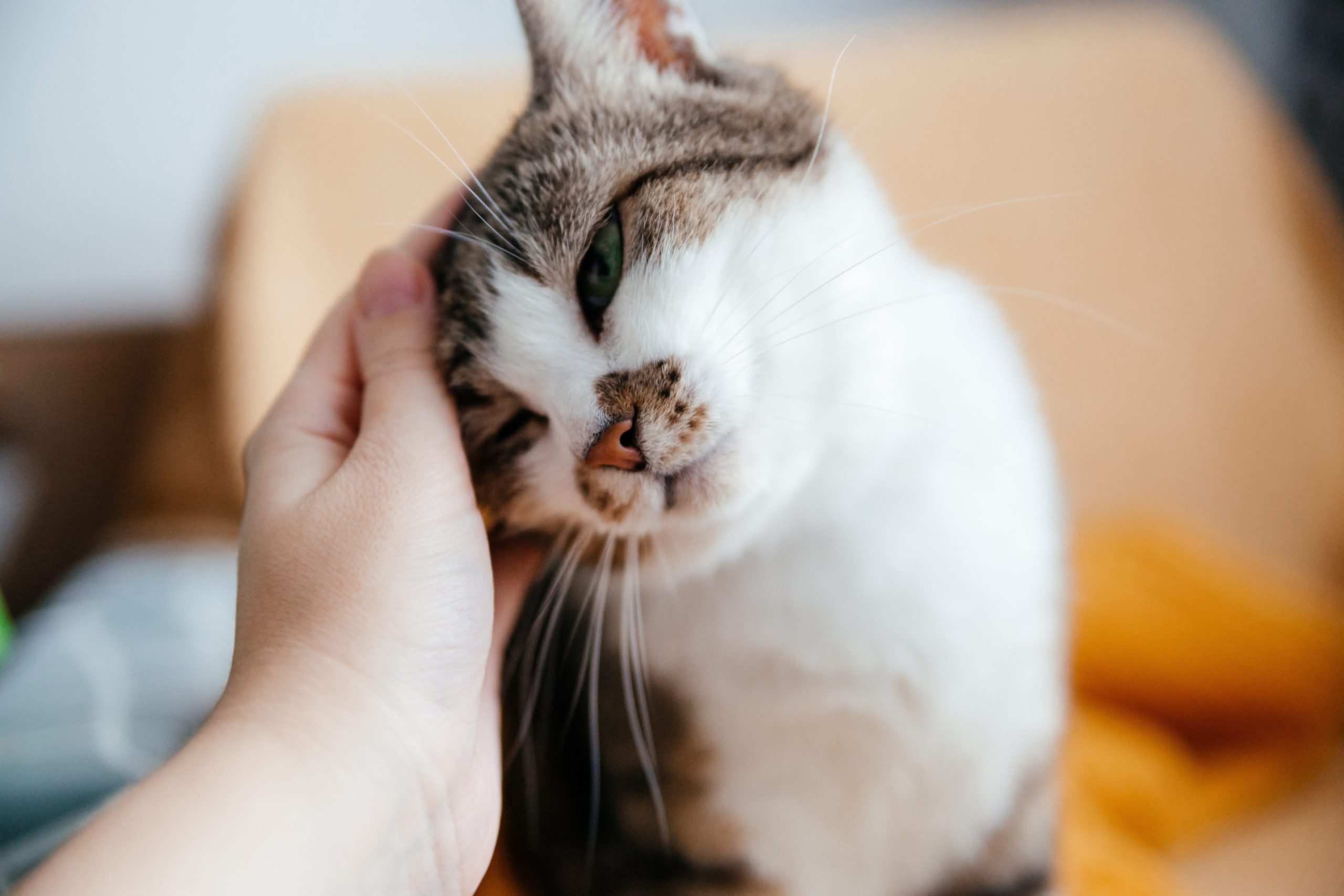
Here is where cat communication gets especially easy to misread.
If an unfamiliar cat rubs against you, you may naturally reach down to start petting. But rubbing doesn’t automatically mean the cat wants to be handled.
A cat meeting someone new may also be investigating that person. PetMD’s veterinary explanation cautions that rubbing against a new person does not necessarily mean the cat wants petting.
Instead of treating every rub as an invitation to scoop the cat up, pay attention to the wider interaction and let the animal set the pace.
No, Your Cat Is Probably Not “Claiming” You
The popular explanation that cats rub against people because they are “claiming ownership” is catchy, but it is too simplistic.
Kristyn R. Vitale’s 2018 review in the Journal of Feline Medicine and Surgery distinguishes between scent associated with rubbing on objects and scent associated with social rubbing involving cats, humans, or other species. The evidence fits better with ideas such as familiarity, scent exchange, and social affiliation than with literal ownership.
So when your cat bumps its forehead against your hand and then loops around your ankles, you do not have to choose between “affection” and “scent marking.” Both social contact and scent communication can be happening during the same interaction.
That is what makes the behavior so interesting. A rub that lasts only a few seconds can function as a greeting, a social exchange, a scent signal, an investigation, or a very efficient reminder that your cat would like your attention right now.
Other Posts You Might Like
-
The ‘Cats Are Loners’ Myth Is Wrong: What Research Shows About Cats’ Social Lives
-
Why Black Cats Are Lucky in Some Countries and Unlucky in Others
-
How Cats Land on Their Feet: The Physics Behind the Feline Righting Reflex
If you like what you just read, then subscribe to our newsletter and follow us on social media.


