


The post Attention Boomers: Millennials Now Outnumber You at the Ballot Box first appeared on Crafting Your Home.
The political weight of older Americans has long been tied to a simple advantage: there have generally been a lot of them, and they have tended to vote at higher rates than younger adults.
That equation is changing significantly.
Millennials have already surpassed Baby Boomers as the largest living adult generation, according to population estimates analyzed by Pew Research Center. In 2019, Pew put the Millennial population at 72.1 million, compared with 71.6 million Boomers.
That does not mean Millennials have literally overtaken Boomers at the ballot box. The distinction matters because the number of people in a generation and the number who actually vote are two different measurements.
The latest national presidential-election data, from 2024, show older voters still made up the larger share of people who cast ballots. Pew found that 56% of voters were at least 50, while 44% were younger than 50.
Still, the demographic balance underneath American elections is moving
Millennials are already larger than Boomers as a living generation
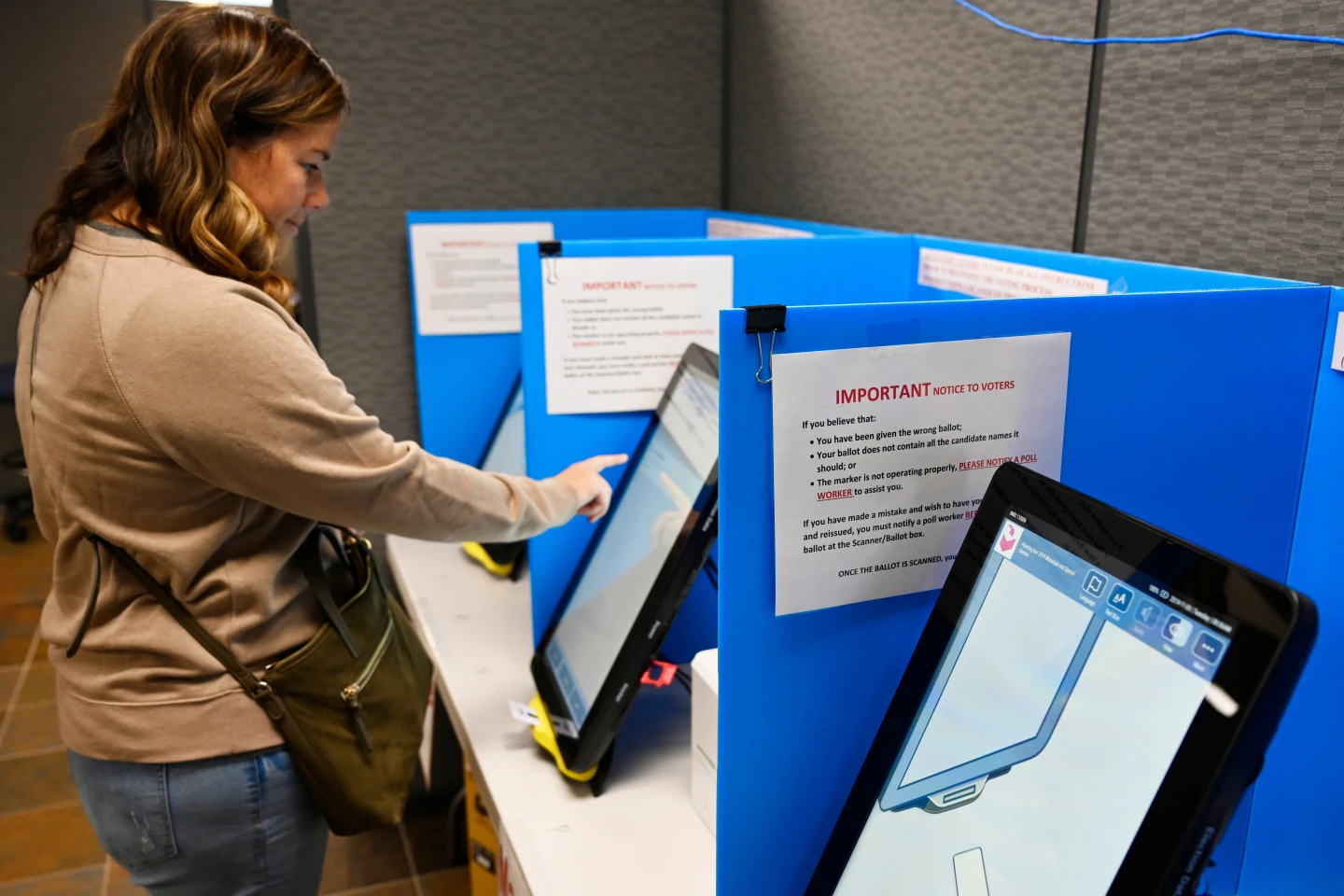
The demographic shift is real even if the headline needs a qualification.
Pew Research Center uses 1981 through 1996 as the Millennial birth range and 1946 through 1964 for Baby Boomers. The organization also cautions that generational boundaries are analytical tools, not biological or official divisions.
Using those definitions, Millennials overtook Boomers in population by 2019. Pew’s analysis of Census Bureau estimates found that Millennials numbered 72.1 million that year, while Boomers numbered 71.6 million.
The difference was small, but the direction was significant.
Immigration also matters. Pew noted that Millennials continued to gain population partly because immigration adds members to the cohort, while the Boomer population declined as deaths began to exceed the number of older immigrants entering the country.
So the electorate’s demographic foundation is getting younger, even as the electorate remains considerably older than the population as a whole.
The ballot box still has an older center of gravity
The most important complication is turnout.
In the 2024 presidential election, the U.S. Census Bureau estimated that 65.3% of the citizen voting-age population voted, representing about 154 million people. About 73.6%, or 174 million citizens of voting age, were registered.
Pew’s validated-voter analysis found that people ages 50 and older accounted for 56% of voters in 2024. Voters younger than 50 accounted for 44%.
That pattern has persisted even as younger generations have grown.
Older Americans therefore retain a numerical advantage among people who actually turn out in presidential elections. A larger Millennial population does not automatically translate into a larger Millennial voting bloc.
The gap matters most because voting participation tends to vary substantially by age. The Census Bureau’s 2024 voting tables break the electorate into groups including ages 18 to 24, 25 to 44, 45 to 64, 65 to 74 and 75 and older, reflecting how differently age groups participate in elections.
Gen X complicates the supposed generational showdown
Another problem with treating American politics as a Boomer-versus-Millennial contest is that Generation X sits between them.
Under Pew’s definitions, Gen Xers were born from 1965 through 1980. They make up a substantial share of the adult population and voting electorate, making it hard to attribute demographic shifts entirely to the two generations at either end.
2024, there were an estimated 245.3 million U.S. citizens age 18 and older. About 61.4 million were ages 30 to 44, while roughly 75.4 million were ages 45 to 64. Another 59.2 million were age 65 and older.
Those age brackets don’t align perfectly with generational boundaries, but they illustrate the problem.
A person born in 1980 and a person born in 1981 fall into different commonly used generational categories, even though they are one year apart in age. A person born in 1964 is classified as a Boomer while someone born in 1965 is generally classified as Gen X.
The political consequences of demographic change cannot be measured accurately by treating those boundaries as hard walls.
Millennials have become a major voting population in their own right

The Millennial political story has also become more complicated as the generation has aged.
Pew’s analysis of the 2024 election found that voters born in the 1980s were more likely to support Donald Trump in 2024 than in 2020. Among 2020 Biden voters born in the 1980s, 8% switched to Trump in 2024, while 2% of Trump voters from that birth cohort switched to Kamala Harris.
That finding matters because it undermines an easy assumption that Millennials represent a permanently fixed political bloc.
Generations age. Their economic circumstances change. Their families, workplaces, neighborhoods and priorities change with them.
Pew found a similar complication among people born in the 1990s and 2000s. Changes in who turned out to vote contributed to the shift toward Trump among those cohorts in 2024.
The Millennial electorate therefore cannot simply be described as a younger version of the electorate that existed when the oldest members first became eligible to vote.
The age divide remains politically visible
Age still strongly shapes political identification.
Younger voters are considerably more likely to identify with or lean toward the Democratic Party, while older voters were more likely to align with Republicans. Among voters ages 60 and older, 53% identified with or leaned Republican compared with 43% who identified with or leaned Democratic.
The younger numbers were different.
Among voters ages 18 to 24, 66% identified with or leaned Democratic and 34% with or leaned Republican. Among voters ages 25 to 29, the corresponding figures were 64% and 32%.
That does not make every Millennial or older voter predictable. It shows a population-level association between age and political affiliation.
The 2024 presidential vote showed another layer of movement. Pew found that voters ages 18 to 49 favored Harris by 7 percentage points, substantially narrower than Biden’s 17-point advantage among that age group in 2020.
The generational map is therefore changing without becoming politically uniform.
Related: It’s Time for a Gen X President After 4 Boomer Presidents and $40 Trillion in Debt
A larger generation does not guarantee greater political power
Population size creates potential political influence. Turnout determines how much of that potential becomes visible on Election Day.
The difference is easy to overlook.
If a generation contains millions more eligible citizens than another generation but participates at lower rates, the larger population may still produce fewer actual voters. That is one reason the 2024 electorate remained older even though Millennials had already become the largest living adult generation several years earlier.
Voters 50 and older constituted 60% of Trump’s coalition and 52% of Harris’ coalition. Younger voters accounted for 40% of Trump’s voters and 48% of Harris’ voters.
The numbers also show why broad claims that one generation controls elections can be misleading.
Older voters were a majority of the electorate. Younger voters were still a substantial part of both major-party coalitions.
Millennials’ political influence will depend on participation, registration, geographic concentration, candidate preferences, and the issues that motivate them, rather than population totals alone.
The real shift may take place gradually
The most defensible reading of the numbers is less dramatic than a generational changing of the guard.
Millennials have already surpassed Boomers in population under Pew’s commonly used generational definitions. The 2024 election nevertheless showed that older Americans remained disproportionately represented among voters.
That leaves the United States in an unusual transitional period.
The generation that once represented America’s largest demographic bulge is getting older, while the generation that followed it has moved into middle age. At the same time, Gen X remains a substantial voting population and Gen Z is entering the electorate in growing numbers.
The Census Bureau’s age data reinforce the broader point: America’s citizen voting-age population is distributed across several large age groups rather than divided neatly between Boomers and Millennials. In 2024, citizens ages 18 to 29 numbered about 49.3 million, those ages 30 to 44 about 61.4 million, those ages 45 to 64 about 75.4 million, and those 65 and older about 59.2 million.
So the ballot box is becoming more generationally diverse, but it has not yet become younger simply because Millennials have become more numerous.
The more consequential question is what happens when population growth and voting participation begin moving in the same direction.
Other Posts You May Like
- The Most Shocking Midterm Election Upsets in U.S. History
- .7 Alarming Reasons America’s Dementia Crisis Is Becoming Too Big to Ignore
If you like what you just read, then subscribe to our newsletter and follow us on social media.


