In 1984, environmental psychologist Roger Ulrich pulled nine years of records from a suburban Pennsylvania hospital and compared 46 gallbladder surgery patients recovering in near-identical rooms. Half looked out on a small stand of trees. Half faced a brick wall. Patients with the tree view went home sooner, needed fewer potent painkillers and drew fewer negative notes from nurses, according to Ulrich’s study in the journal Science.
Nobody in that hospital changed their behavior to get better faster. The room itself did some of the work. A home runs on the same principle every day, quietly setting a baseline mood through light, scent, texture and clutter long before a person consciously registers any of it.
Below are eight ways to shift that baseline toward calm, each built on a distinct mechanism rather than a repeat of the last.
Clear the surface you see first
Image Credit: Seher Doğan/Pexels
The entryway table, the kitchen counter or the spot by the couch where mail piles up sets the emotional tone for everything after it.
Psychologists Darby Saxbe and Rena Repetti of UCLA studied how people described their homes and found that women who described their homes as cluttered or unfinished had flatter daily cortisol slopes, a pattern associated with adverse health outcomes. The 2010 study analyzed 60 dual-income spouses and linked these home descriptions with subsequent cortisol patterns.
Men in the same households showed no comparable shift, a gap researchers attribute partly to who tends to carry the mental load of noticing mess in the first place. The fix does not require a full purge. One cleared surface, kept clear daily, is enough to interrupt the visual cue that triggers the stress response.
Let morning light reach your favorite room
Daylight does more than brighten a room. It sets the body’s circadian clock, which governs mood, alertness and sleep timing. Researchers at the Icahn School of Medicine at Mount Sinai tested this directly, having 20 residents spend one week in apartments fitted with electrochromic glass and another week with standard windows and blinds.
Higher daytime light exposure through the smart glass produced earlier, more consistent melatonin onset and sleep that began about 22 minutes sooner. A home does not need new windows to borrow the effect. Pulling curtains back at wake time and positioning a favorite chair within reach of a window does much of the same work.
Smell reaches the brain differently than sight or sound. Signals from the eyes and ears pass through the thalamus first. Still, scent travels straight to the olfactory bulb and on to the amygdala and hippocampus, the brain’s centers for emotion and memory.
That shortcut is why a single fragrance- baking bread, a specific candle, fresh laundry- can settle a mood faster than a tidy room can. Picking one consistent scent for a space, rather than rotating through several, gives the brain a stable cue to associate with calm over time.
Add a plant that asks for daily attention
Greenery earns its keep through more than appearance. A neuropsychological study using functional near-infrared spectroscopy measured brain activity in nurses exposed to a wall entirely covered in living plants versus a plain white control room. Ten minutes near the living wall lowered oxyhemoglobin concentration in the prefrontal cortex, a pattern associated with relief from mental strain.
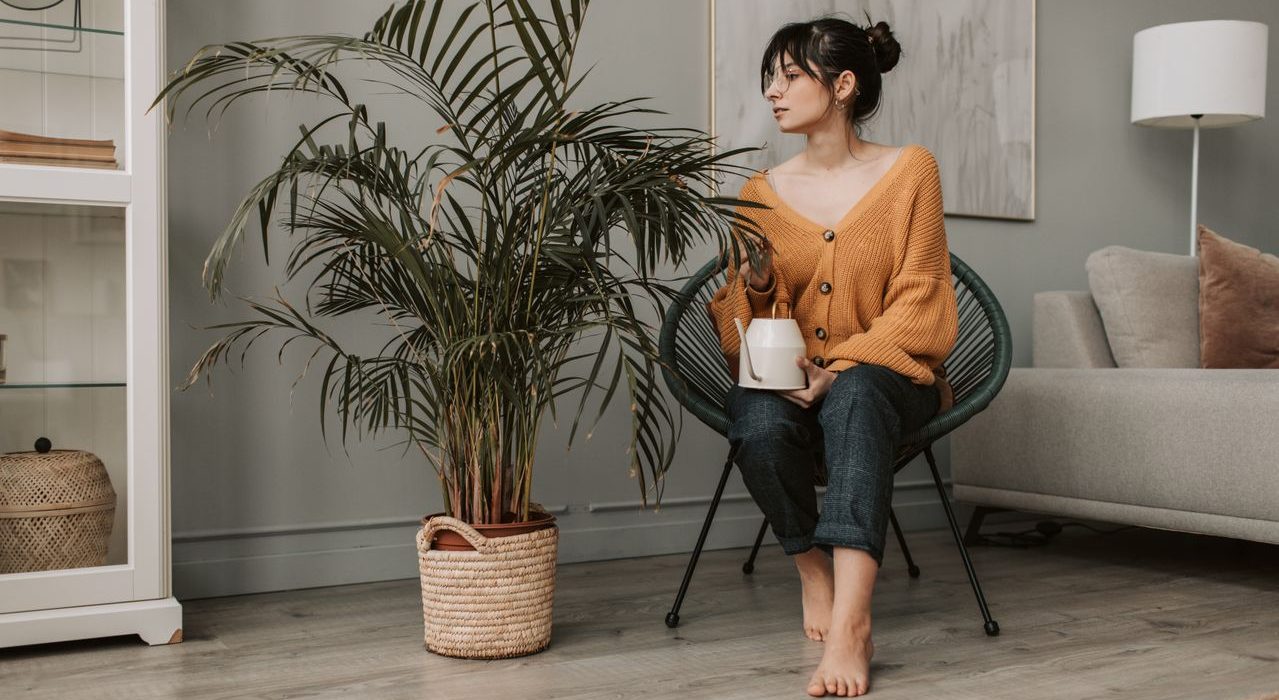
A single plant will not replicate a lab-grade living wall, but the underlying mechanism, sustained visual contact with living green, does not require scale to register. Choosing one that needs regular watering, rather than a low-maintenance succulent left in a corner, also builds a small daily interaction into the room.
A haven is built through repetition as much as through objects. Choosing one fixed spot for a recurring habit, the same chair for morning coffee, the same windowsill for evening tea, turns an ordinary location into an anchor the mind returns to under stress.
This works because the objects and memory research above compounds over time. Each repetition adds another layer of personal history to that one square foot of the house, until the spot itself starts to carry the calming effect the ritual was meant to create.
Display objects that hold a memory
A shelf of items chosen purely for how they photograph rarely does the emotional work of a shelf built around meaning. Stanford marketing researcher Christian Wheeler’s 2021 review describes how owned objects become linked to a person’s sense of self, and how the objects most tied to identity tend to be sentimental rather than expensive.
Studies on personal spaces cited in that review found that observers could judge a stranger’s personality with real accuracy just from the objects left in their bedroom or office. A ticket stub, a handwritten card or a chipped mug from a specific trip does more for a sense of safety than a matching set bought new.
Keep one corner free of screens
Every home now competes with a phone, a television or a laptop for attention in nearly every room. Setting aside a single chair, window seat or reading nook where screens do not go gives the nervous system one reliable place to downshift.
The corner does not need new furniture. It needs a rule, kept consistently, so the brain learns to associate that specific spot with rest rather than input. Over weeks, the association becomes automatic, and simply sitting there starts to lower the mental noise before a book or a cup of tea even shows up.
Layer textures your hands want to touch
Sight gets most of the design attention, but touch shapes how a room feels within seconds of entering it. A wool throw, a linen cushion cover or a worn leather chair gives the hands something to settle into, which in turn slows the pace of a body moving through a space.
Hard, uniform surfaces, glass, laminate, polished stone, read as efficient but rarely as restful. Mixing in even two or three soft, varied textures per room, a nubby rug underfoot, a knit blanket within reach, gives visitors and residents alike a reason to linger rather than pass through.