

This article was originally published on Crafting Your Home. A human contributor also wrote and edited the post.
President Donald Trump has escalated tensions with Canada over the wildfire smoke that has blanketed large parts of the United States in recent days, blaming the country for what he described as failing to properly manage its forests.
In a Truth Social post shared Friday, Trump said the smoke drifting south from hundreds of active Canadian wildfires has created air quality that he called dangerous and totally unacceptable.
He went further, suggesting that the economic and health costs tied to the pollution should be added directly to the tariffs the United States already imposes on Canadian goods.
Trump did not hold back in his characterization of Canada’s handling of its ongoing wildfire crisis. He wrote, “We are holding Canada responsible for the fact that they are not properly maintaining their Forests, and Brush therein, and the United States is being unnecessarily invaded by filthy, polluted, and unhealthy air, the quality of which is dangerous, and totally unacceptable.”
He also accused Canada of refusing to engage in basic forest management and debris removal, arguing that the country understood such neglect would eventually lead to exactly the kind of situation now unfolding across the U.S. Midwest and Northeast.
What Trump said and why he’s linking it to tariffs
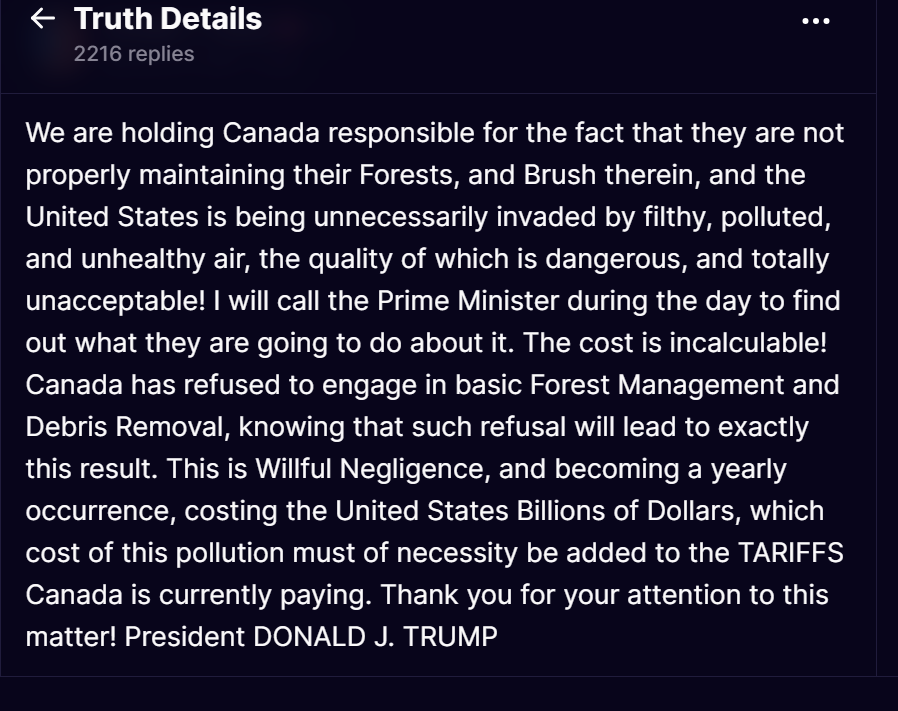
The president used particularly sharp language to frame the situation, describing it as “Willful Negligence” that has become a yearly occurrence and is costing the United States billions of dollars.
In the same post, he argued that the cost of pollution must, in his words, “of necessity be added to the TARIFFS Canada is currently paying.”
Trump also confirmed he planned to speak with Canadian Prime Minister Mark Carney to discuss Canada’s plans for the fires, saying he wanted to find out directly what the country intended to do.
This is not the first time Trump has used tariffs as leverage in disputes with Canada. He has previously imposed some of his highest tariff rates on Canadian goods while accusing the country of unfair trade practices in the lumber and auto industries.
Tensions between the two countries have remained elevated for much of the year, particularly after the U.S. Supreme Court ruled that Trump could not rely on emergency powers to levy tariffs, a decision that pushed his administration toward slower, investigation-based tariff processes instead.
Against that backdrop, Trump’s newest threat adds another point of friction to an already strained trade relationship between the two nations.
The wildfire smoke at the center of this dispute has been significant enough to trigger air quality alerts across a wide stretch of the United States, from Minnesota down through the Great Lakes region and into states as far east as Maryland.
The smoke has been traced primarily to hundreds of active wildfires burning in northwestern Ontario, an area so remote that aircraft remain the only practical means of reaching many affected communities.
As of Friday, roughly 650,000 acres had burned in the region, compared to about 600,000 acres burned at the same point the previous year, according to figures cited by Ontario officials.
Canada pushes back and defends its wildfire response
Canadian officials have firmly rejected the idea that this year’s wildfires are simply the result of poor forest management.
When asked about Trump’s comments, the office of Prime Minister Mark Carney referred reporters to a statement from Canada’s Minister of Emergency Management, Eleanor Olszewski, who said the country is working with urgency alongside provincial and territorial partners to respond to the fires.
Canadian officials have consistently pointed to climate change and increasingly extreme weather conditions as key factors behind the growth of larger, more difficult-to-contain wildfires in recent years, a position that stands in direct contrast to Trump’s framing of the crisis as a matter of negligence.
Ontario Premier Doug Ford addressed the situation directly during a press conference on Friday, announcing that the province would spend 650 million Canadian dollars, or roughly 465 million U.S. dollars, on five new helicopters and six new water bombers to strengthen its firefighting capacity.
Ford described the purchase as the largest of its kind in the province’s history and said the government would not put a price on the safety of its communities.
He also pushed back firmly against American politicians who have criticized Canada’s wildfire response in recent days, suggesting that instead of complaining, the U.S. should consider offering support the way Canada has in the past when American states faced natural disasters of their own.
Ford has also had to defend his government’s firefighting budget domestically, after facing criticism from opposition politicians in Ontario who argued the province’s base funding for emergency forest firefighting was too low given the scale of this year’s fire season.
Ontario budgeted 150 million dollars for emergency firefighting in the 2026 to 2027 cycle, despite having spent 271 million dollars fighting fires the previous year.
Ford has maintained that the base figure represents only a starting point and that the province routinely spends well beyond it depending on need, noting that additional firefighting positions were added and compensation increased for wildland firefighters, pilots, and support staff ahead of this year’s fire season.
The scale of this year’s wildfire activity has been significant on both sides of the border. Ontario alone has already fought nearly 500 fires in 2026, compared to 351 for the entire previous year, with dozens currently classified as out of control in the province’s north.
The United States has also experienced an above-average fire year of its own, with close to 3.7 million acres burned nationwide so far in 2026, compared to a ten-year average of about 2.7 million acres, according to figures from the National Interagency Fire Center.
That context has added complexity to the broader debate over how much blame can reasonably be assigned to any single country when wildfire seasons are intensifying across North America more broadly.
As of Friday, it remained unclear exactly how or whether Trump’s proposal to tie wildfire smoke costs to existing tariffs would move forward, since such a change would likely require formal action through trade channels rather than a simple presidential announcement.
It also remains to be seen what came of the call Trump said he intended to have with Prime Minister Carney, or whether that conversation produced any shift in how the two countries plan to coordinate on wildfire response going forward.
For now, the dispute reflects a broader pattern this year of trade tensions surfacing around issues that go well beyond traditional economic disagreements, with wildfire smoke becoming the latest flashpoint in an already complicated relationship between the two neighboring countries.
If you like what you just read, then subscribe to our newsletter and follow us on social media.


