

This article was originally published on Crafting Your Home. A human contributor also wrote and edited the post.
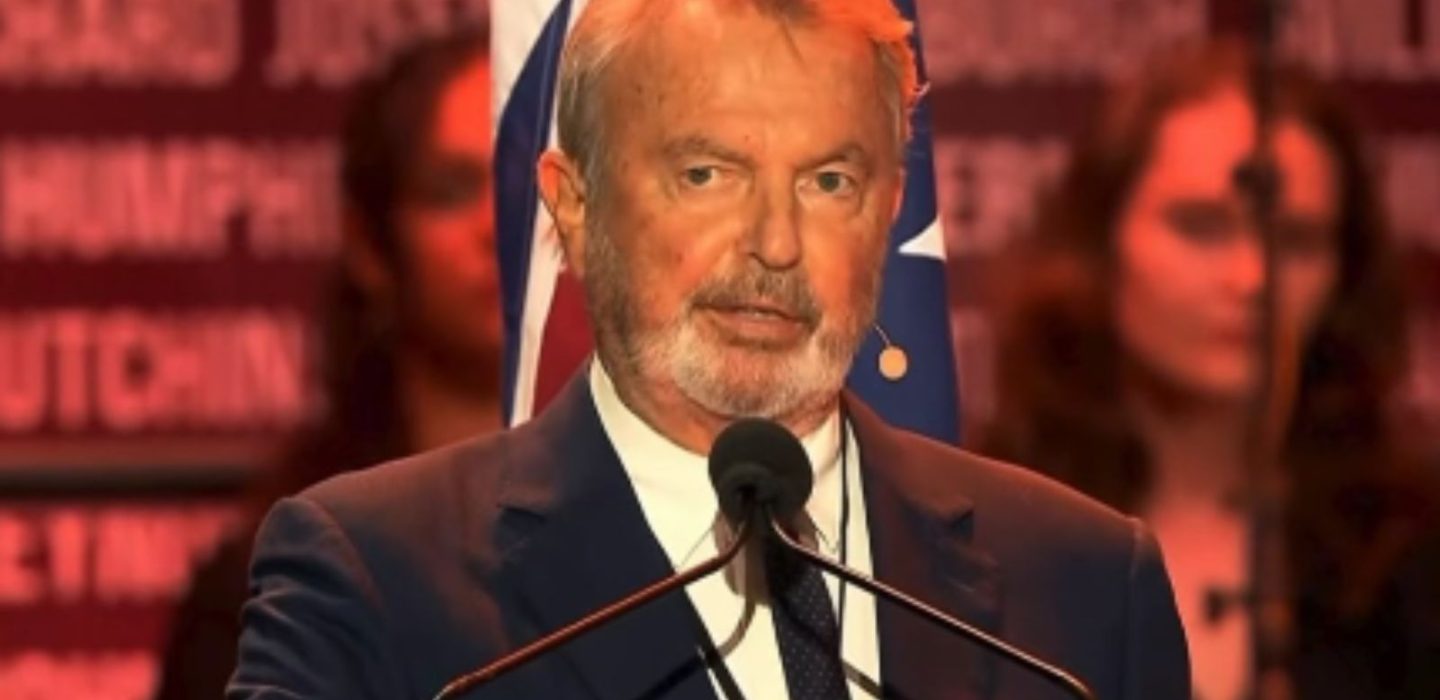
Sam Neill, the New Zealand actor whose nearly five-decade career made him one of the most recognizable and respected faces in film, has died at age 78.
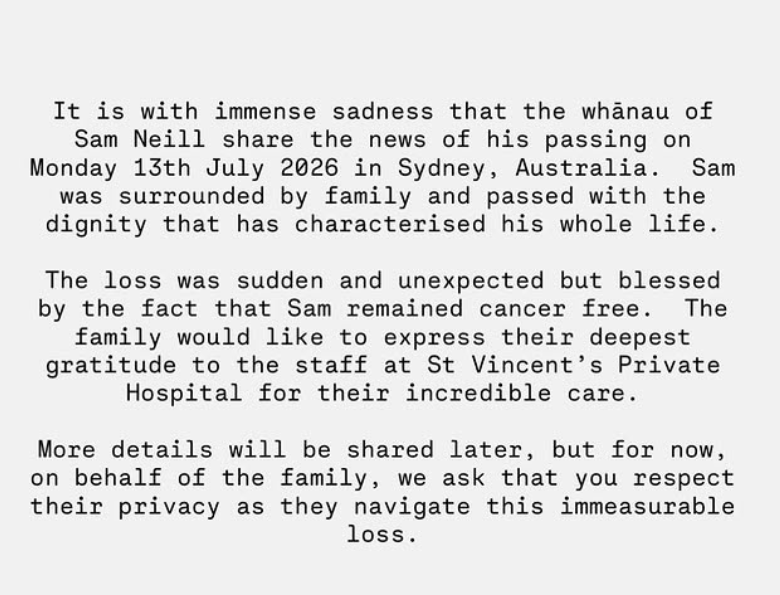
His family confirmed his passing in a statement shared on his official Instagram account, saying he died on Monday, July 13, at St Vincent’s Private Hospital in Sydney, Australia.
The news has landed hard across the film industry, marking the loss of an actor whose range stretched from summer blockbusters to some of the most acclaimed dramas of his generation.
According to the statement, which used the Māori word whānau to refer to Neill’s extended family, his death was sudden and unexpected, though it came with one measure of comfort for those closest to him.
The family noted that Neill remained cancer-free at the time of his passing, adding that he was surrounded by loved ones and passed with the same dignity that had characterized his entire life.
No cause of death has been publicly disclosed, and the family thanked the hospital staff for their care while asking for privacy as they process the loss.
A Sudden Loss That Followed a Hard-Fought Recovery
Neill’s death comes just months after he shared what he described as extraordinary news about his health.
In 2023, he revealed he had been diagnosed with angioimmunoblastic T-cell lymphoma, a rare and aggressive form of non-Hodgkin lymphoma, and underwent chemotherapy while writing about the experience in his memoir, Did I Ever Tell You This? he spoke candidly at the time about the diagnosis reshaping his outlook, telling one interviewer that the darkest moments of his illness had thrown everyday life into sharper focus and left him grateful for his friends.
By April of this year, Neill announced that scans had come back clear, sharing the update with visible relief and calling the result an extraordinary thing to hear.
That recovery made Monday’s news especially jarring for fans and colleagues who had only recently celebrated his health update.
Reports following his death have made clear that whatever caused his passing was not connected to the cancer he had just beaten, though his family has not released further medical details beyond describing the loss as sudden.
Neill had long spoken with unusual candor about mortality, a subject that came up repeatedly in interviews during his cancer treatment.
In one conversation with the Australian Broadcasting Corporation, he said he was not in any way frightened of dying, adding that he would simply be annoyed because there were still things he wanted to do.
That mix of humor and clear-eyed honesty about his own mortality became a defining part of how the public came to know him in his final years, even as he continued to work steadily across film and television.
From Jurassic Park to The Piano, a Career That Refused to Be Boxed In
Born Nigel John Dermot Neill in Omagh, Northern Ireland, in 1947, he moved to New Zealand with his family at age seven and later adopted the name Sam because there were too many boys named Nigel at his school.
He broke through in New Zealand cinema with 1977’s Sleeping Dogs before his international career took off in the 1980s, eventually leading to the role that would define him for millions of moviegoers around the world, paleontologist Dr. Alan Grant in Steven Spielberg’s 1993 blockbuster Jurassic Park.
Neill reprised the role across multiple sequels, most recently in 2022’s Jurassic World: Dominion, and often reflected on the strange staying power of that first film.
He once marveled that he had never imagined the movie would embed itself so deeply in popular culture, noting that its most memorable lines and moments had become part of everyday life for generations of fans, decades after filming wrapped.
Alongside costars Laura Dern, Jeff Goldblum, and the late Richard Attenborough, Neill helped anchor a film that remains one of the highest-grossing franchises in movie history. Beyond the dinosaurs, Neill built a body of work defined by range rather than typecasting.
He played a Soviet submarine officer in the 1990s The Hunt for Red October, starred opposite Holly Hunter in Jane Campion’s Oscar-winning drama The Piano, and delivered a haunted turn as an astrophysicist in the 1997 sci-fi horror film Event Horizon.
Television audiences knew him as the ruthless Chester Campbell in Peaky Blinders, and he later starred opposite Annette Bening in the Peacock series Apples Never Fall, proof that his range never dimmed even in the later stretch of his career.
Tributes Pour In From Costars, Collaborators, and World Leaders
Reaction to Neill’s death came quickly from across the industry and beyond. Jurassic World: Dominion director Colin Trevorrow described him as a deeply soulful and beautiful man whose strength gave everyone around him strength, adding that it is not every lifetime you get to call a legend a friend.
The official Peaky Blinders account said the production team was devastated by the news and expressed lasting gratitude for Neill’s contribution to the show during his time playing Chester Campbell.
Fellow actor Richard E. Grant, who worked alongside Neill on the film Palm Beach, remembered him as an officer and a gentleman in the truest sense, while singer and longtime friend Kylie Minogue shared a simple farewell using the Māori word for goodbye.
Neill was known for naming animals on his New Zealand farm after celebrity friends, including a chicken named after Laura Dern and a duck named after Minogue herself, a running joke on his social media that endeared him to fans well beyond his film work.
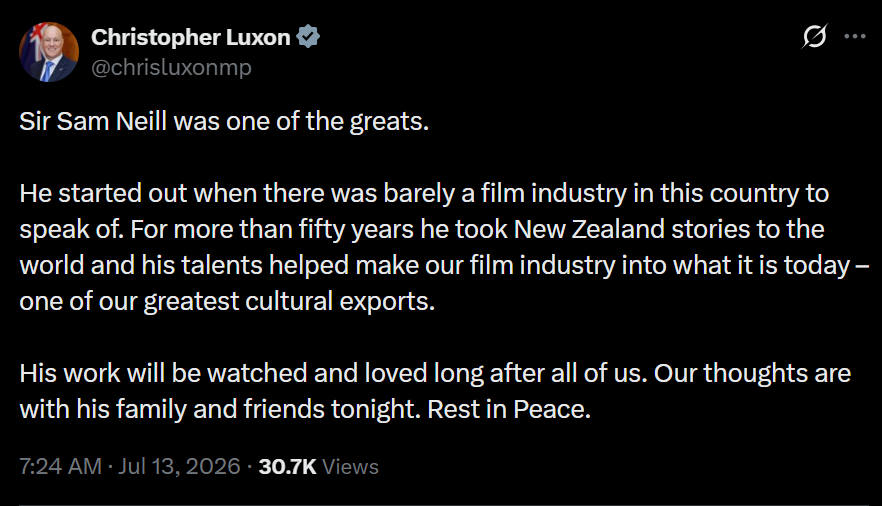
Tributes also came from political leaders on both sides of the Tasman Sea. New Zealand Prime Minister Christopher Luxon called Neill one of the greats, crediting him with taking New Zealand stories to the world at a time when the country barely had a film industry to speak of.
Australian Prime Minister Anthony Albanese echoed that sentiment, saying Neill had earned a special place in Australian hearts and describing him as wry, dry, thoughtful and laconic, someone who faced his illness with the same dignity and humor that defined every performance he gave.
Neill is survived by his four children, including his son Tim and his daughter Elena, along with the wider family and countless collaborators who worked alongside him on more than fifty films and television projects.
His memoir, his winemaking label Two Paddocks in Central Otago, and his decades of work on screen leave behind a legacy that, as tributes from around the world have made clear over the past day, reached far beyond any single role.
For an actor who once said he never much liked Hollywood and felt most at peace on his own New Zealand farm, the outpouring of grief from fans and fellow performers alike reflects just how deeply his work resonated, whether audiences knew him as a paleontologist facing down dinosaurs or a quiet farmer content to stay close to home.
What made Neill stand out across five decades in front of the camera was never just the size of his roles, but the consistency with which he brought care to them.
Directors who worked with him across genres, from historical drama to science-fiction horror, repeatedly pointed to his thoughtfulness on set and his willingness to fully disappear into a character rather than lean on his growing fame.
That same quality carried into his public life off-screen, where he was known for a self-deprecating sense of humor and a genuine reluctance to embrace the celebrity that came with playing one of cinema’s most beloved characters.
His death arrives at a moment when the Jurassic franchise he helped build remains as culturally relevant as ever, with new installments still drawing audiences more than three decades after the original film’s release.
Fans revisiting his performance as Dr. Alan Grant this week have found themselves returning not just to a blockbuster adventure, but to a portrayal defined by warmth, patience and quiet authority, qualities that colleagues and admirers alike say defined Neill both on screen and off.
As tributes continue to arrive from across the industry and from world leaders in both New Zealand and Australia, the shared sentiment has been remarkably consistent: film has lost one of its most versatile and genuinely beloved performers.
If you like what you just read, then subscribe to our newsletter and follow us on social media.


