The United States is entering a new and far more emotionally charged phase of its immigration debate, where a Supreme Court ruling has settled one question but opened the door to an entirely different kind of conflict. The Court has reaffirmed that children born on U.S. soil remain citizens under the Fourteenth Amendment, regardless of their parents’ immigration status or temporary presence.
That ruling preserved a constitutional promise that has shaped American identity for more than a century.
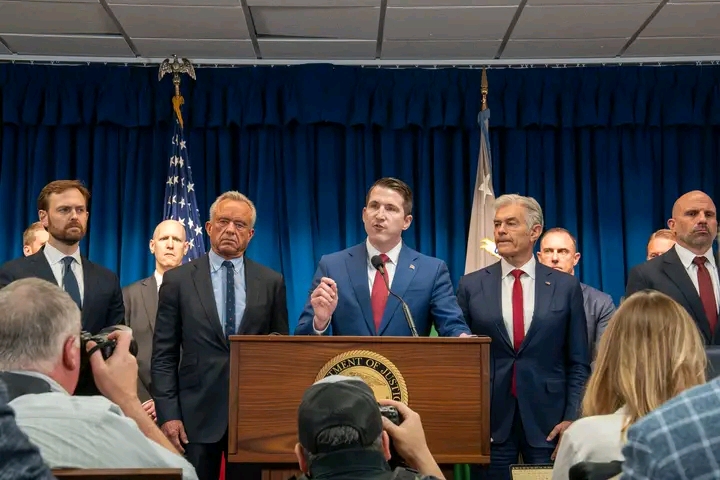
But even as that legal foundation holds firm, a parallel battle is intensifying in the shadows of enforcement. The Justice Department is no longer trying to redefine who is a citizen at birth. Instead, it is targeting the hidden systems it believes are quietly commercializing that outcome.
The hidden industry built around American birth.

Behind the political language of “birth tourism” lies a sprawling, loosely organized international service economy. It operates across borders, languages, and digital platforms, often far from public view. At its core are intermediaries who coordinate travel, lodging, medical appointments, visa applications, and post-birth documentation for expectant mothers traveling to the United States.
These services are frequently marketed as convenience packages. In practice, they can resemble full logistical operations, with pricing tiers that vary based on hospital selection, visa risk, length of stay, and the level of concealment required during immigration interviews.
Clients are often guided on what to say to consular officers, how to frame travel intentions, and how to avoid raising suspicion during entry screening.
When intent becomes the crime
Under U.S. immigration law, entering the country while pregnant is not illegal. The legal risk emerges when applicants are accused of misrepresenting their purpose of travel or participating in coordinated schemes that conceal their true intentions from immigration authorities.
This creates a fragile legal threshold: the same journey can be lawful or unlawful depending entirely on what a traveler knew, said, or concealed before boarding a flight.
That distinction is at the heart of current enforcement efforts. Prosecutors are increasingly focusing on visa fraud, false statements, and financial deception rather than childbirth itself. But intent is not something that can be measured directly.
A global race for mobility disguised as motherhood
The deeper reality driving this issue is not simply immigration enforcement. It is global inequality in mobility.
American citizenship remains one of the most valuable legal statuses in the world, offering access to education systems, labor markets, and travel freedoms that are restricted or unavailable in many other countries. That disparity creates structural demand, particularly among families from nations with weaker passports or limited global access.
Birth tourism exists at the intersection of that demand and the legal guarantee of birthright citizenship. It is not driven solely by individual decisions but by a global system in which citizenship itself has become a form of inherited economic advantage.
The enforcement machine behind the scenes
Federal enforcement agencies are no longer treating birth tourism as an abstract policy concern. They are treating it as a networked ecosystem of financial and immigration fraud.
Investigations often begin far from hospitals. They begin in digital spaces, encrypted messaging apps, online advertisements, and payment platforms that reveal patterns of coordinated travel planning. Prosecutors then follow financial trails through wire transfers, service fees, and business accounts linked to maternity facilitators.
The shift is significant. Birth tourism enforcement is no longer confined to immigration officers at airports. It now resembles financial crime investigation, cyber forensics, and international fraud detection operating under a single umbrella.
Hospitals at the center of an unseen pressure point
While much of the debate focuses on immigration law, a quieter strain exists within the U.S. healthcare system.
Hospitals are constitutionally required to provide emergency care regardless of immigration status. That includes labor and delivery services. But when patients are uninsured or foreign-based, financial responsibility often becomes complicated, leading to unpaid bills or delayed reimbursement.
In major urban hospitals, administrators have occasionally flagged cases involving international maternity patients as financially complex, not because care is denied, but because billing and recovery mechanisms become difficult to enforce across borders.
The emotional fault line in immigration enforcement
At the center of this crackdown lies a question that cannot be answered with statutes alone: how far should a government go in interpreting intent?
For some, aggressive enforcement is a necessary defense against fraud networks that exploit legal loopholes. For others, it raises the unsettling possibility that pregnancy itself could become a trigger for suspicion in visa processing.
A system caught between law and reality
The Supreme Court has reaffirmed the constitutional principle of birthright citizenship. That part of the debate is settled, at least for now. But the Justice Department’s crackdown reveals a second layer of conflict, one that is harder to resolve and far more deeply embedded in global inequality, digital commerce, and human aspiration.
The law may be clear. The human incentives are not.