


A renewed wave of political debate surrounding U.S.–Iran nuclear negotiations after former Vice President Kamala Harris sharply criticized President Donald Trump’s approach, suggesting that any emerging agreement with Tehran may ultimately resemble the Obama-era nuclear framework known as the JCPOA.
We observe that Harris delivered her remarks during a public discussion at the R20 Regions of Climate Action Summit in Vienna, Austria, an event primarily focused on climate policy but which shifted into geopolitical territory as the Iran negotiations became a focal point. Her comments quickly reignited tensions in Washington over the direction, credibility, and legacy of U.S. foreign policy toward Iran.
Harris’s Core Argument on the Iran Nuclear Negotiations
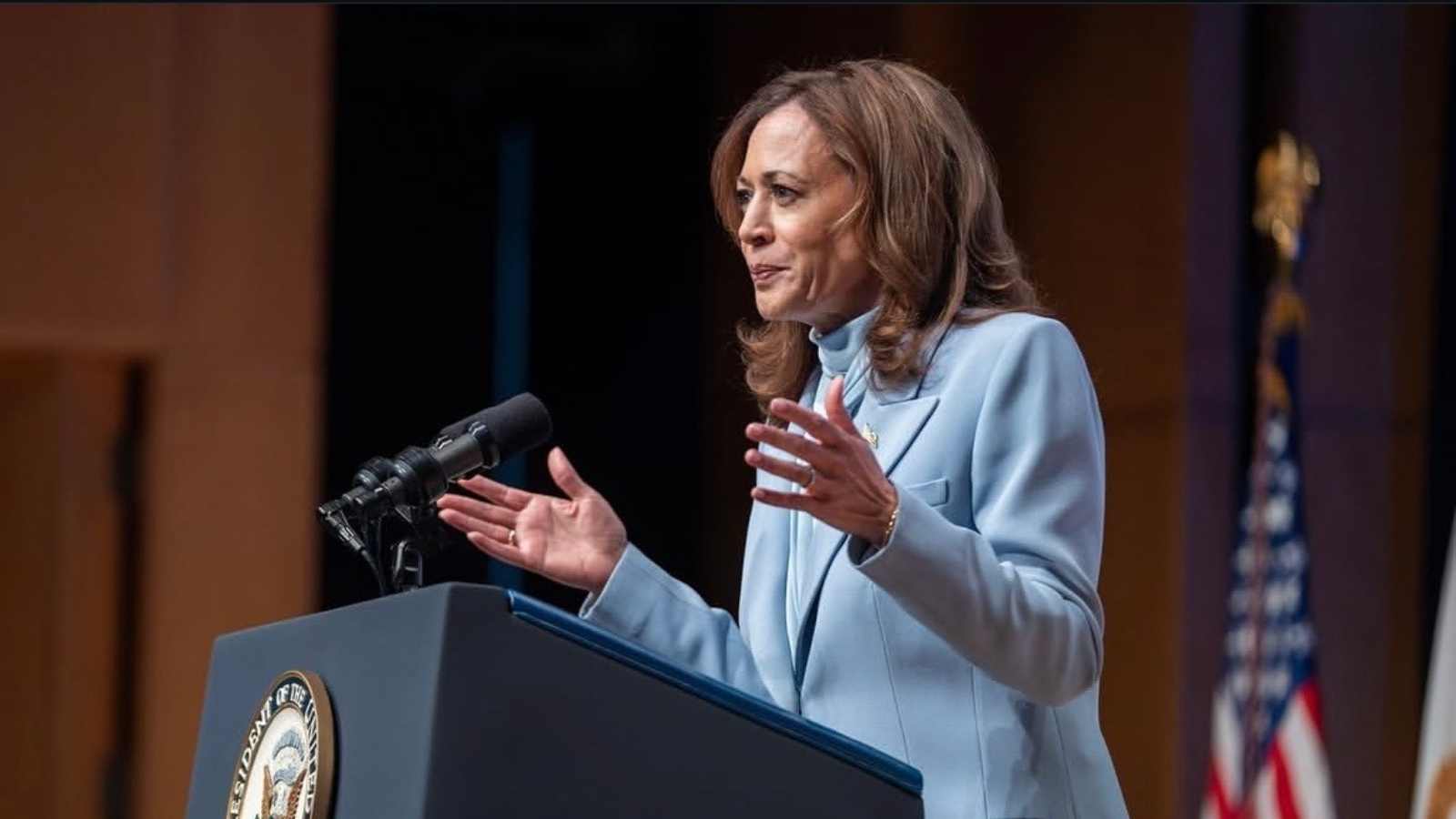
Kamala Harris’s central claim: that the Trump administration, despite previously abandoning the 2015 Iran nuclear deal, may end up negotiating terms that closely resemble it, while still framing the outcome as a political victory.
According to her remarks, any agreement emerging from current discussions would likely be presented as a breakthrough, even if structurally it aligns with the same limitations and verification mechanisms that defined the original Joint Comprehensive Plan of Action (JCPOA).
Harris emphasized the irony of this trajectory, arguing that dismantling the original agreement only to return to similar conditions represents policy circularity rather than progress.
Understanding the JCPOA Framework and Its Political Legacy
We examine the foundation of the debate by revisiting the JCPOA, signed in 2015 between Iran and the P5+1 nations, including the United States, United Kingdom, France, Russia, China, Germany, and the European Union.
The agreement was designed to restrict Iran’s nuclear program through:
- Reduction of installed centrifuges
- Continuous monitoring by the International Atomic Energy Agency (IAEA)
- Extended breakout time thresholds to prevent rapid weaponization
We recognize that Implementation Day in 2016 marked the formal verification of Iran’s compliance with initial requirements, making the deal one of the most closely monitored nuclear agreements in modern diplomacy.
However, in 2018, President Trump withdrew the United States from the agreement, arguing that it failed to ensure long-term security guarantees and enabled economic benefits for Iran without sufficient constraints on nuclear development.
Trump’s Withdrawal and the Shift in U.S. Iran Policy

We assess the policy shift that followed the U.S. exit from the JCPOA. After withdrawal, the administration pursued a “maximum pressure” strategy involving renewed sanctions and diplomatic isolation of Iran.
This approach was framed as an effort to force a stronger agreement, with officials arguing that the original deal lacked permanence and failed to address ballistic missile development and regional activity concerns.
We observe that Harris’s critique directly challenges this logic, suggesting that years of heightened pressure and geopolitical tension may ultimately lead back to a similar diplomatic structure rather than a fundamentally new framework.
Harris’s Vienna Remarks and Political Messaging
We highlight that Harris made her statements during a wide-ranging discussion at the R20 summit, hosted by former California Governor Arnold Schwarzenegger, where environmental policy and global cooperation were central themes.
Despite the climate-focused agenda, Iran policy emerged as a critical point of discussion. Harris argued that future announcements from the Trump administration would likely be framed as decisive victories, even if they mirror previously established agreements.
We note her emphasis on the concept of political narrative versus diplomatic substance, suggesting that public messaging may diverge significantly from the structural reality of any negotiated outcome.
Timeline of U.S.–Iran Nuclear Policy Shifts
We present a structured overview of key developments in the nuclear diplomacy timeline to contextualize the ongoing debate:
timeline
title U.S.–Iran Nuclear Agreement Evolution
2015 : JCPOA signed between Iran and P5+1 nations
2016 : Implementation Day confirmed by IAEA compliance review
2018 : U.S. withdraws from JCPOA under Trump administration
2018-2025 : Sanctions reinstated, “maximum pressure” strategy implemented
2026 : Renewed negotiations and debate over new agreement structure
We observe that this timeline reflects a cyclical policy environment in which diplomatic frameworks are dismantled and later revisited under new political conditions.
Strategic Concerns Over Policy Reversal and Consistency
We examine Harris’s broader concern regarding policy consistency. Her argument centers on the idea that withdrawing from an existing multilateral agreement only to potentially reconstruct a similar framework later raises questions about strategic coherence.
We identify three core issues embedded in this debate:
- Credibility Gap: Frequent shifts in U.S. commitments may weaken international trust
- Negotiation Cycles: Repeated return to similar diplomatic outcomes suggests limited strategic deviation
- Political Framing: Success narratives may overshadow structural similarities between agreements
We understand that these concerns reflect ongoing divisions in Washington over how to evaluate diplomatic effectiveness in long-term geopolitical conflicts.
Competing Interpretations of “Victory” in Foreign Policy
Harris’s remarks suggest that declarations of victory may not align with measurable changes in policy architecture.
From her perspective, a new agreement resembling the JCPOA would not represent a breakthrough but rather a return to previously established conditions under a different political label.
We note that this framing places emphasis on continuity rather than transformation, challenging the idea that policy reversals necessarily lead to improved outcomes.
Key Stakeholder Positions in the Iran Negotiation Debate
- Harris-aligned perspective: Supports structured multilateral agreements with international oversight
- Trump administration position: Previously criticized JCPOA as insufficient and sought stronger terms
- International mediators: Focused on stabilizing nuclear restrictions and preventing escalation
- Iranian position: Seeks sanctions relief in exchange for nuclear compliance guarantees
We observe that these positions create a complex negotiation environment where diplomatic objectives often compete with domestic political narratives.
Risk Factors and Global Security Considerations
We assess the broader implications of stalled or cyclical negotiations. Nuclear diplomacy involving Iran remains a high-stakes issue with direct implications for regional stability, energy markets, and international security architecture.
Key risk variables include:
- Expansion or limitation of uranium enrichment activities
- Enforcement capacity of international monitoring systems
- Regional escalation involving allied states
- Economic pressure through sanctions or relief mechanisms
We recognize that even partial agreements carry significant geopolitical weight due to the sensitivity of nuclear proliferation concerns.
Ongoing Uncertainty in U.S.–Iran Diplomatic Outlook
We conclude this analysis by noting that the current negotiation phase remains fluid, with no finalized agreement publicly confirmed. Harris’s comments reflect a broader skepticism about whether new diplomatic efforts will meaningfully depart from past structures or simply repackage earlier agreements under new political narratives.
We observe that the outcome of these negotiations will likely influence not only U.S.–Iran relations but also the future credibility of multilateral nuclear diplomacy frameworks worldwide.


