


Before you reach for the salt, pass it carefully. That instinct, the one that makes some people set the salt cellar down on the table rather than hand it directly to someone, is older than most countries currently in existence.
It is a food superstition, quietly alive in kitchens, wedding halls, holiday dinners, and family tables all over the world, carried forward by people who cannot always explain why they do it but do it anyway.
Food superstitions are not relics of ignorance. They are fossils of genuine human anxiety, about survival, about illness, about luck and misfortune and the terrifying randomness of whether the harvest would come in or the family would stay healthy through winter.
Before scientific frameworks existed to explain why things went wrong, people constructed meaning from what they had: bread, eggs, salt, tea, and the endless interpretive possibilities of an ordinary meal.
Here are eight of the most fascinating food superstitions from around the world, where they came from, and why some of them never quite left.
Never Pass Salt Directly Into Someone’s Hand

Salt was not always cheap. For most of human history it was scarce, expensive, and essential, it preserved meat, prevented disease, and functioned as currency in some economies. Roman soldiers were partly paid in salt, which is where the word “salary” comes from.
Given all of that, it is not hard to understand why elaborate rules developed around its handling.
The superstition against passing salt directly hand to hand emerged across multiple European cultures and carried a consistent warning: doing so would transfer sorrow between the two people involved, or invite conflict into the relationship.
The English phrase “help to salt, help to sorrow” preserved the belief in tidy rhyming form. The Scottish and Irish versions were equally grim.
The solution was to place the salt on the table and let the other person pick it up themselves, a practice that persists in households where no one can quite explain why they do it but would feel faintly wrong doing it differently.
Spilling salt, a related superstition, required throwing a pinch over the left shoulder to blind the devil lurking there. These beliefs are connected by the same underlying logic: salt was precious enough that carelessness with it felt like tempting fate.
Eggshells Must Be Crushed After Eating
This one has teeth. Across Britain and parts of northern Europe, it was considered dangerous, not merely unlucky but actively dangerous, to leave an eggshell intact after you had eaten the contents.
The specific threat was that witches would collect whole shells, use them as miniature boats, and sail them out to sea to summon storms that could wreck ships and drown sailors.
This is obviously not how maritime disasters work. But the people who believed it were not naive, they were living in coastal communities where storms were genuinely deadly and unpredictable, and they were operating within a framework that took witchcraft seriously as a causal mechanism.
Crushing the shells was a reasonable precaution given the belief system, in the same way locking your door is a reasonable precaution given the existence of burglars.
The practice was widespread enough that it appears in multiple historical records and folk tradition compilations. John Aubrey documented it in seventeenth-century England.
It persisted long enough that parents were still telling children to crush their eggshells in the nineteenth century, by which point the witchcraft rationale had largely been forgotten and the habit survived on its own momentum.
Bread Scored With a Cross Before Baking

The cross cut into the top of a loaf of bread before it goes into the oven is familiar enough that most people assume it is purely technical, a scoring pattern that controls how the bread expands during baking. That part is true. The scoring does help. But it was not the original reason.
For centuries, marking bread with a cross before baking was understood as protection.
It kept evil spirits from entering the loaf, prevented witches from sitting on it and ruining the rise, and invited divine blessing into the household’s daily bread.
The practice predates Christianity in some forms, early pagan bread-marking traditions were absorbed and reinterpreted as the faith spread through Europe.
What is interesting is that the superstition and the practical technique ended up perfectly aligned. Scoring the bread genuinely does improve the bake.
The protective ritual turned out to have a real function, which possibly explains why it survived so thoroughly that the supernatural rationale eventually fell away entirely while the gesture remained.
Most bakeries score their loaves today for entirely pragmatic reasons. They are, unknowingly, continuing a tradition that people once believed kept the devil out of their dinner.
A Hole in Bread Meant a Coffin
On the darker end of bread superstitions sits this one from parts of Britain: if you sliced open a loaf and found an unusual hole inside, a larger cavity than the ordinary air pockets in the crumb… it was an omen of death.
The shape of the hole resembled a coffin, and its presence in the household’s bread meant someone close to the family would die soon.
Families apparently spent considerable time after such a discovery speculating about who the warning might apply to.
Scientifically, large holes in bread result from overproofing, uneven mixing, or trapped gases during baking, entirely mechanical processes with no predictive relationship to human mortality.
But in a period when death was far more present and unpredictable than it is in most modern contexts, the impulse to find warning signs in ordinary objects was not irrational. It was a way of feeling that misfortune was at least legible, if not preventable.
Tea Leaves and Teapots as Social Forecasting Tools
Tea arrived in Britain in the seventeenth century and was expensive enough, initially, that the rituals surrounding it took on significance beyond the beverage itself.
The superstitions that developed around tea were remarkably specific. Two people pouring from the same teapot were said to be courting conflict.
Leaving the lid off the teapot during brewing was interpreted as a signal that an unexpected visitor was on their way. Bubbles in a cup of tea were read as omens, floating toward the drinker meant money coming; floating away meant money going.
Tasseography, reading tea leaves after the cup was drained, formalized the fortune-telling dimension into an actual practice with its own interpretive vocabulary.
Particular leaf formations carried specific meanings, and reading them was a social activity as much as a predictive one, giving the tea ceremony an additional layer of meaning and entertainment.
Some people still read tea leaves today, though the practice has shifted from earnest divination to something closer to a parlor game.
The Christmas Cake Stirring Ritual
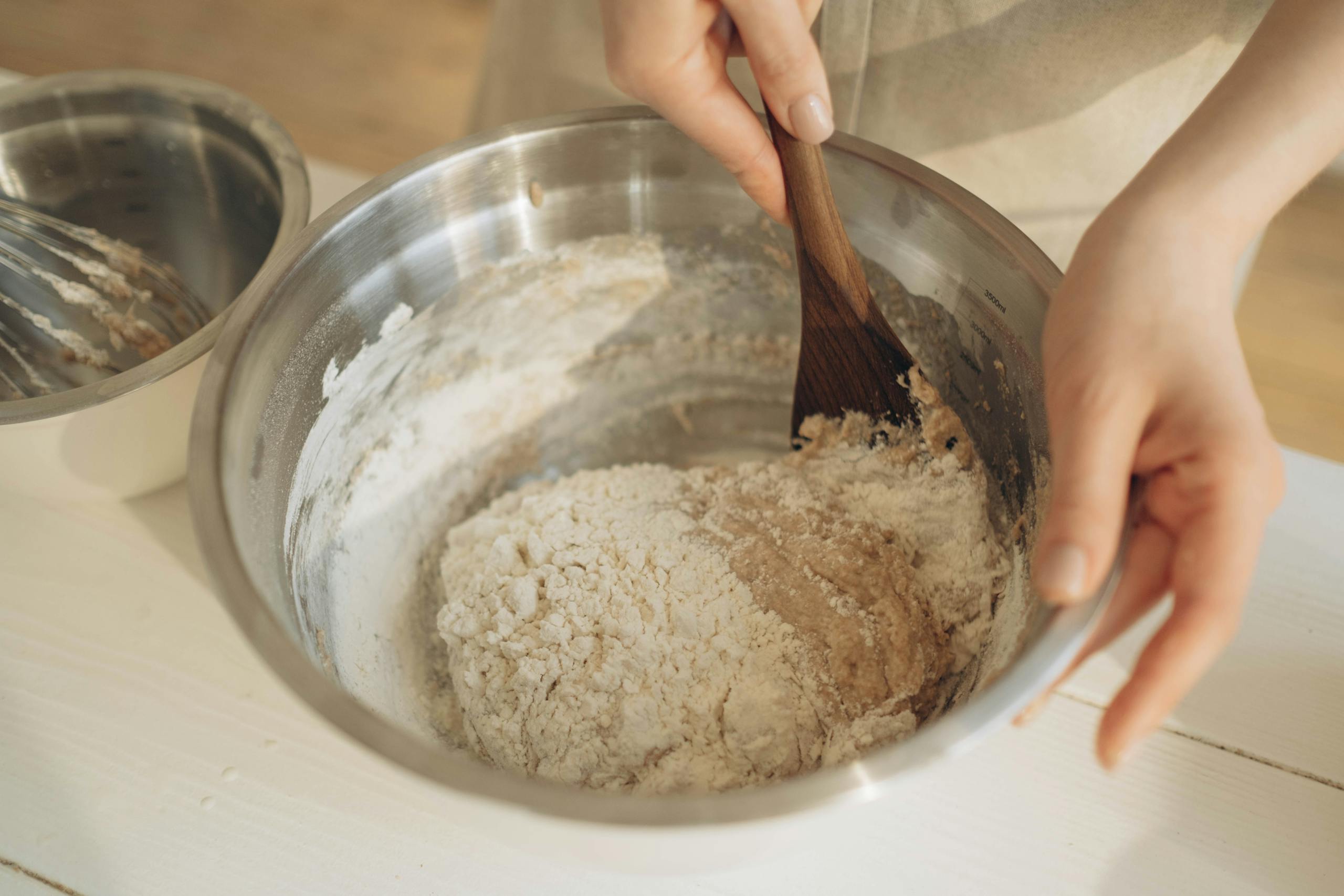
The tradition of the Christmas pudding, or Christmas cake, depending on the family, required that every person in the household take a turn stirring the mixture before it was cooked.
The stirring had to be done in a specific direction: east to west, following the path of the Star of Bethlehem as the Magi supposedly traveled. Each family member stirred and made a wish.
Participation was believed to ensure prosperity and happiness in the year ahead. Missing your turn had consequences, for unmarried women especially, skipping the stir was said to delay marriage for another year.
Objects were sometimes baked into the pudding itself: a coin for wealth, a ring for marriage, a thimble for a life of service. Finding an object in your portion was both a party game and a genuine forecast, according to those who believed in it.
The ritual function was real regardless of the supernatural element: it gathered the family around a single task, gave everyone a role in preparing the celebration, and built the anticipation that makes festivals meaningful.
Garlic Against the Evil Eye
Garlic’s reputation as a protective substance runs through an enormous range of cultures and centuries. Vampires are only the most famous application.
The Evil Eye, the belief that envy or excessive admiration from another person could inadvertently cause misfortune to the admired, appears in ancient Mesopotamian, Greek, Roman, and Middle Eastern traditions, among others.
Protection against it took many forms. In Greek culture, garlic was one of the most reliable.
Carrying a clove of garlic, hanging it in doorways, or incorporating it into protective amulets was believed to ward off the dangerous attention that the Evil Eye transmitted.
The connection was not arbitrary: garlic has genuine antimicrobial properties that were empirically observable long before anyone understood why, which gave it a reputation for mysterious efficacy.
Something that kept food from spoiling and seemed to protect against certain illnesses could plausibly protect against invisible curses as well.
The Evil Eye belief persists across many cultures today, particularly in Greek, Turkish, Italian, and Middle Eastern communities, and garlic’s protective symbolism travels with it.
Throwing Rice at Weddings

The rice thrown at weddings, or the confetti, flower petals, or biodegradable alternatives that have largely replaced it, carries the same symbolic weight it always has, even when the people throwing it have no idea why they are doing it.
Rice represented abundance, fertility, and the hope that the couple’s future would be full rather than empty.
Showering newlyweds with it was a communal gesture of goodwill, an expression of the community’s investment in the marriage’s success, and a practical invocation of prosperity at a moment when the couple was beginning a shared life with uncertain prospects.
The substitutions have not changed the underlying grammar of the gesture. Bubbles, wildflower seeds, and paper hearts are contemporary translations of the same sentence: we are rooting for you, and we are expressing that wish through something thrown at your heads as you leave.
The superstition has evolved into a custom, and the custom persists because it serves the same function it always did, giving the gathered crowd a role in the celebration and a way to express collective hope.
Conclusion
What food superstitions share, across every culture and century represented here, is function.
They were not arbitrary. They grew up around real anxieties, about scarce resources, about invisible threats, about death and illness and the randomness of fortune, and they provided something useful: a framework, a ritual, a small act of control in circumstances where control was limited.
The ones that survived longest are the ones that either merged with a real practical purpose, scoring bread, crushing eggshells, gathering the family to stir the cake, or the ones that became so socially embedded that the supernatural rationale fell away while the gesture remained.
We still set the salt on the table. We still throw things at weddings. We still pull the wishbone and score the bread and knock on wood. The beliefs that generated these habits are mostly gone.
The habits remain because rituals do not require their original justification to continue being useful. They just need a table, and a family around it, and someone who learned the custom from someone else and passes it on without quite knowing why.