


The Post: 10 Things That May No Longer Earn Their Place in Your Home After 70 first appeared on Crafting Your Home
A home that has worked beautifully for decades can still benefit from a few thoughtful edits. After 70, the goal doesn’t have to be ruthless decluttering or turning a comfortable house into a bare, personality-free space.
Sometimes it simply means noticing which belongings have become inconvenient, awkwardly placed, or no longer worth the space they occupy.
Guidance from the National Institute on Aging, AARP, and the FDA points to several household items worth replacing, rearranging, or letting go. Here are 10 that may no longer deserve a permanent spot in the house.
1. Loose Throw Rugs
That little rug by the sofa may pull a room together, but if it shifts, curls, or bunches, it can also make the floor harder to navigate.
The National Institute on Aging advises avoiding small throw rugs and making sure carpeting is securely fixed in place. Research has also linked rugs and carpets with thousands of fall-related emergency department visits among adults 65 and older each year.
That doesn’t mean every rug has to disappear. A securely installed floor covering is very different from a lightweight decorative rug that slides whenever someone walks over it.
2. Bathroom Mats That Won’t Stay Put
A bath mat should make the bathroom more comfortable, not behave like a sled.
The National Institute on Aging recommends nonskid mats or strips on surfaces that can become wet.
So the issue isn’t necessarily whether there is a bathroom mat at all. It is whether that mat stays firmly where it belongs.
If yours scoots across the tile with the slightest nudge, replacing it with a nonskid option may be one of the simplest household upgrades you can make.
Related: 7 Ultimate Guide to Creative Bathroom Ideas: Transform Your Space with Style
3. Extension Cords Stretched Across the Floor
Some extension cords become so familiar that they practically turn into permanent fixtures.
But electrical cords running through walking areas are exactly the kind of everyday obstacle worth reconsidering. The National Institute on Aging recommends keeping cords near walls and away from walking paths.
AARP also cautions against simply tucking cords underneath rugs.
Instead of accepting a cord across the room forever, it may be time to reconsider where you place furniture, lamps, or other plugged-in items.
4. Low Coffee Tables in the Middle of the Action
A coffee table can be useful. A coffee table that everyone has to maneuver around is another story.
The National Institute on Aging specifically identifies low coffee tables and other furniture positioned in walking areas as household obstacles worth addressing.
AARP similarly recommends removing unnecessary furniture when it makes rooms more difficult to move through.
No rule says coffee tables have to go. But one that gets repeatedly bumped into or forces an awkward detour may have outlived its usefulness in that spot.
5. Chairs That Are Difficult to Get Out Of
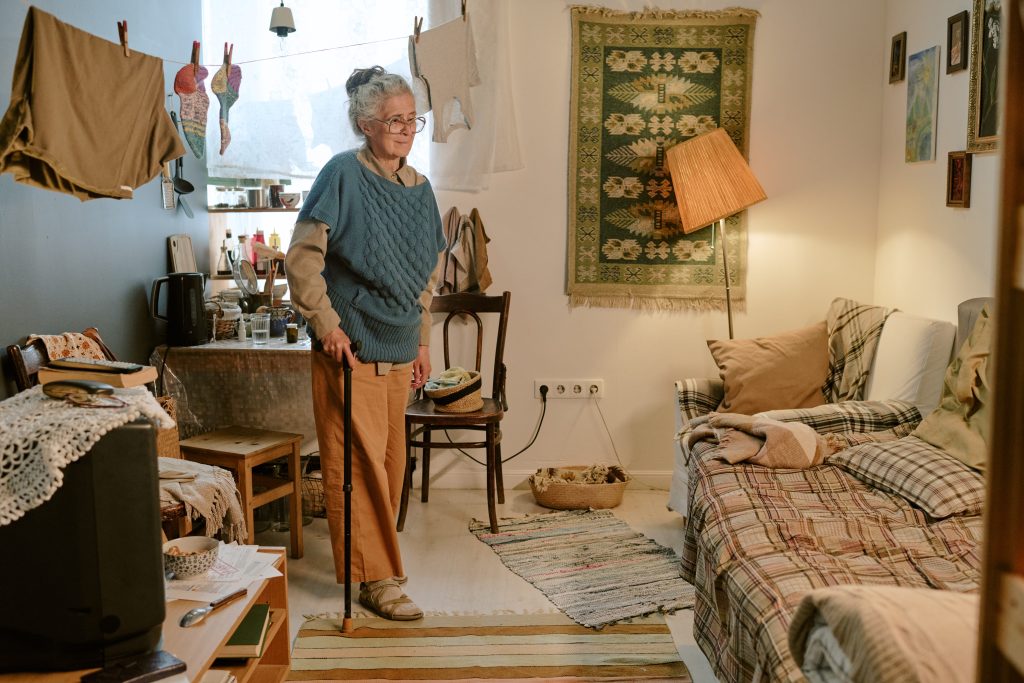
Furniture should work for the person using it, not demand a minor athletic event every time someone wants to stand up.
The National Institute on Aging recommends sofas and chairs with heights that make sitting down and getting up easier. AARP also notes that armrests can be useful on chairs.
That doesn’t mean replacing perfectly comfortable furniture based on age alone. It simply means paying attention to how a favorite chair functions now. If getting out of it has become frustrating, a different seat may deserve favorite-chair status instead.
6. The Chair You Use as a Makeshift Ladder
Plenty of households have that one chair that occasionally gets promoted to “step stool.”
The National Institute on Aging advises against standing on chairs or tables to reach high shelves.
Instead, move frequently used belongings somewhere easier to reach, retrieve them with a reach tool, or access them with help.
If you use a step stool, NIA recommends a sturdy option with a handrail and someone nearby.
In other words, the dining chair can retire from its unofficial second job.
7. Burned-Out Bulbs You Keep Meaning to Replace
Everyone has had one: the dead hallway bulb that somehow remains on the to-do list for three weeks.
Adequate lighting is especially useful around hallways, stairways, beds and bathrooms.
The National Institute on Aging recommends conveniently located switches and night lights in key areas, while AARP advises ample indoor and outdoor lighting.
A burned-out bulb may seem trivial, but replacing it is also one of the fastest home-maintenance jobs on this list.
8. Shoes, Papers and Other Floor Clutter
A stack of mail becomes two stacks. Shoes collect beside the doorway. A sweater lands on the stairs “just for now.”
Soon, the floor is doing double duty as storage.
The National Institute on Aging recommends keeping books, papers, clothing, and shoes off floors and stairways.
AARP suggests making decluttering manageable by starting with a small area and sorting belongings into categories such as keep, donate, and toss.
No whole-house overhaul required. One clear walkway is a perfectly respectable place to begin.
9. Heirloom China You’re Saving for Someone Who Doesn’t Want It
Sentimental possessions can be difficult to part with, especially when they come with a family story.
But keeping a cabinet full of wedding China or family silver for someone else only makes sense if that person actually wants it.
AARP cites professional organizing advice that encourages people to ask intended recipients directly whether they want inherited belongings and to accept the answer when it is no.
That conversation may make it easier to decide what truly deserves precious storage space.
Related: Boomers, Stop Hoarding the China. Millennials Don’t Want It as an Inheritance
10. Expired or Unwanted Medicines
Old and unwanted medicines have a habit of quietly accumulating in cabinets and drawers.
The FDA says the preferred disposal option for most unused or expired prescription and over-the-counter medicines is a drug take-back location or prepaid mail-back envelope.
And no, flushing everything is not the answer. The FDA maintains a specific list of medicines you may flush when an appropriate take-back option is unavailable.
Clearing out unwanted medications is another practical way to keep household storage from becoming a collection of things nobody intends to use.
A well-edited home doesn’t have to feel emptier; it can simply make more room for the things that are useful, comfortable, and genuinely worth keeping.
Other Posts You Might Like.
- The Decluttering Method That’s Finally Winning Against Overcrowded Homes and It Only Takes a Weekend
- 8 Things Your Children May Sell, Donate, or Pass Along After You’re Gone
- 6 Kitchen Storage Habits That Are Quietly Shrinking Your Small Kitchen
If you like what you just read, then subscribe to our newsletter and follow us on social media.


