


The post 10 Holiday Decorations Every 1960s Home Had first appeared on Crafting Your Home.
The 1960s had a recognizable holiday-decorating vocabulary, and it was aggressively shiny, colorful, commercial, homemade, and occasionally a little strange.
Period catalogs, newspapers, museum collections and contemporary reporting leave behind a surprisingly clear picture. Families decorated trees with glass and metal, covered rooms with greenery and tinsel, bought inexpensive plastic figures, and increasingly treated holiday lighting as part of the spectacle. Modern nostalgia often cleans up that aesthetic. The real 1960s version had plenty of visual clutter.
Aluminum trees
The aluminum Christmas tree was the decade’s great decorating flex. Wisconsin Historical Museum records show that sales of Evergleam aluminum trees peaked in 1964 and 1965, while the brand held an estimated 60% to 65% share of the American and Canadian aluminum-tree market throughout the 1960s. About 75% to 80% of Evergleam trees were silver, with green, gold and pink making up the rest.
The appeal was brutally simple: a tree that looked more like a piece of modern design than something dragged in from a forest. Rotating color wheels were sold to throw shifting light across the metallic branches. For a decade obsessed with new materials, new technology and futuristic interiors, an aluminum tree fit the mood almost perfectly.
Bubble lights
Bubble lights were one of the strangest decorations to become genuinely fashionable. Claremont Graduate University records that NOMA introduced the lights in 1946 and that they remained fashionable well into the 1960s, when colored liquid inside candle-shaped glass tubes bubbled as the lights heated.
That movement mattered. A normal bulb glowed, while a bubble light seemed to do something, giving the tree a small mechanical drama. The National Museum of American History preserves an eight-light set with colored liquid tubes, plastic skirts and clips designed to attach the lights directly to tree branches.
Metallic icicles
The 1960s Christmas tree did not believe in leaving many branches exposed. A December 1965 Daily Pilot advertisement offered boxes containing 275 strands of icicles for 19 cents and 450 metalized strands for 33 cents, along with angel hair, garland, and other inexpensive tree decorations.
The prices explain part of the appeal. A family did not need an expensive heirloom collection to make a tree look dramatically fuller. Cheap metallic strands could multiply the sparkle quickly, giving an ordinary tree the exaggerated shine that mid-century Christmas photos often preserve.
Colored electric lights
Electric Christmas lights had been around for decades, but the 1960s pushed them toward spectacle. The National Park Service records that the 1962 National Community Christmas Tree carried 5,000 multicolored lights and 4,000 ornaments, giving a sense of the scale Americans had come to associate with public Christmas displays.
Homes could imitate the same logic on a smaller scale. Strings of red, green, blue and yellow bulbs gave living rooms a distinctly artificial glow that candles could never produce. The result was cheerful, excessive and unmistakably electrical, which suited an era increasingly comfortable with technology appearing everywhere in domestic life.
Related Post: 6 Nostalgic Christmas Traditions We Wish Would Make a Comeback
Glass ornaments
Glass ornaments remained central even as plastic and aluminum entered the market. The Smithsonian’s National Museum of American History holds a Christmas tree ornament made in Tucson in 1962, constructed from glass and metal and cataloged specifically as an ornament and decoration.
That combination captures something important about the period. A 1960s tree could be modern without abandoning older materials, and glass gave families the reflective surface needed to catch all those electric lights. The result was a tree that could sparkle from across the room without requiring an expensive or complicated decorating scheme.
Tinsel
Tinsel had been part of Christmas decorating long before the 1960s, which may be exactly why it survived into the decade. The National Museum of American History has multiple American-used examples in its collection, including silver and red tinsel garlands combined with small mirrored glass ornaments.
The aesthetic was wonderfully excessive. Tinsel did not carefully frame the tree or disappear into its branches. It caught every available bit of light and made the whole thing shimmer. Modern decorating often rewards restraint, while mid-century holiday decorating could look far more interested in making sure nobody missed the tree.
Tree skirts
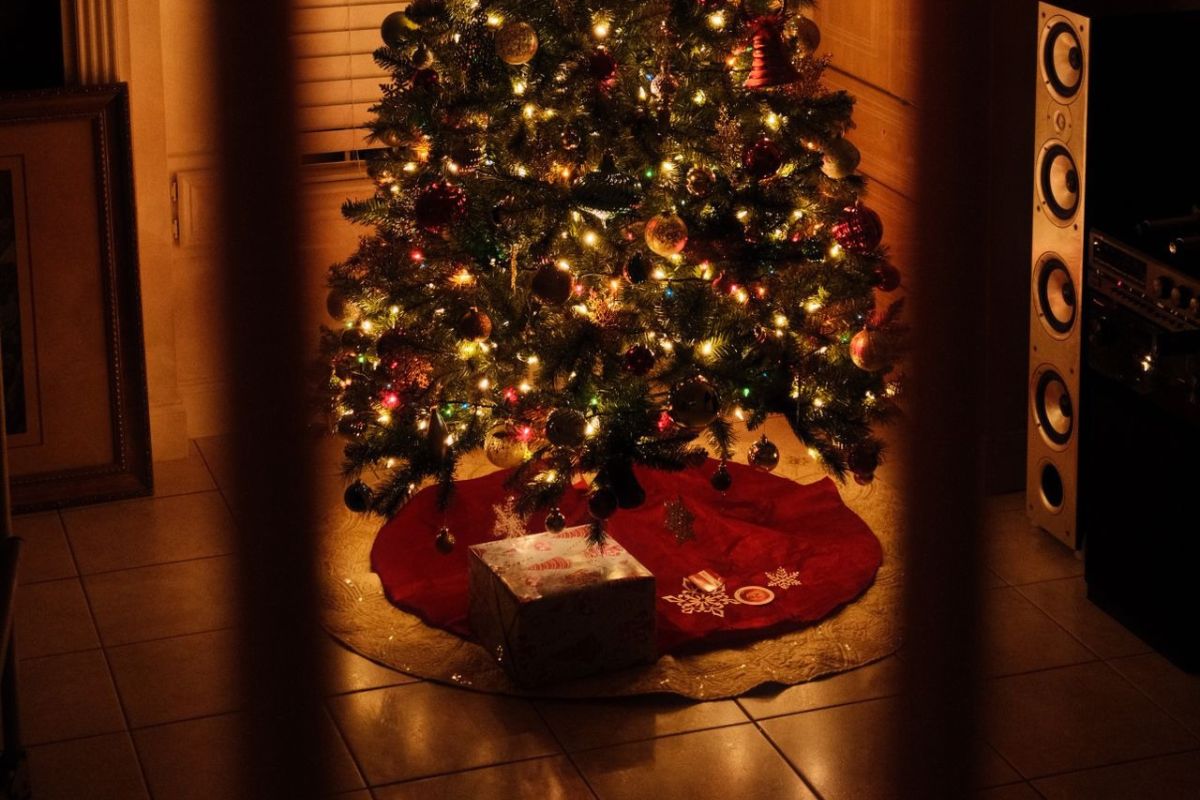
The tree skirt was one of those decorations that completed the illusion that the entire tree had been considered from top to bottom.
Families could sew, paste, embellish and improvise their own holiday accessories rather than relying entirely on store-bought merchandise. The handmade version could be loud, imperfect and highly personal, which is precisely why surviving examples now feel so distinctive.
Related Post: 6 Christmas Traditions Boomers Cherish and Millennials Find Exhausting
Holly and greenery brought the outdoors inside
Artificial shine was only half the story.
Greenery gave the decade’s interiors a familiar holiday texture that metal and plastic could not replicate. Holly leaves, branches and poinsettias also worked beyond the tree, appearing around entertaining spaces and gathering areas.
The visual formula was easy to understand: red, green and bright accents could turn an ordinary room into a Christmas room without remodeling anything.
Plastic Santas started invading the house
Large vintage animated and motorized Santa Claus holiday decorations and toys from the 1950s through the 1970s commonly required four heavy D batteries to power internal electric motors, moving arms, lighted candles, or music boxes.
Santa no longer had to sit quietly on a mantel as a traditional figure. He could run on batteries, occupy a corner and become another piece of household entertainment. The 1960s were perfectly comfortable turning familiar Christmas symbols into molded plastic objects with electrical parts.
Christmas stockings were part decoration, part ritual
Stockings were useful because they worked as decoration before anyone put a gift inside them.
The broader retail history also shows how established the tradition had become. Sears had been selling Christmas stockings since 1910, and by 1968 its Christmas catalog had officially become the Wish Book, reaching roughly 605 pages and turning holiday shopping into an enormous annual retail ritual.
Other Posts You May Like
If you like what you just read, then subscribe to our newsletter and follow us on social media.


